






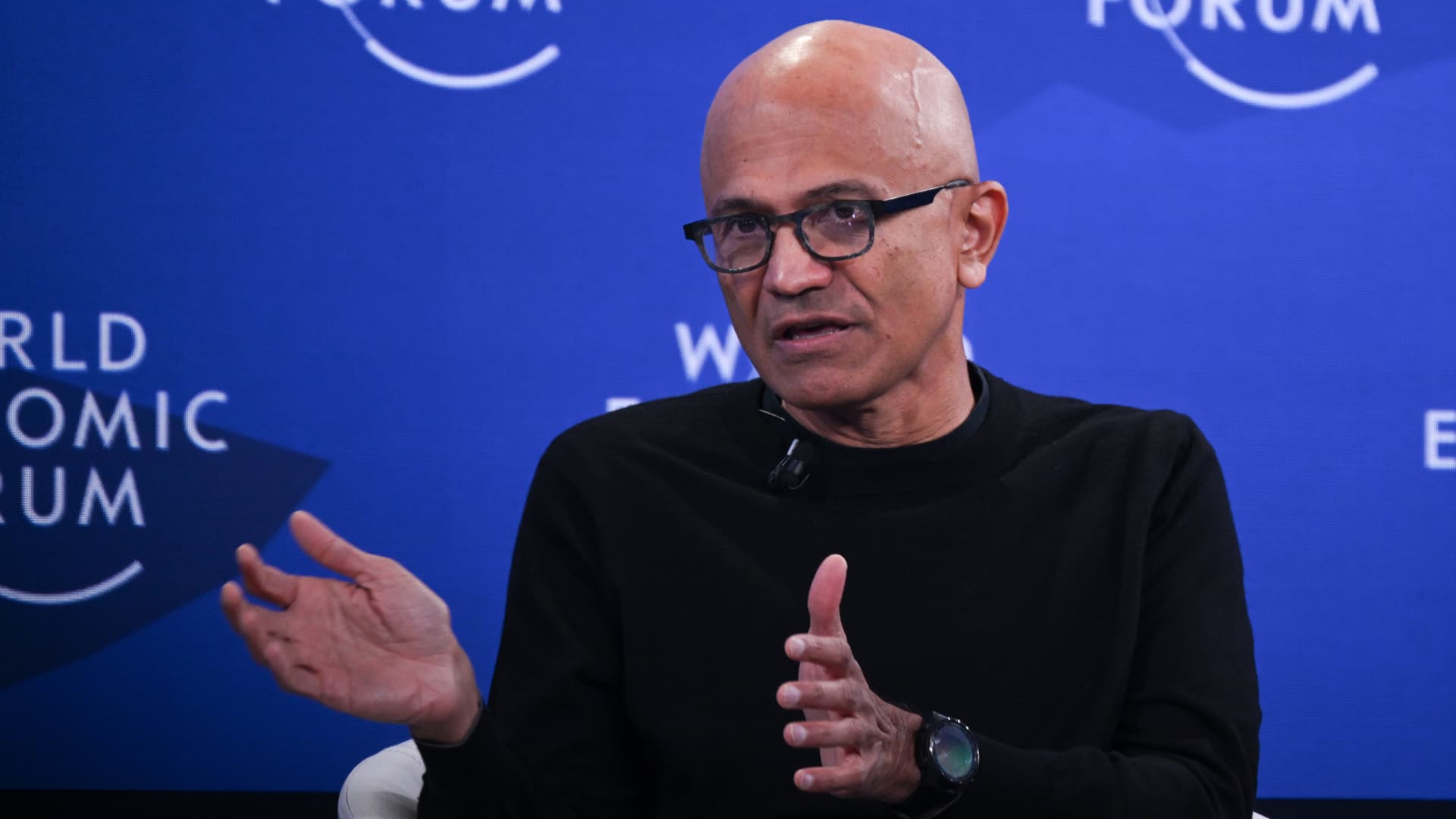
Chairman and CEO of Microsoft Satya Nadella delivers a speech during the World Economic Forum (WEF) Annual Meeting in Davos, Switzerland on January 20, 2026.
Harun Ozalp | Anadolu | Getty Images
Microsoft shares fell 6% in extended trading on Wednesday after the software maker posted slowing cloud growth.
Here’s how the company performed in comparison with LSEG consensus:
- Earnings per share: $4.14 adjusted vs. $3.97 expected
- Revenue: $81.27 billion vs. $80.27 billion expected
With respect to guidance, Microsoft called for $80.65 billion to $81.75 billion in fiscal third-quarter revenue. The middle of the range was $81.2 billion, meeting the LSEG consensus of $81.19 billion. The company’s forecast for quarterly Azure cloud growth was 37% to 38% at constant currency. The StreetAccount consensus was 37.1%.
Microsoft’s revenue grew 16.7% year over year in the fiscal second quarter, which ended on Dec. 31, according to a statement.
Net income, at $38.46 billion, or $5.16 per share, was up from $24.11 billion, or $3.23 per share, in the same quarter a year earlier. Adjusted earnings exclude impact from investments in OpenAI. The company’s gross margin was the narrowest it’s been in three years, coming in just over 68%.
Revenue from Azure and other cloud services grew 39%, compared with 40% growth in the fiscal first quarter. Analysts surveyed by StreetAccount and CNBC had expected 39.4% and 38.9% growth, respectively.
The company reported $9.97 billion in other income, compared with other expense of $2.29 billion in the same quarter a year ago. The swing comes three months after OpenAI announced a restructuring that involved its for-profit arm becoming a public-benefit corporation. Microsoft saw a decrease in its proportionate ownership of OpenAI, yielding a dilution gain.
At year end, the company’s commercial remaining performance obligation, a measurement of unearned revenue and amounts that will be recognized as revenue later, stood at $625 billion, up some 110%. That’s thanks to OpenAI’s $250 billion cloud commitment with Microsoft during the quarter. Microsoft said 45% of commercial remaining performance obligation is tied to OpenAI, with the remainder growing 28%.
“The backlog is really good, but the disclosure that OpenAI is 45% of their backlog, it goes back to the situation where, Can OpenAI achieve these financial goals to pay Oracle, Microsoft and many of the providers,” Jefferies analyst Brent Thill said on CNBC’s Closing Bell Overtime.
Commercial bookings growth, which tracks quarterly activity, surged to 230% from 112% in the fiscal first quarter.
Microsoft’s Intelligent Cloud segment that includes Azure cloud infrastructure produced $32.91 billion in revenue, up nearly 29% and more than the $32.40 billion consensus among analysts surveyed by StreetAccount.
The Productivity and Business Processing segment delivered $34.12 billion in revenue, which was up about 16% and higher than StreetAccount’s $33.48 billion consensus. The unit contains Office productivity software, Dynamics business management software and LinkedIn.
Microsoft now has 15 million seats for its Microsoft 365 Copilot add-on for commercial productivity software subscriptions. Investors have been paying attention to the adoption of Microsoft 365 Copilot as a way to increase revenue from each user. Until this point, Microsoft had not talked about the number of people who have access.
Copilot has room to grow. Microsoft now has over 450 million paid commercial Microsoft 365 seats.
The More Personal Computing segment, featuring Windows, Xbox, Surface and Bing, contributed $14.25 billion in revenue. That was down about 3% and below the $14.38 billion StreetAccount consensus. Technology industry researcher Gartner said PC shipments rose 9.3% in the quarter, with support for the Windows 10 operating system ending in October.
Gaming revenue declined 9.5%. In a X post he posted and later deleted in October, former Microsoft Xbox executive Mike Ybarra called the gaming unit’s strategy “confusing.”
Like its cloud rivals such as Amazon, Microsoft has been building data centers filled with special-purpose chips that can run generative artificial intelligence models. Microsoft also pays for capacity from CoreWeave and Nebius in the form of leases.
Microsoft’s capital expenditures and finance leases in the quarter came to $37.5 billion, up 66%. Analysts polled by Visible Alpha had expected $34.31 billion.
“All up, we added nearly one gigawatt of total capacity this quarter alone,” Microsoft CEO Satya Nadella said on a conference call with analysts.
During the quarter, Microsoft said it will raise prices of commercial Office productivity software subscriptions, and Anthropic announced plans to buy $30 billion in cloud services and contract up to a gigawatt of additional computing capacity from Microsoft.
In the past three months, Microsoft stock has fallen about 11%, while the S&P 500 index has gained 1%, with investors pondering the risk of generative AI models hurting the growth prospects for traditional software.
Executives will discuss the results and provide guidance on a conference call with analysts starting at 5:30 p.m. ET.
This is developing news. Please check back for updates.


https://www.cnbc.com/2026/01/28/microsoft-msft-q2-earnings-report-2026.html


