


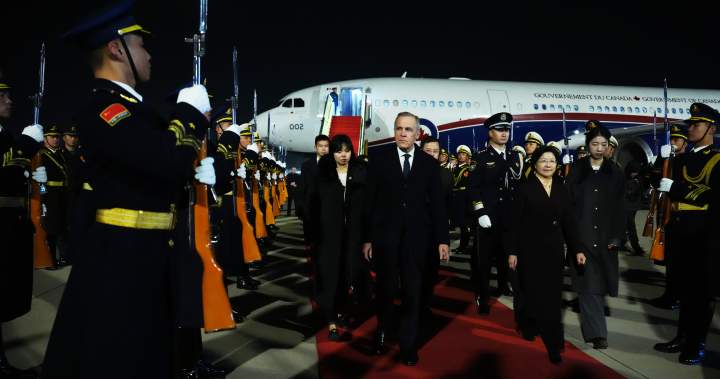
Prime Minister Mark Carney has landed in Beijing, marking the first visit by a Canadian prime minister to China in eight years.

Carney will meet with senior communist leaders Thursday ahead of a Friday meeting with President Xi Jinping and a business banquet.
It’s the first visit by a Canadian prime minister since China detained two Canadians for nearly three years in 2019 in retaliation for the arrest of a Chinese tech executive in Vancouver on a U.S. extradition warrant.
Carney has talked about advancin

g trade and environmental co-operation with China, while keeping Beijing away from sectors that touch on national security or the Arctic.
A major issue this week will be China’s heavy tariffs on pork, canola and seafood, which were imposed after Ottawa ordered tariffs on Chinese electric vehicles, steel and aluminum.
Western and Atlantic premiers are hoping China drops these tariffs, with Saskatchewan Premier Scott Moe visiting China during Carney’s stay, but Ontario Premier Doug Ford said Tuesday he’s “very concerned” Canada might drop policies he said are necessary to protect the auto sector.
Experts see the trip as a short but consequential visit, as China and Canada try to move past years of diplomatic tensions and Ottawa pushes to double non-U.S. trade by 2035.

“It is Carney’s pragmatic foreign policy in action,” said Asia Pacific Foundation vice-president Vina Nadjibulla.
“There is not going to be one word that can describe this relationship, but the public messaging around it needs to continue to be clear-eyed, fully recognizing the complexities of the relationship.”
Carney will meet with senior communist leaders Thursday ahead of a Friday meeting with President Xi Jinping and a business banquet.
It comes after years of warnings about Chinese electoral interference in Canada, mounting human rights concerns involving the Uyghur minority and free speech in Hong Kong, and military actions aimed at broadening China’s territory beyond the nautical zone laid out by the United Nations.
Those issues prompted the Liberals in 2022 to brand China a “disruptive global power” that does not share Canada’s values.
Carney’s government has since described Beijing as strategic partner, and recently advised two Liberal MPs to quit a Taiwan visit early to avoid confusion over Ottawa’s policy of not recognizing the self-governing island as an independent country.

Get breaking National news
For news impacting Canada and around the world, sign up for breaking news alerts delivered directly to you when they happen.
Dylan Loh, a professor at Nanyang Technological University in Singapore who focuses on China’s foreign policy, said Beijing needs better diplomatic relations with other countries and hopes to profit from the pushback Washington is generating through its aggressive foreign policy.
China’s leaders are also grappling with high youth unemployment and property market woes, he said.
“From Beijing’s perspective, they are viewing this not just in isolation. They’re viewing Canada as part of the broader story,” he said. “Part of it is having a conducive external environment geopolitically, economically, such that they feel secure at home.”
Loh said he expects Carney and Xi will sign “low-hanging-fruit agreements” and offer “some allusion to resetting the relationship or starting again from a clean slate” — but it will come at some cost.

“It’s quite clear that in return for normalization of economic relations, they will want to see a less antagonistic position that Canada will take with regards to Beijing’s interests,” he said.
Beijing has asked Ottawa repeatedly to acknowledge that it caused the rift in diplomatic relations. Loh said Ottawa could be more reconciliatory behind closed doors without “caving into pressure in public” and fully satisfying China.
“They want to see that Canada has learned its lesson, and that needs to be manifest in some way,” he said.
Carney has talked of advancing trade and environmental co-operation with China, while keeping Beijing away from sectors that touch on national security or the Arctic.
Loh said China normally does not like to compartmentalize parts of a relationship and prefers to link trade, security and other matters together. But he said Beijing has accepted limited engagement with Canada’s peers, such as the European Union.
Nadjibulla says there could be movement on energy, such as agreement to export more Canadian oil and gas to China and possibly clean energy. She said that regardless of any tangible progress, Canada needs to resist any attempt by China to suggest Ottawa is in “strategic alignment” in China when “pragmatic economic engagement” is Carney’s only goal.
“Beijing will try to use this trip as a diplomatic win, and as part of its broader strategic narrative around China being a more responsible major power, contrasting it to the U.S. — and of course, drawing attention to the challenges Canada is having currently with the U.S.,” she said.


“We have to be much more cautious around that.”

Nadjibulla added that any moves Canada makes will be closely watched by Washington ahead of negotiations this year on the North American trade deal. The visit will also have practical implications for Canada’s relationships across the Indo-Pacific, where many countries are trying to resist coercion from both Washington and Beijing.
Graham Shantz, president of the Canada China Business Council, said Carney might take up the Australian approach of continuing to criticize China on human rights grounds while pursuing trade that boosts both economies.
He said Canada is “underinvested” in China, to the detriment of manufacturers, service providers and educational institutions.
Shantz, whose group is hosting a Friday banquet dinner in Beijing, said Canada should also engage with China on issues like exchange rate policies.
“It will be critical to Canada and to Canadian interests to understand both what we want, and then also to understand how we need to negotiate for that, within the context of how China works,” he said.
“China is usually very well prepared for understanding who they are and what they want. It’s important for Canada to be well prepared.”
China is expected to launch its next five-year plan in March. Shantz said it would be smart for Carney to seek out areas where Canada could benefit from economic partnerships. Carney is expected to be back in China for the APEC summit in November; Shantz said that could be a way to touch base on the state of economic ties.
A major issue this week will be China’s heavy tariffs on Canadian pork, canola and seafood. China imposed the tariffs after Ottawa ordered tariffs on Chinese electric vehicles, steel and aluminum.
Experts say the automotive tariffs respond to Canadian concerns about China’s subsidized output flooding the market and deindustrializing local sectors. But the Canadian tariffs followed closely on almost identical moves by Washington, which has long argued that Chinese cars could pose national security risks.

Beijing sees Ottawa as having taken part in American efforts to prevent China’s economic rise. The China Daily editorial board — which is known to reflect the views of the Chinese Communist Party — on Monday said Canada had enacted “policies to contain China in lockstep with the United States.”
It said Carney must show his new approach to China “is not just a makeshift move to reduce the bill being charged by the U.S. If Ottawa still chooses to subject its China policy to the will of Washington again in the future, it will only render its previous efforts to mend ties with Beijing in vain.”
The editorial also said China wants “a fair, open and nondiscriminatory business environment for Chinese enterprises,” which many see as a call to drop investment and research restrictions Ottawa has put in place on national security grounds.
Loh said it’s important that Canadians manage their expectations for Carney’s visit.
“There are some areas of deep disagreements between Canada and Beijing, and one visit is not going to resolve (all of) it,” he said.
Mark Carney arrives in Beijing to kick off China trade mission
