






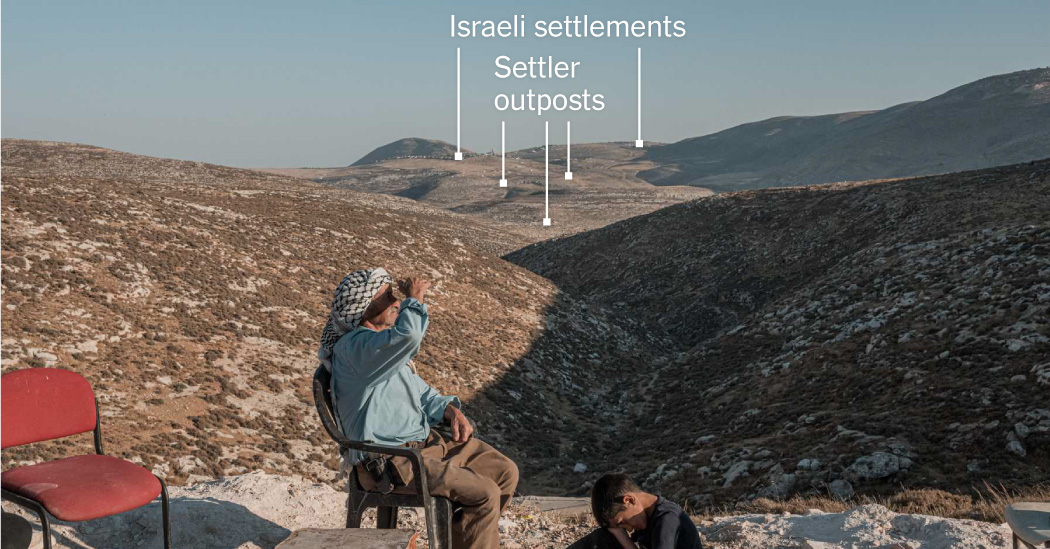
Every Saturday, sheep owned by Jewish settlers march through the olive groves that Rezeq Abu Naim and his family have tended for generations, crushing tree limbs and damaging roots. The extremist settlers, armed and sometimes masked, lead their herds to drink from the family’s scant water supplies while Mr. Abu Naim watches from the ramshackle tents of Al Mughayir, where he lives above the valley.
“I beg you, I beg you. God, just let us be,’” Mr. Abu Naim recalled telling settlers during a recent confrontation. “Just go away. We don’t want any problems.”
Vast stretches of his family’s farm and wheat have been seized by Israeli settlers who have set up outposts, illegal encampments that can eventually grow to become large settlements, on the nearby hills.
New roads cut through the land on which his own flock of sheep graze — and settlers routinely steal the animals, he said. Six months ago, a masked settler armed with a gun broke into his family home at 3 a.m., he recalled. He described raiders tearing through his son’s nearby home at night last December, slashing tents and stealing solar panels.
The family takes turns at night guarding their sheep against attacks from settlers. On a recent day, we found Mr. Abu Naim resting on pillows, a portable radio pressed to his ear listening for regional news.
Go away. Go away from here. Leave, Mr. Abu Naim said the settlers have told him repeatedly.
“I’m 70 years old, and I’ve been here all my life,” he replies. “But you came yesterday, and you want me now to leave, to go home.”
“This is my home.”
The fate of a farmer trying to wrest a livelihood out of a landscape dotted since biblical times by sheep and gnarled olive trees may seem distant from a modern world of clashing superpowers.
But these remote hilltops and hamlets sit at the leading edge of an intractable geopolitical conflict.
Even as the war in Gaza commanded the world’s attention over the past two years, the facts on the ground were shifting in the West Bank, intensifying the battle for control of the lands of Bethlehem and Jericho, Ramallah and Hebron.
For many Palestinians, they are the foundation of a future state of their own — and a future peace. But for many Jews, they are a rightful homeland.
Extremist Jewish settlers and Palestinian farmers are the foot soldiers in this endless conflict, an extension of the war in 1948 that accompanied the establishment of Israel. And since the Oct. 7., 2023, attack on Israel by Palestinian militants from Gaza, Israel’s far-right government has embraced a playbook of expanding settlements across the West Bank, transforming the region, piece by piece, from a patchwork of connected Palestinian villages into a collection of Israeli neighborhoods.
The unrelenting violent campaign by these settlers, that critics say is largely tolerated by the Israeli military, consists of brutal harassment, beatings, even killings, as well as high-impact roadblocks and village closures. These are coupled with a drastic increase in land seizures by the state and the demolition of villages to force Palestinians to abandon their land.
Many of the settlers are young extremists whose views go beyond even the far-right ideology of the government. They are not generally operating on direct orders from Israel’s military leadership. But they know the military frequently looks the other way and facilitates their actions.
In many cases, it is the military that forces Palestinians to evacuate or orders the destruction of their homes once settlers drive them to flee.
Accelerating violence and displacement in the West Bank
We attempted to speak to settlers near two of the West Bank villages that have been the targets of such pressure. None were willing to speak with us.
In a statement, the Israeli military said that its “security forces are committed to maintaining order and security for all residents of the area and act decisively against any manifestations of violence within their area of responsibility.”
The far-right Israeli government has been transparent about its mission: to sabotage what diplomats call the two-state solution and its goal of an Israeli and a Palestinian nation living side by side. “Every town, every neighborhood, every housing unit,” Bezalel Smotrich, the ultra-right-wing finance minister, said recently, “is another nail in the coffin of this dangerous idea.”
For years, the United Nations, the United States and much of the Western world have warned that the continuous expansion of Israeli settlements would eventually make the establishment of a contiguous Palestinian state impossible.
Across the West Bank, there is desperation among Palestinian villagers and farmers as they watch the takeover of their lands at a pace never seen before. And there is fear that the changes are already becoming irreversible.
We spent more than two months in a dozen villages in the West Bank, meeting with Palestinian families, local officials, Bedouin farmers and young human rights activists, often visiting from abroad. We watched as groups of young Israeli settlers showed up in Palestinian villages to harass or intimidate them.
We met a family in Tulkarm whose 21-year-old daughter, Rahaf al-Ashqar, was killed in February by an explosion set off by Israeli soldiers who raided their home, claiming they were looking for terrorists.
We saw a 16-foot fence covered with razor wire that was built this year in the town of Sinjil that now separates Walid Naim from his family’s orchards.
We watched settlers block the road and try to stop Palestinian farmers from leaving their land after harvesting their olive trees in October.
In October, after settlers and soldiers stormed the gate of Masher Hamdan’s farm in the village of Turmus Aya, he decided to evacuate his sheep, goats, lambs and poultry to save his livelihood.
The New York Times studied mapping data and court orders that document the expansion of claims by the Israeli government to land that had long been in Palestinian hands. We photographed the construction of Israeli roadblocks designed to limit Palestinian movements and saw the installation of fences that cut off farmers from their land.
The Israeli onslaught has all but vanquished a free Palestinian existence in the West Bank. While the Palestinian Authority governs part of the West Bank, the Israeli military remains the occupying power of the whole territory, and military law supersedes the authority’s rule.
There is little due process and villagers live at the mercy of vigilante settlers and members of military platoons who exert almost total power over them. Settlers, who are subject to Israeli civil and criminal law rather than the military’s jurisdiction, are rarely detained or arrested for extremist or violent actions, while the military routinely rounds up Palestinians with little explanation or justification.
In late November, the Israeli military launched what it called a counterterrorism operation in the West Bank city of Tubas, arresting 22 Palestinians. On Dec. 10, Israeli officials approved construction of 764 homes in three West Bank settlements. The day before, the military uprooted about 20 acres of olive trees in a village south of Nablus.
How to Empty a Village
The campaign to isolate Palestinians and drive them off their land is evident in Al Mughayir, about 20 miles north of Jerusalem. What used to be a thriving Palestinian village has been surrounded by Jewish settlements, and villagers like Mr. Abu Naim have been squeezed into increasingly smaller areas, cut off from their land and their livelihoods.
Al Mughayir is one of several small Palestinian villages clustered roughly in the center of the West Bank, all of which have been relentlessly targeted in recent months by settlers and the Israeli government.
This is the pattern that has played out across the West Bank, transforming the entire territory.
A Jewish outpost, not authorized under Israeli law, pops up — a small trailer, perhaps, or a large tent housing just a few young men. Settler attacks soon follow. Then come the military orders demanding evacuations of Palestinian communities and the installation of large, iron roadblocks cutting off Palestinian villagers from the rest of the West Bank.
Over weeks and months, the outposts grow and are often eventually authorized by the Israeli government. Settlers build homes, businesses, schools and roads to accommodate hundreds and eventually thousands of Jewish families. In the Palestinian villages, the opposite happens. Schools are shuttered, farmers are cut off from their lands, and homes are destroyed.
The campaign started in earnest after Prime Minister Benjamin Netanyahu returned to office in 2022 and accelerated after the war began. In 2024 and 2025, Israelis built about 130 new outposts, more than the number built in the previous two decades, according to Peace Now, an Israeli activist group that tracks settlement expansion.
Erasure
The flip side of the construction is destruction.
Across the West Bank, settlers and the military razed more than 1,500 Palestinian structures in 2025 — double the annual average in the decade before the war.
The dismantling of one long-established Palestinian community, East Muarrajat, began not long after a settler attack. On July 3, settlers, aided by members of the Israeli military, went house to house through the village where Bedouin families had lived for several generations in the white sand hills of the Jordan Valley, just north of Jericho.
The residents, who had already suffered years of harassment, decided that night to abandon their homes in the middle of the night when dozens of masked settlers, many of whom appeared to be drunk, showed up on four-wheeled ATVs. Some brandished guns as they raced through the village on the vehicles and circled crying women and children.
The settlers rammed the vehicles into people’s homes, then ransacked them, tearing down furnishings and throwing belongings outside while screaming obscenities.
“It was like the whole village was a compound of people screaming and yelling,” recalled one villager, Mohammed Mlehat. “We were afraid of things that are unspeakable, because they were dozens of young men who seemed to be drugged or drunk.”
A statement by the Israeli military said soldiers arrived in East Muarrajat that night after receiving reports of “friction” between Palestinians and settlers but “no violent incidents were identified.”
Fearful of more attacks, the villagers left that night, Mr. Mlehat said, and the destruction of the homes happened in the days and weeks that followed. His family now lives in tents without access to drinking water or electricity, just a few miles from where the village, now reduced to mostly rubble, once stood.
Among the few buildings still standing in East Muarrajat is an abandoned school that began operating in 1964. Through broken classroom windows, there are SpongeBob curtains still visible and school supplies scattered on the ground. A playground is littered with discarded hula hoops and backpacks strewn about.
Mr. Mlehat’s nephew, Jamal Mlehat, said the attacks showed the hypocrisy of settlers who seek sympathy, saying they want only to establish homes for themselves. He cited a Bedouin proverb: “You attack with the wolf and you cry with the sheep.”
“This is what they did with us,” he said.
Unending Harassment
The episodes of intimidation rarely let up.
The number of attacks by extremist settlers in the West Bank has skyrocketed in the last two years. In October, there were an average of eight incidents per day, the highest since the United Nations began keeping records two decades ago.
That coincided with the start of the olive harvest in the West Bank, when many Palestinian farmers have just four weeks to secure their livelihoods from the ancient trees that cover the region’s valleys and hills.
We saw Yousef Fandi and his brother, Abed Alnasser Fandi, being attacked in a field of olive trees in the village of Huwara on the morning of Oct. 9. They told us later that day that they had been tending the family olive grove when they were surrounded by settlers.
One was on horseback, armed and masked. Two others walked beside him. A fourth carried an assault rifle.
“What are you doing here?” demanded the man with the gun, leveling the weapon at them, Yousef Fandi recalled.
The settlers took the men’s phones, ordered them to the ground and proceeded to kick them in the ribs and head for about a half-hour, a scene we witnessed ourselves. Blood spotted Mr. Fandi’s shirt as he later recounted the beating to us.
“I thought that they might shoot us,” he said.
Since Oct. 1, the United Nations reports, 151 Palestinians have been injured in more than 178 separate attacks on olive harvesters. About half were tied to settlers and the rest to soldiers, the organization said.
By the time the Israeli soldiers arrived that morning in the village of Huwara, southwest of the city of Nablus, a large group of villagers had gathered, joined by journalists and activists who had heard about the clash.
The soldiers told the settlers to leave — but bore bad news for the Palestinians eager to return to their harvest.
As the villagers pushed to gain access to the fields, one of the soldiers waved a copy of a military order. A map on the document showed the olive orchard in Huwara completely covered in red, indicating that Palestinians were not allowed in the area for the next 30 days.
“The order was signed following an operational situation assessment,” the Israeli military said in a statement in response to questions. “Accordingly, farmers were informed that they would not be permitted to harvest in the area at that time.”
Military orders have become a staple of the Israeli settlement drive in the West Bank, with the government often declaring territory to be “state land” and denying Palestinian claims to family-owned property.
The clash in Huwara that day ended the way many others did during the olive harvest: with the farmers denied access to their fields.
“I have the documents of this land,” Yousef Fandi protested. “This is my land.”
Deadly Confrontations
For Sayfollah Musallet, a 20-year-old Palestinian American, one of the clashes with settlers turned deadly.
One Friday in July, young Israeli settlers cascaded down from their hilltop outpost above Sinjil, armed and masked, instigating a clash with Palestinian farmers whose land the settlers claimed as their own.
A pickup truck driven by the settlers ran into a crowd of Palestinians and activists, breaking one man’s leg before speeding off, according to Jonathan Pollak, an Israeli activist who witnessed the incident. When a Palestinian ambulance arrived, settlers pelted it with rocks and batons, cracking its windshield, Mr. Pollak said.
During the confrontation, Israeli settlers beat Mr. Musallet to death, according to his family members and the Palestinian authorities. Mike Huckabee, the American ambassador to Israel and a staunch supporter of the Netanyahu government, called the death a “criminal and terrorist act” and demanded that the Israeli authorities “aggressively investigate” it.
A second Palestinian man, Mohammad Shalabi, 23, was also killed during the clash. His body was found by villagers late that night with a gunshot wound and extensive bruising on his face and neck, according to his uncle.
Both men were buried at a funeral two days later that was attended by hundreds of villagers.
In the past three years alone, there were more than 1,200 Palestinian fatalities in the West Bank, nearly double the number for the decade before that, the United Nations reports.
A statement about the incident in Sinjil from the Israeli military said that “terrorists threw stones at Israeli civilians near the village” and said that the incident was being investigated.
Mr. Pollak, who was helping the Palestinians in Sinjil and was arrested by the Israeli military that day, said the violence by the settlers was part of a clear pattern.
“I want to say it was an inconceivable tragedy, but really, tragedy isn’t the right word,” he said. “You know, a tragedy is a force of nature. A tragedy is being hit by a lightning bolt. This is not what happened here.”
Renewed Attacks
For Mr. Abu Naim, the farmer in Al Mughayir, the threats to his family have not stopped.
On Sunday, Dec. 7, at 1:40 a.m., eight masked settlers armed with clubs attacked the caves and tents where Mr. Abu Naim and his nine children and grandchildren live. Six members of the family were sent to the hospital, including his 13-year-old grandson, who suffered cuts and bruises to his head.
The scene was described to us by activists, several of whom were sleeping at the home and were also injured. One of them, Phoebe Smith, who is from Britain, was wakened by screams, she said. When she went outside, she was attacked, too.
“I was outside of the tent, being beaten by them around the torso, the legs, the head,” Ms. Smith recalled as she recovered in Ramallah. “It was terrifying. Really terrifying.”
The Dec. 7 onslaught lasted about 10 minutes, she said. The attackers turned over furniture, grabbed three phones and used Ms. Smith’s laptop computer to beat several of the family members. They did not enter another tent, where Mr. Abu Naim’s daughter, nearly nine months pregnant, was cowering inside with two children.
Before heading out, the settlers issued a warning: Leave for good within two days, they said, or we will return and burn you in your home.
The Israeli military did not show up on Dec. 7. But three days later, on Dec. 10, settlers did return for another round of intimidation. Then a few hours later, activists said, five military jeeps carrying 20 soldiers and border police officers arrived with an order declaring the family’s compound a closed military zone.
Two activists were detained, and Mr. Abu Naim’s pregnant daughter and several children fled to safety. On Dec. 12, the military returned and extended the closure for 30 days. In a statement, the Israeli military said Palestinians instigated the Dec. 10 clash by throwing stones and rolling burning tires toward Israelis, which the villagers deny.
The statement said the area was declared a military zone on Dec. 12 “to maintain calm in the area following a prolonged period of tension.”
From the rocky edge of a cliff overlooking the valley, Mr. Abu Naim can keep an eye on his sheep. He can see the Jewish outposts that have sprung up in recent months. And he can try to spot any settlers headed toward his home to warn his children and grandchildren.
The war in Gaza, Mr. Abu Naim said, was a turning point.
“We used to come and go, mostly without any problems,” he recalled recently. “If we met the army, they would ask for our IDs. We give them. We went back and forth. We didn’t have the same problems.”
“But,” he added, “these guys are completely different.”
https://www.nytimes.com/interactive/2025/12/20/world/middleeast/west-bank-settlements.html


