






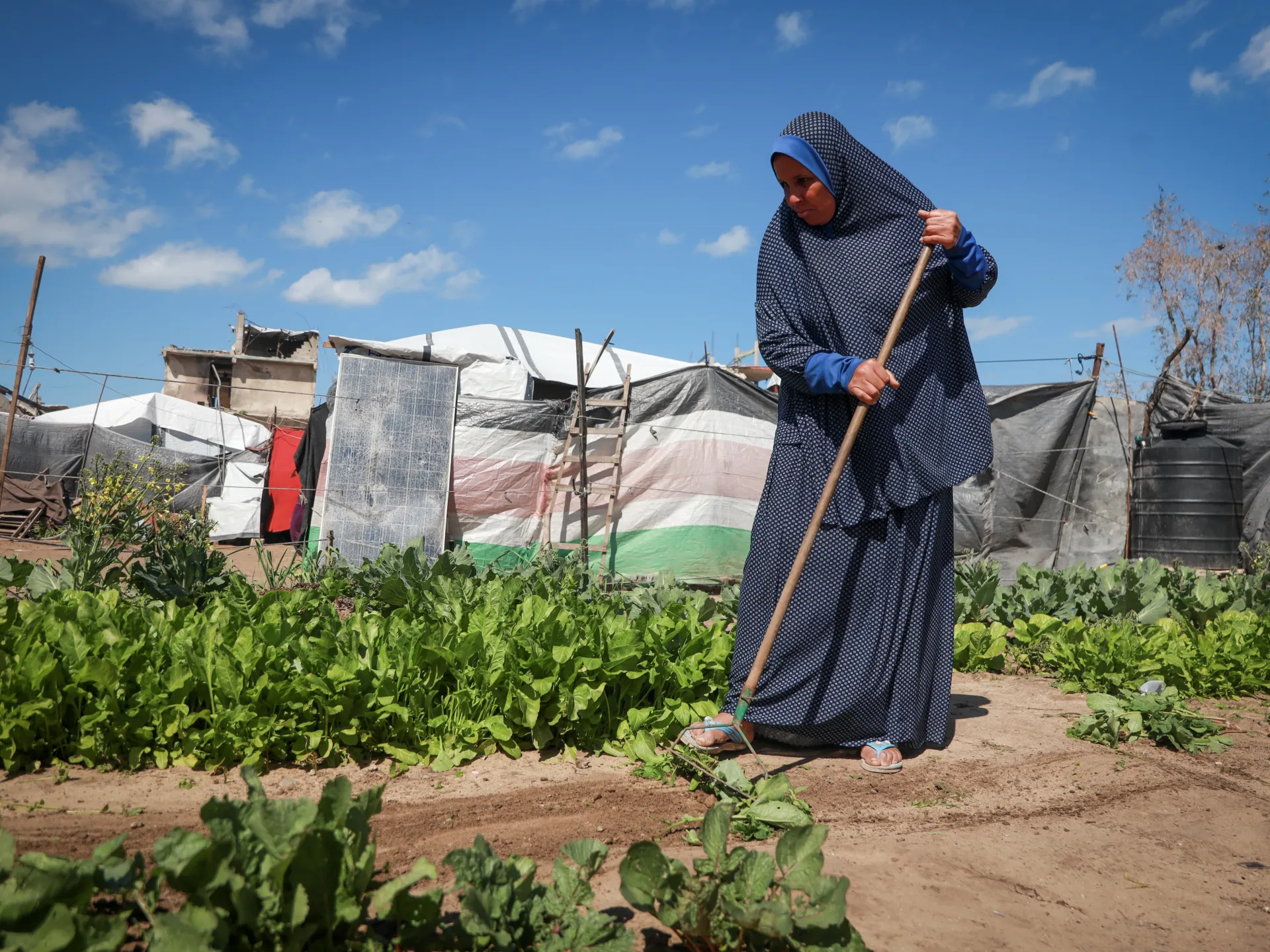
Gaza City, Gaza Strip – Inside a tent pitched on a small patch of land, Sawsan al-Jadba sits with her children on the final strip of her property, just metres away from the rest of her seized land.
Before Israel’s 2023 genocidal war against Palestinians in the Gaza Strip, the 54-year-old owned three plots of about 2,000 square metres (21,530 square feet) each: One inherited from her father in the eastern Tuffah neighbourhood; another in Abu Safiya, northeast of Gaza City; and a third along Salah al-Din Street in central Gaza.
Recommended Stories
list of 3 itemsend of list
“They were a paradise,” she recalls. “I planted olive trees and citrus fruits … they were the source of livelihood for me and my children.”
Like thousands across Gaza, al-Jadba has seen that reality change completely. Her home was destroyed, and most of her land has become inaccessible as it falls within the so-called “yellow line”, an Israeli military demarcation line that slices through more than half of Gaza’s territory.
Today, only about 600 square metres (6,460 square feet) remain of al-Jadba’s land in Tuffah. She describes the loss as “a deep wound in her chest”, a nightmare she never imagined living through. Still, she is determined to stay put with her daughters and grandchildren, cultivating her remaining plot again despite limited resources.
“Land is like honour,” she says. “Even if only a single metre of my land remains, I will do the impossible to stay on it.”


Al-Jadba says her connection to the land is more than memory or symbolism. It’s a daily experience of both loss and attachment. This reality is closely linked to a not-so-distant past, when she participated in Land Day commemorations recalling the events of March 30, 1976, when six unarmed Palestinians were killed by Israeli forces during protests against Israel’s confiscation of Palestinian land.
Fifty years on, Land Day has become a foundational moment in Palestinian national consciousness, renewing the bond between the people and the lands they lost decades ago – not merely as property, but as identity, existence and an inalienable right.
“It was a day when we renewed our connection to lands occupied in 1967 and 1948, demanding our right to return,” al-Jadba says with frustration. “But today, the meaning has completely changed … now we are demanding the lands they took from us during this war, drawing new borders for us.”
During the war, al-Jadba and her family were displaced to southern Gaza, where they stayed for months. Following a “ceasefire” reached between Israel and the Palestinian group Hamas in October 2025, she rushed back to check on her land.
“I was like someone trying to catch their breath again … what remained of my home was completely destroyed, and the land was bulldozed,” she says. “But I thanked God, now I live on what remains, and I dream of reaching the rest.”
She says she has decided to continue farming as an act of survival and daily resistance.
“The only solution is to live and to hold on to my land,” she says, pointing to the crops she has planted. “Eggplants, peppers, and tomatoes … During Ramadan, we planted arugula, parsley and spinach. Gaza’s land is fertile; if you give to it, it gives back.”
Israel’s latest war took from al-Jadba not only her land but also two of her sons, while her husband was killed during another war, in 2008–2009.
Despite the loss of loved ones, the hardships of displacement, and the scarce resources, al-Jadba has never considered leaving.
“Life is very difficult, yes. But what has happened in Gaza – genocide, starvation, looting – will not stop me from holding on to my land,” she says. “I will stay on my land until the very last moment … and if I die, I will be buried in it.”

Uprooted from the land
Land Day is traditionally marked by public demonstrations and official commemorations.
However, for the third consecutive year, the anniversary comes amid harsher conditions for Gaza’s population. After more than two-and-a-half years of war, widespread destruction, and mass displacement, thousands of Palestinians in Gaza have lost or been cut off from their land and homes.
Large portions of the territory are now inaccessible, either due to destruction or as a result of imposed military geography. Estimates indicate that Israeli forces now control more than half of Gaza’s total area. Meanwhile, agricultural lands, once the backbone of food security, have been either destroyed or largely isolated.
At the centre of this transformation is the “yellow line” that stretches from north to south, with a depth ranging from 2km to 7km (1.2 miles to 4.3 miles).


Beyond this line, marked by yellow concrete barriers, stretch large areas designated by the Israeli army as “combat zones” that are off-limits to Palestinians. They include entire residential neighbourhoods and much of eastern Gaza’s agricultural lands.
According to various estimates, between 52 percent and 58 percent of Gaza’s land now falls under direct Israeli control, effectively confining the population to less than half of the territory.
This new reality has not only reshaped geography, but also redefined the meaning of Land Day.
While the commemoration was historically tied to the right of return to lands lost in 1948, it is now also about access to lands and homes lost during the latest war on Gaza.
“They destroyed our homes and uprooted us from our land,” says Bashir Hamouda, sitting outside his family’s cluster of tents in western Gaza, surrounded by destruction.
“Today we are homeless … living in camps that are not fit for human life. No one feels our suffering,” laments the 68-year-old.

Hamouda was forced to flee his home in Jabalia, in northern Gaza, under Israeli bombardment. He left behind three houses and two plots of land filled with olive trees, palm trees, and various fruits.
“When I left my home and land … I wished the house would collapse on me so I could die inside it,” he says, tearfully. “It felt like my heart was ripped out. Can a person live without a heart? I cannot live without land … the land is the heart.”
For him, this year’s Land Day is not just a remembrance of history, but what he describes as “a new uprooting, a bitter experience”.
“Today, the issue is no longer only about the lands of 1948 or 1976, but also about what we have recently lost in Gaza: Our land, our homes, everything,” he says, his eyes tearing.
Hamouda attributes this “bitter shift” in the meaning of Land Day, from the right of return to ancestral villages to the demand to return to recently destroyed homes, to what he describes as “international silence and inaction towards the Palestinians’ suffering”.
“When our grandparents’ lands were stolen in 1948 and 1976, the world stood by and did nothing.”
“The same is happening now, as we endure genocide. We, our children, and grandchildren … and again, the world does nothing,” he adds. “Before, we demanded our historical right of return. Today, we are demanding to return to our homes in eastern Jabalia, just minutes away.”
This shift reflects the scale of change imposed by the war that extends beyond Gaza, coinciding with escalating land confiscation and settlement expansion in the occupied West Bank and Jerusalem, along with ongoing forced displacement across multiple areas.
In this new reality, the relationship to land is measured not only by what has been lost, but by what remains and what people continue to fight to hold onto.
“I sit with my grandchildren – more than 50 of them – and teach them what land means. I plant in them the meaning of belonging,” says Hamouda.
For him, this act of teaching is the minimum he can do under displacement.
“We will not forget this land,” he says. “If we do not return, the generations after us will.”
https://www.aljazeera.com/features/2026/3/30/land-day-in-gaza-between-memory-and-the-fight-for-what-remains?traffic_source=rss


