








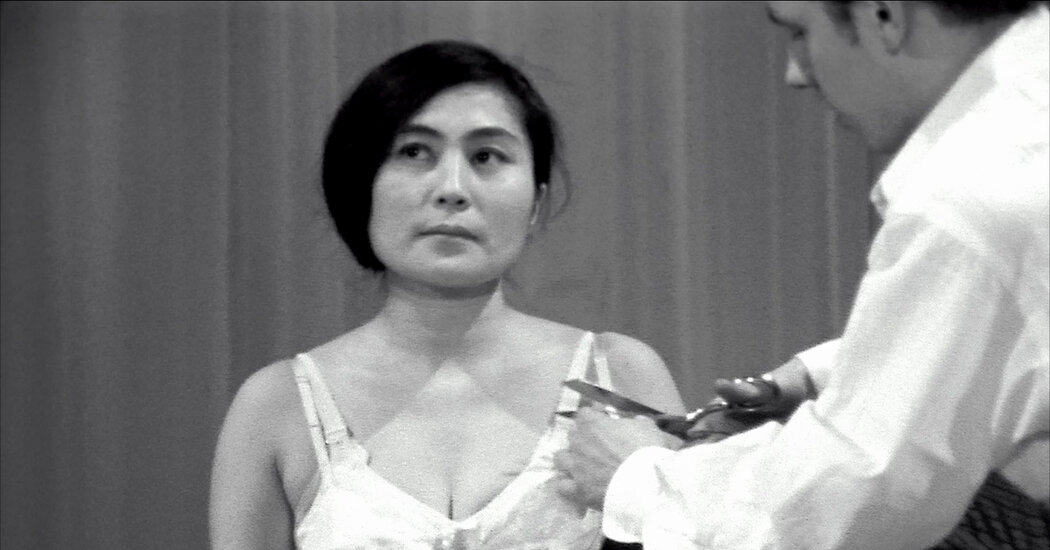
Viewing “Cut Piece” now, what struck me is how genuinely unsettling it remains. I watched the short film once, then again, floored by how relevant, how prophetic, it feels in our own cultural moment, when many of the long-held gains of feminism, both legal and cultural, seem on the brink of being lost forever. The reality most people took for granted merely a few years ago — that men and women were inherently equal, and that as a society we were collectively striving to remedy the ways in which we weren’t paid or treated as such — is being peeled away with alarming speed. This atmosphere is surely one reason we are seeing a resurgence of interest in feminist performance art of the 1960s, ’70s and early ’80s, much of it difficult, aggressive and surprisingly radical — certainly for its era but even now.
In the past decade or so, the defining trend among curators has been to shine a light on artists who were previously “overlooked.” Various groups who were once misunderstood, neglected or ignored have been excavated and exhibited — artists of color, older women artists, women of Abstract Expressionism and so on (though “overlooked” is, of course, itself a deprecating term). The “rediscovery-industrial complex,” as it’s been wryly termed, has now reached female performance artists, arguably sidelined in their day not only for the confrontational radicalism of their work — what Schneemann called the “considered disregard for the comfort of the audience” — but because their particular art form was not salable, collectible or tied to the market in any way.
Ono, who has a new exhibition, “Yoko Ono: Music of the Mind,” opening at the Broad museum in Los Angeles next month, is at the center of this reassessment, but she’s not alone. In July, London’s Tate Modern, where the Ono show originated, will mount a significant retrospective of the work of Ana Mendieta, the Cuban American multidisciplinary artist who died in 1985 at 36 years old. The exhibition picks up where this winter’s comprehensive show at Marian Goodman Gallery in New York, “Ana Mendieta: Back to the Source,” left off, examining her short but prolific career through early paintings, remastered films, late sculptures and site-specific interventions in natural landscapes, which Mendieta documented with slides, photographs or film.
Also this spring, Abramović, now 79 and the most influential performance artist still working — for “The Artist Is Present” at MoMA in 2010, she sat staring at museumgoers for roughly seven hours a day over two and a half months, and has generally made testing the limits of human endurance her artistic pursuit — is presenting new and old work at the Gallerie dell’Accademia in Venice, the first living female artist to have a major solo exhibition there. And her “Balkan Erotic Epic,” a four-hour dancing and singing extravaganza that mines Balkan folklore, will have its North American premiere at New York’s Park Avenue Armory in December.
https://www.nytimes.com/2026/04/30/t-magazine/feminist-performance-art-yoko-ono.html


