


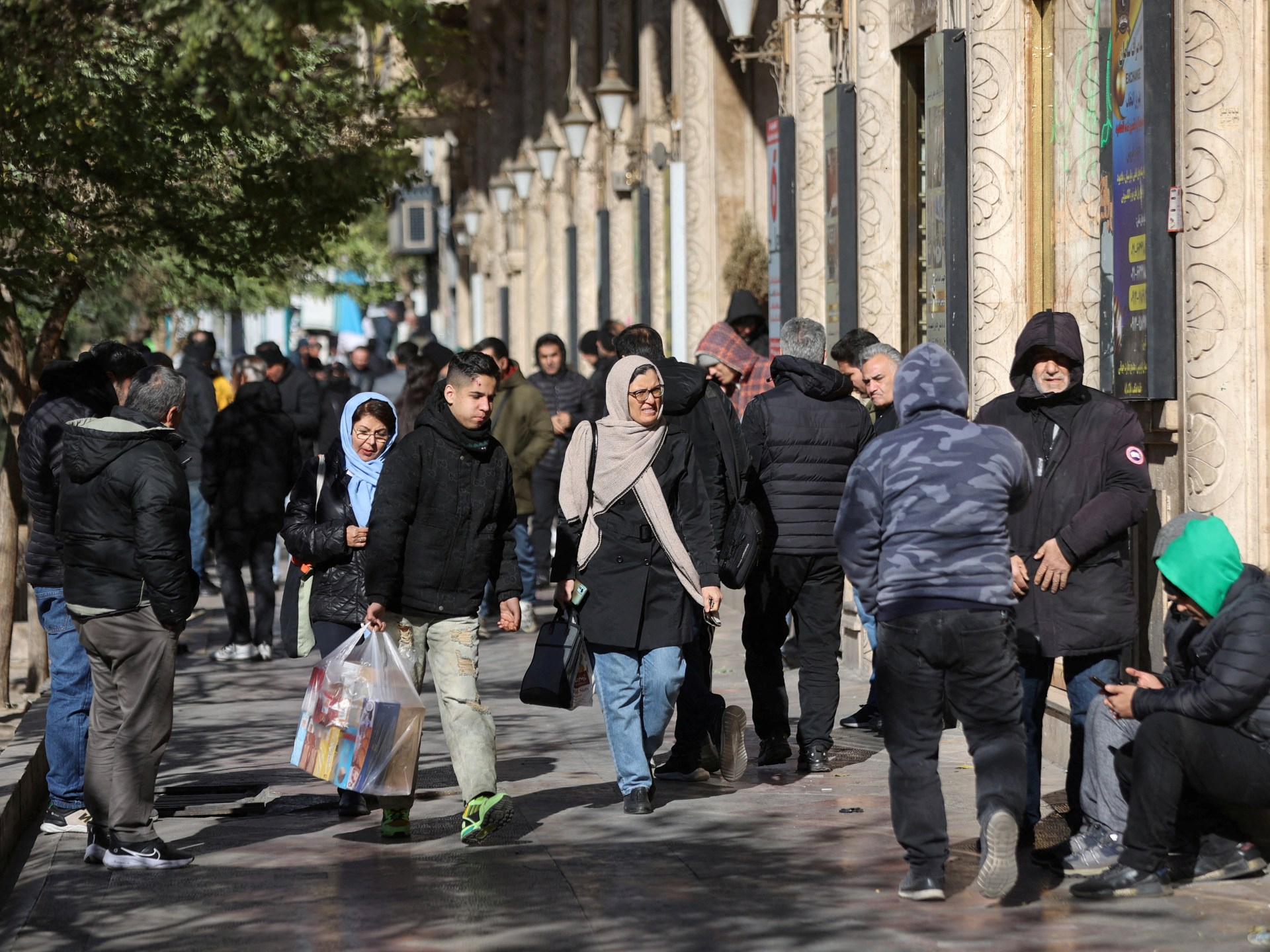
Tehran, Iran – Iranians are again experiencing internet disruptions amid ongoing protests across the country as state authorities warn against foreign sabotage and organise demonstrations.
Internet users have since Thursday reported sporadic disruptions to home and mobile connections, with data from the US-based global internet infrastructure and cybersecurity company Cloudflare on Saturday showing an average 35 percent lower traffic volume in Iran compared with previous days.
Recommended Stories
list of 3 itemsend of list
Iranian authorities have shut down or slowed connectivity levels during previous rounds of protests, limiting Iranians to only a localised intranet. Internet connectivity came to a near-complete halt in mid-June for several days during the height of the war with Israel and the United States.
The government has not specifically commented on the latest slowdown in the context of the protests, but Minister of Information and Communications Technology Sattar Hashemi told reporters that Iran had fended off one of the largest cyberattacks in recent memory on Sunday, which could have contributed to limited internet bandwidth.
The protests that started last Sunday among traders and salesmen in downtown Tehran have since spread to cities across the country. At least 10 people have been killed during the demonstrations.
Among those killed was a young business owner in the city of Hamedan in western Iran, which has seen several days of intense protests and the deployment of security forces.
Hamzeh Amraei, the regional governor’s political and security deputy, told state media on Saturday that the man’s death was “suspicious” and was carried out by “enemies” to portray Iranian authorities in a negative way in the media.
Morteza Heydari, the top security official in the city of Qom, south of Tehran, confirmed on Saturday that a 17-year-old boy was shot dead. He claimed that “hostile elements” were behind the incident, without elaborating. The official said that another person “linked with terrorist movements” died after a grenade exploded in his hands.
State media reported on Saturday that a “veteran member” of the Islamic Revolutionary Guard Corps (IRGC) was killed by armed and masked men in Malekshahi, in the central province of Ilam. The semiofficial Fars news agency said that at least three people were killed in the city.
Multiple protests have been confirmed by state authorities and local reports over the past several days in the province of Lorestan in the western part of the country. The provincial branch of the IRGC said in a statement on Saturday that “three major leaders of the recent riots” in the city of Khorramabad were arrested, without naming the individuals.
State television has also aired alleged confessions of Iranian men with blindfolds or blurred out faces, who claimed that they were armed or in contact with foreign agents to create instability in Iran.
Supreme Leader Ayatollah Ali Khamenei, in an address on Saturday, blamed foreign influence and said that “rioters must be put in their place”.
The comments came after US and Iranian officials exchanged barbs, after US President Donald Trump said he would “come to the rescue” of Iranian protesters if they were killed.
“They are unashamedly dropping the bombs on women and children and committing genocide, but they tell us we must not hurt anyone,” Iranian President Masoud Pezeshkian said during a speech on Saturday afternoon, in reference to US backing for Israel’s genocidal war on Gaza, where the US has brokered a tenuous ceasefire.

Iranian authorities organised a large gathering in downtown Tehran on Saturday evening, and state media reported that thousands of people were in attendance, with those present displaying religious imagery to mark a national holiday commemorating Ali ibn Abi Talib, the first Shia imam.
Authorities also set up numerous banners and posters in main squares in towns and cities across the country, which displayed images of Qassem Soleimani, Iran’s former top general, who was killed by the US on January 3, 2020, in an air strike in Iraq. Authorities are organising demonstrations in many cities to commemorate the anniversary of the assassination of the commander, who was also an architect of Iran’s so-called “axis of resistance”.
Many businesses, schools, universities and government offices have been shuttered since Wednesday, when the government announced a day off, citing cold weather and plans to manage electricity supply. Thursdays and Fridays are weekend days in Iran, and Saturday was a religious holiday.
It was not clear whether businesses would reopen on Sunday. Several online shop owners and social media personalities have said they will cease their normal business activities while the protests are ongoing as a show of solidarity and concern.
Protests have also been ongoing in universities, especially among several top schools in Tehran, with multiple videos and reports by student groups indicating that several students were detained.
Economic conditions have been deteriorating for years amid “maximum pressure” sanctions imposed by Trump in 2018 over Iran’s nuclear programme. Inflation stands at about 50 percent, and has been among the highest in the world over recent years.
In an apparent response to the protests last week, the government fired the central bank chief, Mohammad Reza Farzin. His replacement, Abdolnaser Hemmati, was impeached in March while serving as economy minister. Hemmati also oversaw a rapid decline of the national currency during his tenure as central bank chief between 2018 and 2021.
Farzin was appointed as special adviser to the president in economic affairs on Thursday.
https://www.aljazeera.com/news/2026/1/3/internet-disruption-several-arrests-made-as-iran-protests-continue?traffic_source=rss
