







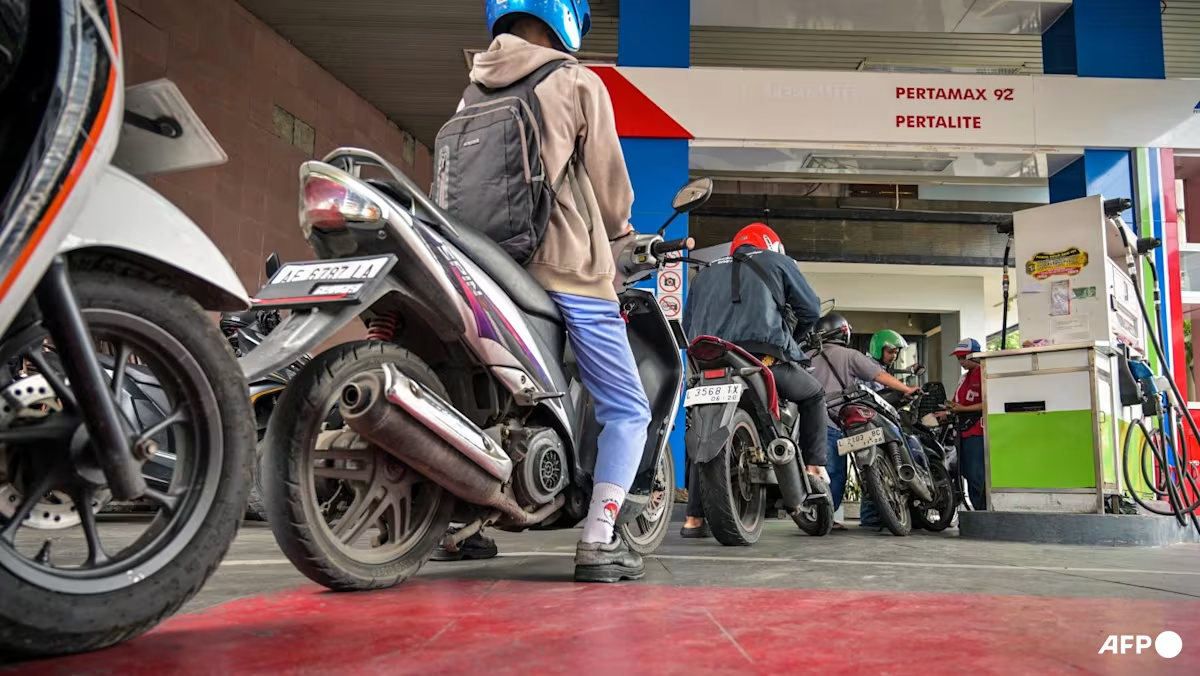
JAKARTA: Indonesia’s senior economic minister said on Friday (Mar 13) that the country may impose additional taxes on certain commodities, such as palm oil, if the government needs to reduce the impact on the budget from rising global oil prices.
Airlangga Hartarto, speaking at a briefing of the national cabinet, said Indonesia, a global commodities powerhouse and the world’s largest producer of palm oil and nickel, could also impose additional taxes on nickel, gold, and copper.
At the briefing, President Prabowo Subianto said austerity measures could be taken to reduce the impact of rising global oil prices.
Airlangga said government modelling showed that if the Iran war caused oil prices to stay high, it would be difficult to keep the fiscal deficit under a legal mandate of 3 per cent of GDP without cutting spending or reducing economic growth.
“These are scenarios we may have to discuss,” he said, and spoke about the option to issue an emergency order if the deficit limit needed to be breached.
He said the government had forecast three scenarios to predict how the Middle East war could impact Southeast Asia’s largest economy.
Under the first scenario, where the war lasted for five months and crude oil averaged US$86 a barrel this year, the rupiah would fall to 17,000 per US dollar, which would mean that growth would be maintained at 5.3 per cent, but the fiscal deficit would hit 3.18 per cent, he said.
In a scenario where crude averaged US$97, growth would drop to 5.2 per cent and the deficit would hit 3.53 per cent, Airlangga said. The worst-case scenario had crude averaging US$115, which would mean the deficit would cross 4 per cent of GDP.
Oil prices extended their climb on Friday as disruptions in the Gulf from the Middle East war outweighed US and International Energy Agency measures to ease supply concerns.
Brent futures for May LCOc1 were up 88 cents, or 0.9 per cent, to US$101.34 a barrel at 0918 GMT, heading for a weekly increase of 9 per cent. US West Texas Intermediate (WTI) crude for April CLc1 was up 26 cents, or 0.3 per cent, at $95.99 a barrel, set for a 6 per cent rise for the week.
On Friday, Goldman Sachs predicted that Brent oil would average more than US$100 a barrel in March and US$85 in April due to the war, damage to Middle East energy infrastructure and disruptions in the Strait of Hormuz.
https://www.channelnewsasia.com/asia/indonesia-minister-oil-prices-iran-middle-east-war-5991796


