


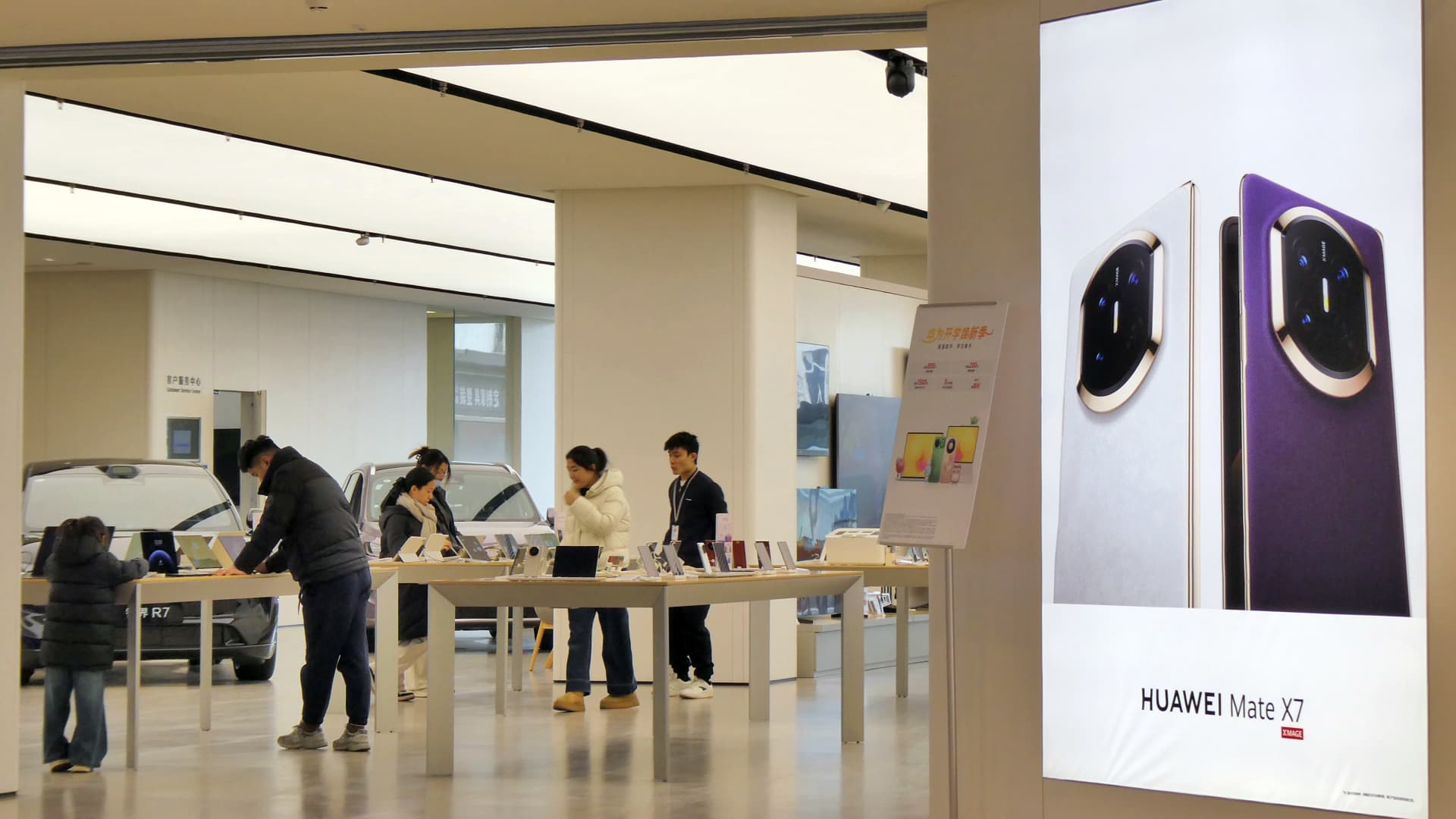
Consumers browse Huawei phones in a shopping mall in Yantai, Shandong Province, China on March 8, 2026.
Cfoto | Future Publishing | Getty Images
Huawei’s push to develop its own artificial intelligence chip has yet to drive the double-digit revenue gains of its peers, as Chinese companies strive to narrow the gap with the U.S. on AI.
Cloud computing revenue from external customers fell by 3.5% in 2025 to 32.16 billion yuan ($4.6 billion), Huawei said. The company is the second-largest cloud provider in mainland China.
While overall cloud revenue including internal customers rose by 4.8% to 72.8 billion yuan, the main ICT infrastructure segment reported revenue growth that slowed to 2.6%, down from 4.9% in 2024.
That’s the segment that would include Huawei’s self-developed Ascend AI chip solutions, meant to rival Nvidia. Huawei’s total ICT revenue for 2025 was 375.01 billion yuan.
The U.S. has restricted Chinese companies’ access to the most advanced Nvidia chips, while Beijing has urged tech self sufficiency at home.

Huawei’s decline in cloud revenue to external customers comes as ByteDance has rapidly grown its AI cloud business in China in the last several months, albeit from a small base.
The TikTok owner is reportedly ramping up access to high-end Nvidia chips in a partnership deal with a planned Malaysia data center. ByteDance and Alibaba also plan to place orders of Huawei’s new AI chip, Reuters reported last week, citing sources. ByteDance declined to comment. The two other Chinese companies did not immediately respond to a CNBC request for comment.
U.S.-developed AI tools are generally considered the most capable in the world, although some Chinese models have shown an edge in video generation. Not all U.S. AI models are officially accessible in mainland China.
Huawei’s modest cloud growth figures come amid rapid industry expansion worldwide and slower economic growth in China.
Globally, spending on cloud infrastructure services rose by 29% in the fourth quarter in a sixth-straight quarter of market expansion of more than 20%, according to Omdia. The firm predicts 27% cloud growth in 2026.
Earlier this month, Alibaba, the largest cloud computing company by market share in mainland China, reported a 36% increase in segment revenue to 43.28 billion yuan in 2025. Tencent said increased cloud service revenues domestically and internationally helped drive a 22% year-on-year increase in business services revenue in 2025.
Local promotions this month in China for AI tool OpenClaw have also encouraged many locals to download the agent and pay for related cloud and AI model services. China’s consumer spending has remained tepid since the pandemic.
Consumer revenue slows

Subscribe now
Huawei smartphones ranked first in China last year by shipments, up by 1.7%, according to Counterpoint. But the Chinese company lost ground to Apple toward the end of 2025 after the iPhone 17’s release.
For 2025 overall, the telecommunication giant reported revenue of 880.9 billion yuan, up 2%, on net profit of 68 billion, up around 8% from a year ago.
The company spent a record 192.3 billion yuan in research and development, or 21.8% of revenue.
“In 2025, Huawei’s overall performance remained steady,” Sabrina Meng, Huawei’s rotating chairwoman, said in a brief statement, which also expressed gratitude to customers, partners and employees.
The intelligent automotive solutions unit saw revenue of 45.02 billion yuan, with growth slowing to 72% year-on-year, down from a whopping 474.4% in 2024, as the autos business captured an initial surge in electric vehicles. Huawei partners with several automobile manufacturers for in-car software and driver-assist technology.
https://www.cnbc.com/2026/03/31/huawei-annual-report-2025-cloud-computing-revenue.html
