


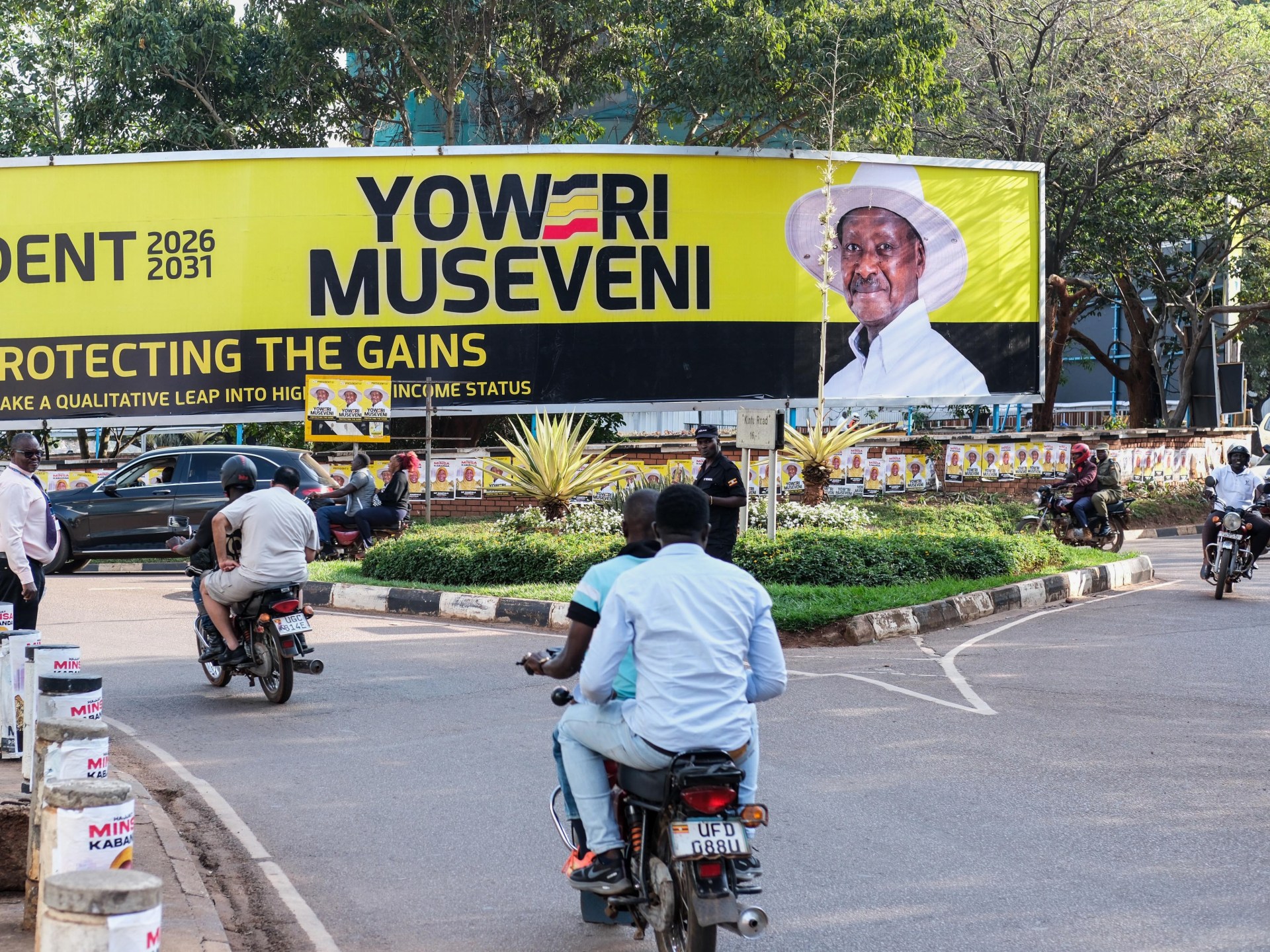
The home of every Ugandan president, State House, is nestled in the hilly uptown Nasakero area of the capital city, Kampala.
For four decades, it has been home to just one president – Yoweri Museveni, who has been in office longer than any other Ugandan leader.
Recommended Stories
list of 3 itemsend of list
Following Thursday’s election, Museveni’s tight hold on the country has been extended for the seventh time. Although he faced his biggest challenger in the form of popular opposition candidate and musician Robert “Bobi Wine” Kyagulanyi, the country’s electoral commission declared that Museveni had won with 72 percent of the vote.
At 81, Museveni is the third-longest serving president in the world.
His control over Uganda, analysts say, is absolute, and the appointment of his son, General Muhoozi Kainerugaba, as army chief back in 2024 has prompted worries among activists of a dynastic succession plan in the near future.
In a young country where about 70 percent of the 46 million population is under 35, Museveni is the only president most Ugandans have ever known. By the time he completes his latest term in 2031, he will have served for 45 years.
However, he is not alone. Across Africa, from hilly Kampala to riverside Brazzaville, several “life-long” leaders like him have held onto power for decades, despite organising routine elections that give their administrations the semblance of democratic rule.
Political experts studying these figures say at least three of them: Museveni of Uganda, Paul Biya of Cameroon, and Sassou Nguesso of the Republic of the Congo, have perfected unique formulas that help them consolidate power, using tools like compromised elections, divide and rule tactics, and powerful foreign alliances.
Al Jazeera reached out to the three governments for comments, but did not get a response.

In Uganda, fighting corruption ‘with corruption’
For Museveni, violence is used as a means to suppress dissent and keep allies in check, Kampala-based political analyst Job Kiija told Al Jazeera.
The regional strongman was first sworn in as president back in 1986, after he led the rebel National Resistance Army to overturn an unpopular civilian administration in a violent six-year conflict now known as the Ugandan Bush War. He has remained president under the rebranded National Resistance Movement.
Museveni’s ideas of leadership were likely shaped early on, as a political science student in neighbouring Tanzania, researchers note. At the time, he studied philosopher and anti-colonial theorist Frantz Fanon’s theory of violence.
Violence, Fanon wrote in his book, The Wretched of the Earth, was the highest form of political struggle, one necessary for decolonisation. In his final year thesis (PDF), Museveni focused on that theory and wholly supported the philosopher’s position.
Rather than apply that thinking to a colonial force, however, Museveni has unleashed it on opposition leaders, journalists, and activists in Uganda, Kiija said.
In 2020, when Bobi Wine first emerged on the political scene under the umbrella of the National Unity Party, the opposition candidate immediately garnered widespread support, particularly from young people. Ugandan forces, however, responded forcefully to his rallies, killing many Bobi Wine supporters.
The same scenarios played out in the lead-up to this month’s election. Security forces targeted opposition rallies with excessive force and subjected opposition supporters to arbitrary arrests and torture, according to a report from rights group Amnesty International.
Opposition figures are also routinely jailed in Uganda. Kizza Besigye, a Museveni ally turned four-time presidential candidate, has been imprisoned since November 2024 on accusations of plotting to remove Museveni. He faces a treason charge, which is punishable by death in the country.
Within his own camp, Kiija said, Museveni deliberately allows his allies to overstep their boundaries, and then holds their actions over their heads to deter dissent.
“He allows people around him to dip their hands in state coffers, so that they are soiled, and then he uses that against them,” the analyst said.
“Everyone around him – he has a portfolio on them, he knows how much you have stolen, what you have amassed, and that’s one of the reasons we can’t fight corruption because he uses that as a tool to keep people in check.”
Uganda has suffered political instability since its independence from Britain in 1962. The British colonialists employed indirect rule and appointed members of the majority Buganda tribe to important positions, while excluding others. Post-colonial Uganda’s instability and weak institutions are partly attributed to that history, experts say.
In 2005, the Ugandan parliament removed term limits from the constitution, paving the way for Museveni to run indefinitely.
Although rich in gold, oil, and cash crops like coffee, the country is reliant on Western aid. Museveni positions the country as a stabilising force in the Great Lakes region, contributing troops to regional missions, such as in the fight against the al-Shabab armed group in Somalia, thus gaining Western support.
Uganda also hosts two million refugees from South Sudan, Democratic Republic of the Congo (DRC), and Sudan – more than any other African nation.
Among its biggest donors is the United States. Washington contributed about $970m in yearly development aid, mainly for health and humanitarian needs, although US concerns over democratic backsliding and Uganda’s criminalisation of same-sex relations strained ties. The current Trump administration has, however, severely cut aid globally, affecting the country.
While Museveni was the clear favourite to win Thursday’s vote, Bobi Wine has dismissed the results as “fake”. Meanwhile, eyes are now on how Museveni’s eldest child, Kainerugaaba, will be positioned in the near future. The 51-year-old, Kiija said, is clearly being groomed for the top job.

Cameroon’s ‘absentee president’
Just months before Museveni soared to an easy victory, on the opposite side of the continent, Biya, the 92-year-old president of Cameroon, won an eighth term in office in October’s presidential polls.
Biya, who heads the governing Cameroon People’s Democratic Movement (RDPC), has been in power since 1982 and is the world’s oldest sitting president. The country’s parliament removed term limits in 2008, and last year’s win gives him another seven years at the helm.
The president is known for spending extensive periods away from the spotlight and even abroad, earning him the nickname “absentee president”. There have been frequent speculations about his health, with rumours of his death circulating on social media now and again, only for the president to pop up briefly on national television.
Still, few Cameroonians, least of all politician Kah Walla, were surprised when Biya won another term.
Walla, 60, who competed in three past presidential races, told Al Jazeera that the president uses the very tool essential to democracies: elections.
“We live in an electoral autocracy where the dictator has figured out how to use elections as one of the instruments to keep himself in power,” she said, adding that the electoral body is essentially an extension of the government.
Manu Lekunze, a lecturer in international relations at the University of Aberdeen in Scotland, told Al Jazeera that Biya uses well-funded information campaigns to “divide-and-rule” between Cameroon’s multiple ethnic groups.
Biya’s campaign machine often harps on how opposition politicians will represent only their ethnic groups, he said. Biya himself enjoys support from his Beti tribe, the adjacent majority Bamileke-Bamus, and the Fulanis by staying close to traditional leaders.
“He believes he is going to live for a long time,” Lekunze said. “[He] has an ethnic coalition that will support him regardless, and he uses that to get the simple majority he needs, which makes him really comfortable in power.”
Like Museveni, Biya is also accused of using violence – but “selectively”, Walla noted. Some Cameroonians, she said, refuse to call their country a “dictatorship” because there’s a semblance of freedom.
“Biya realised that you need to give people a channel to vent so the resistance won’t build,” Walla said.
“You can go on TV and say anything about the president, and nothing might happen, but someone else might say the same thing, or even less, and be punished [arrested] for it. So that has led people to self-censor because nobody knows where the line is.”
At least 48 people were killed by security forces during protests in support of opposition candidate Issa Tchiroma, who claimed Biya’s win in October as fraudulent, and declared himself the winner. The now-exiled Tchiroma abandoned Biya’s government to run in the elections and gained support from his Fulani group, as well as several others.
In 2016, security forces also notably cracked down on the country’s minority Anglophone regions – the Southwest and Northwest regions – after teachers and lawyers there took to the streets to decry the lack of opportunities for English-speakers. British and French colonial rule saw two distinct entities merged after independence, but the imbalance tilts in favour of the majority Francophone population.
The violent government response escalated into an ongoing rebellion, with armed groups fighting for the secession of an independent state, Ambazonia.
Surrounding Biya is a tight elite that Lekunze says benefits from the status quo, including Ferdinand Ngoh-Ngoh, the country’s secretary-general and de facto president. However, Biya has never identified or visibly groomed a successor.
There are fears that the lack of a single, known face to rally around in the case of Biya’s death could cause political turmoil within his party, and likely, the country. Walla, though, believes that would be helpful.
“Should he pass away, we will be in an extremely uncertain position, but it is still in our best interests to take to the streets at that point because if we don’t, the system will perpetuate itself,” she said.

Power, petroleum, foreign backers in Congo-Brazzaville
Despite protests in the streets and unrest among opposition figures in Cameroon and Uganda, the two pivotal presidential elections ended with no real change in leaderships that have been cemented over decades.
Meanwhile, another octogenarian is seek yet another term under similar conditions. In the Republic of the Congo, 81-year-old President Denis Sassou Nguesso, who has held office for 40 years, is set to run again in the March 2026 vote under his Congo Labour Party.
Nguesso was first elected to office in 1979 and led the country for 12 years before losing elections. On his second attempt in 1997, he seized power in a bloody civil war, and has remained in office since. In 2015, Nguesso also pushed through a controversial referendum that removed presidential term limits.
Under him, Congo has remained grossly underdeveloped despite its oil wealth, with basic infrastructure lacking due to corruption, said Andrea Ngombert, the exiled founder of Sassoufit, a group advocating for Nguesso’s exit.
Powerful foreign alliances, Ngombert noted, have helped Nguesso consolidate power for decades as he keeps a secure hold on powerful entities, including through marriage.
His daughter, the late Edith Bongo, married into the dynastic Bongo family, which ruled Gabon for decades until a military coup in 2023.
Nguesso was also a strong ally of the late Angolan president, Jose Eduardo dos Santos. When he returned to seize power, a thousand Angolan forces supported his “Ninja” militia and helped secure his victory.
The president similarly had backing from France, which provided him with arms during the war to protect oil investments in Congo, Ngombert said.
“He is not just operating on a continental level, but on an international one,” the activist said.
“He has his nose in everyone’s business, and he knows when to pull your secrets out to control you. Everyone knows if you need things to work, you must have Nguesso on your side.”
Ngueso’s influence in Paris has, however, plummeted since 2013, after pressure from civil society finally forced France to launch investigations into his family’s numerous assets in Europe and the US. In 2022, French authorities seized property belonging to his son, Denis-Christel Sassou Nguesso.
In place of France, observers say Nguesso has turned to China.
Beijing offers the government loans and foreign direct investment, and can use its veto power to shield Nguesso from possible scrutiny at the United Nations in return for lucrative oil deals, Ngombert said. Nguesso has also defended China in the face of reported rights violations in Xinjiang and Hong Kong, and is against the recognition of Taiwan as a sovereign state.
“In this arrangement, China is the shark and Congo-Brazzaville the remora – an asymmetrical but symbiotic relationship in which one feeds off the other and removes harmful parasites, while the other provides protection from other predators,” Ngombert added.
Are free elections at stake in Africa?
Across Africa, observers argue, the three leaders and several others have used force, divisive tactics, and foreign backing to secure and maintain power.
Ironically, analysts say, they have also perfected using elections – meant to be an essential democratic tool – to disenfranchise citizens.
“Elections have become a ritual, a way of just ticking the box for these leaders, but they are not held meaningfully for citizens who want to be able to express their feelings with votes,” Tendai Mbanje, an elections expert at South Africa’s University of Pretoria, told Al Jazeera.
“Electoral institutions have been captured and have deviated from their mandate, and the people leading them have no integrity, as most are political appointees,” he added.
Yet, despite this bleak outlook, African countries don’t have the luxury to discard elections: citizens cannot afford to stop voting or requesting fair electoral conditions, he warned.
“We should not abandon elections because they remain the only legitimate way for citizens to state their choice,” Mbanje said.
“What people need to do is to resist – through protests, through legal mobilisation. Opposition leaders, citizen movements, and religious leaders must all rise in resistance.”
https://www.aljazeera.com/news/2026/1/19/from-uganda-to-cameroon-how-africas-leaders-for-life-stay-in-power?traffic_source=rss
