






The addictions crisis is taking a toll on some remote and isolated communities in northern Manitoba.


It’s something Carol Kobliski sees in her community of Nisichawayasihk Cree Nation every day.
“I just don’t want to see a child pick up meth or crack and overdose on it. That’s what scares me the most,” Kobliski told Global News.
“If there’s a little baby, two or three years old, and they go pick it up thinking it’s candy … Is that what it’s going to take to wake up the community? It’s scary.”
Kobliski stands near a billboard she installed that highlights the impact drug dealers are having on young people in the community. She says the sign had previously been torn down before they relocated it.
Iris Dyck / Global News
Kobliski is the chief of law enforcement for Nisichawayasihk Cree Nation (NCN), running a team of First Nations Safety Officers that patrol the community, working to prevent crime, enforce bylaws and assist the RCMP in policing the community.
“People want a safe community. They don’t like what’s going on, and we never had this. It was never this bad, but since the illicit drugs have come in, it’s getting worse,” she said.
Nisichawayasihk Cree Nation is 80 kilometres west of Thompson, Man.
Iris Dyck / Global News
Nisichawayasihk Cree Nation.
Iris Dyck / Global News
The Cree nation in Nelson House is a picturesque, tight-knit community on the north shore of Footprint Lake, about an hour from Thompson, Man.
Kobliski says NCN has been gripped by addictions, crime and violence in recent years, and it’s having a devastating impact on children and youth.


Get breaking National news
For news impacting Canada and around the world, sign up for breaking news alerts delivered directly to you when they happen.
“Over here is our new graveyard, and it’s filling up fast,” Kobliski said while driving past a new cemetery in the community.
“We’ve been going through a lot of death in the community the last five years. We’re constantly having funerals every month. Like sometimes, seven in a month.”
Kobliski says too many children and youth are having their lives cut short at the hands of addictions and violence seeping into the Cree community in Nelson House.
Iris Dyck / Global News
Nisichawayasihk has an RCMP detachment in the community, and the First Nations Safety Officers manage a checkstop, monitoring everyone coming and going. Kobliski says they regularly catch drug dealers and bootleggers smuggling drugs and alcohol into the community by vehicle, snowmobile, quad or boat. Nisichawayasihk has bylaws restricting how much alcohol individuals can bring into the community.
The First Nations Safety Officers on Nisichawayasihk Cree Nation run a checkstop, monitoring everyone entering and leaving the community.
Iris Dyck / Global News
Kobliski says she’s also seized countless weapons from youth and community members, including machetes, homemade weapons, baseball bats and bear mace. Those are just some of the items she seized this past summer alone.
“Look at how sharp that is,” Kobliski said while holding one of the machetes she seized from the community.
“They’re assaulting each other with this. You can kill somebody with this stuff. People are being medevacked out of the community with 75 stitches to the head and skull.”
Kobliski shows a machete that First Nations Safety Officers seized from community members.
Iris Dyck / Global News
Kobliski was presented with an award from the Manitoba RCMP for her work protecting the community as a First Nations Safety Officer.
Iris Dyck / Global News
The issue isn’t isolated to NCN, as drugs and crime are impacting many northern Manitoba communities. This month, Manitoba RCMP announced a major bust resulting from a six-month investigation, dubbed ‘ Project Derry,’ into a drug trafficking ring in Bunibonibee Cree Nation, leading to 23 arrests.
“There’s an opioid crisis in our First Nations communities and it’s all throughout our north,” Manitoba Keewatinowi Okimakanak Grand Chief Garrison Settee told Global News.
Grand Chief Settee says it’s an issue top of mind for chiefs in northern Manitoba.
“I think the younger people are getting hooked on drugs earlier and it’s really sad how it affects them. And I think the behaviour that manifests when they are on these drugs is very harmful to themselves and to other people.”
MKO Grand Chief Garrison Settee says the opioid addiction crisis is an issue front and centre for First Nations chiefs in northern Manitoba.
Iris Dyck / Global News
Kobliski says there are safety risks involved with the work the First Nations Safety Officers do, but nothing will deter her from working to keep her community safe.
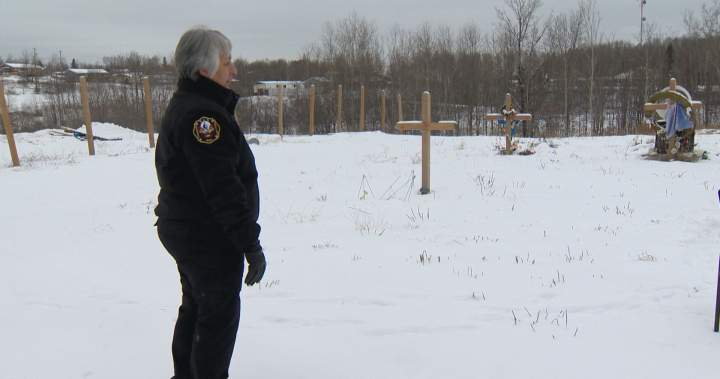
“This is what we’re trying to prevent,” Kobliski said while standing in a graveyard in Nisichawayasihk.
“By having our First Nations Safety Officers in the community, helping our community, helping with the RCMP so we don’t have to keep burying our young people. And it’s sad that they just don’t see it. Our community — they don’t see what’s happening.”
“I don’t want to see a child in here,” Kobliski added, fighting through tears.
“That’s the scariest thing that I fear, is to see a child be buried because of an overdose … and I hope that people wake up.”
Fighting the addictions crisis in northern Manitoba’s Nisichawayasihk Cree Nation


