


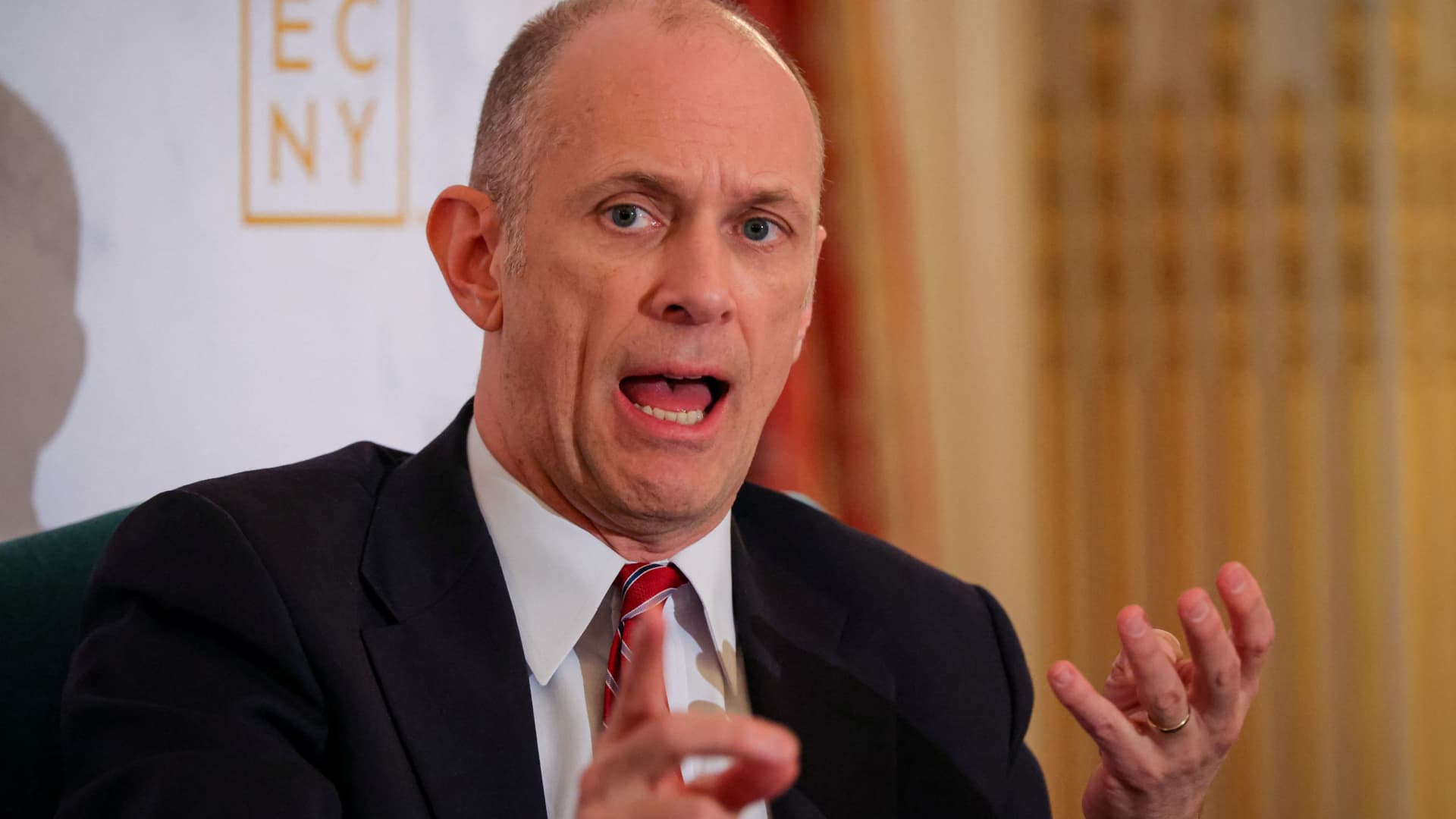

Chicago Federal Reserve President Austan Goolsbee on Friday explained why he voted against this week’s interest rate cut, telling CNBC that policymakers should have waited until they had more information before easing further.
“I’m pretty optimistic that for 2026 rates will will be able to be a fair bit lower than they are today,” the central banker said during a “Squawk Box” interview. “But I’ve just been uncomfortable front-loading too many rate cuts and assuming that what we’ve seen in inflation will be transitory.”
Goolsbee was one of three Federal Open Market Committee members to vote against the quarter percentage point reduction, the third consecutive easing measure. He was joined by Kansas City Fed President Jeffrey Schmid, as well as Governor Stephen Miran, who preferred a steeper cut.
While he has said in the past he sees room for rates to come down further, Goolsbee said a lack of progress on inflation argued against moving now.
Recent readings show the annual inflation rate around 2.8%, well above the Fed’s 2% target.
“There’s no way around we’ve been four and a half years above the inflation target, and the last six months have shown no progress,” Goolsbee said. “Right before the lights went out [for the government shutdown], you saw a couple of relatively disturbing readings on services inflation. I just want to make sure that if we believe that this is transitory, let’s not just put all our eggs in.”
“While I voted to lower rates at the September and October meetings, I believe we should have waited to get more data, especially about inflation, before lowering rates further,” the policymaker said in a post on the Chicago Fed’s website.
Goolsbee will not be a voter on the FOMC in 2026 but will still participate in meetings.
“Given that inflation has been above our target for four and a half years, further progress on it has been stalled for several months, and almost all the businesspeople and consumers we have spoken to in the district lately identify prices as a main concern, I felt the more prudent course would have been to wait for more information.” he wrote in a post on the Chicago Fed website.
In the CNBC interview, he elaborated on his misgivings about cutting.
While other Fed officials have expressed concern about the weakening labor market, Goolsbee said data has shown conditions to be “pretty stable.”
“I’m pretty optimistic that for 2026 rates will will be able to be a fair bit lower than they are today. But I’ve just been uncomfortable front loading too many rate cuts,” he said in the interview. “We don’t take a lot of extra risk, in my view, to just wait to Q1 2026, and make sure that we’re back on path at 2% inflation.”
The FOMC on Wednesday voted to lower its benchmark rate to a range between 3.5%-3.75%.
In his post-meeting news conference, Chair Jerome Powell expressed worry that the labor market looks weaker than the headline numbers suggest, saying he expects official nonfarm payroll counts to be lowered and show losses in recent months.
For his part, Goolsbee said he is “one of the most optimistic people” that rates will be lower in the year ahead.
Schmid also released a statement Friday explaining his dissent. He also voted against a rate cut in October.
“Inflation remains too high, the economy shows continued momentum, and the labor market—though cooling—remains largely in balance,” Schmid said. “I view the current stance of monetary policy as being only modestly, if at all, restrictive. With this assessment, my preference was to leave the target range for the policy rate unchanged at this week’s meeting.”
Earlier Friday morning, Philadelphia Fed President Anna Paulson, who will vote in 2026, said she views policy as “somewhat restrictive” and is more worried about unemployment than inflation.
https://www.cnbc.com/2025/12/12/feds-goolsbee-explains-vote-against-rate-cut-says-central-bank-should-have-waited.html
