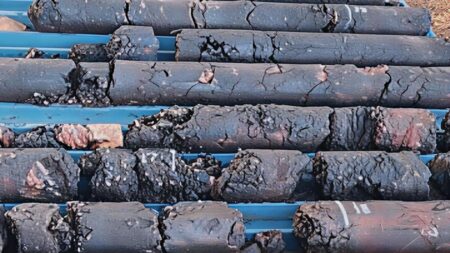






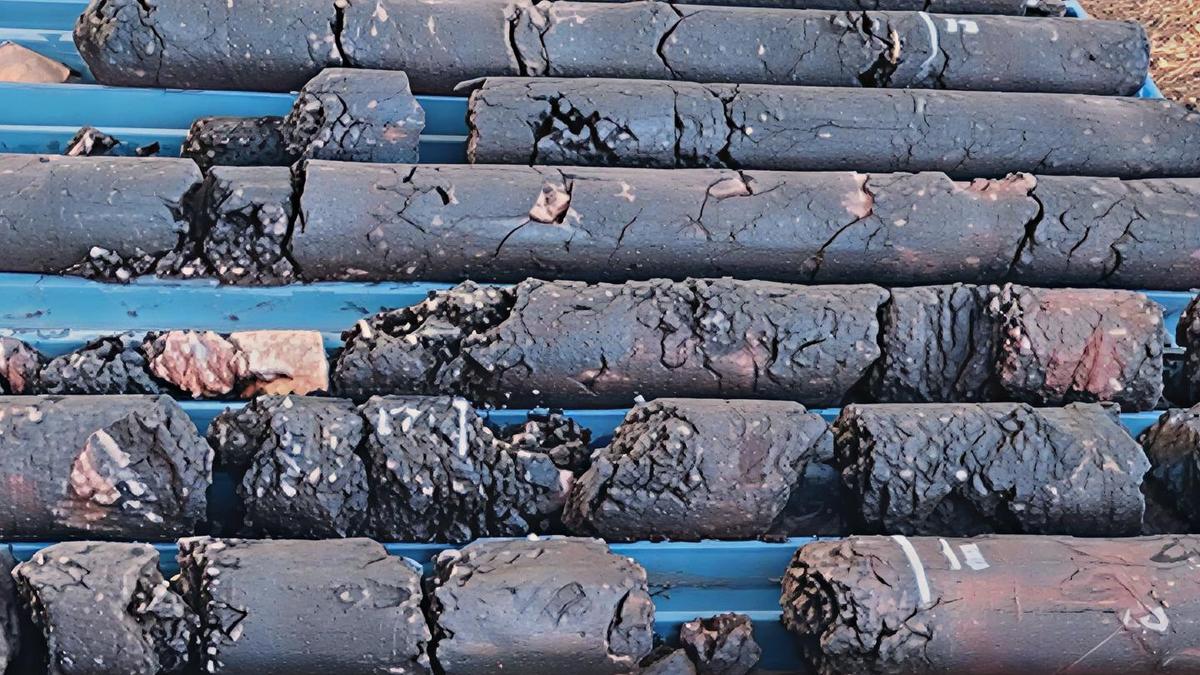
Estrella Resources has delivered another set of exceptional assay results assaying up to 58 per cent manganese from its Ira Miri prospect, 10 kilometres west of Bauro in Timor-Leste, confirming the project as an emerging high-grade, laterally extensive sedimentary manganese system.
The company’s latest diamond drilling has returned multiple intervals above 50 per cent manganese with very low impurities, including standout results of 58.02 per cent manganese in one hole and 55.1 per cent manganese in a second.
Of the dozen new holes reported, 10 intersected significant manganese mineralisation, with an average grade of 35 per cent manganese across mineralised intervals.
The best intercept among results to hand returned 3m assaying 35.7 per cent manganese from 1.4 metres, including 1.5m at 55.1 per cent manganese from just 1.4m depth.
A second hole gave up 4m going 25.7 per cent manganese from 9.2m, including a 1.05-metre section at 49.6 per cent manganese from 15.9m, while a third hole delivered 0.4m at an impressive 58.02 per cent manganese within a broader 1.1-metre intercept running 52.6 per cent manganese from 17.3m.
The company says the results confirm and build on a background of previously reported ultra-high-grade intercepts, including 6.45m assaying 51.7 per cent manganese in one hole, with another hole boring through 8.05m going 53 per cent manganese.
The mineralisation style features just 0.04 per cent phosphorus, 2 per cent iron and 5.12 per cent alumina, combined with relatively high silica at an average of 37.08 per cent.
The chemical characteristics of the project’s mineralisation style mirror other world-class high-silica, low-iron, stratiform manganese deposits, which include Mexico’s Molango deposit and Australia’s Groote Eylandt operation, two of the largest and highest-quality manganese deposits globally.
Estrella Resources managing director Chris Daws said: “Ira Miri continues to deliver exceptional grades, with results that rival those seen in some of the world’s best sedimentary manganese deposits. The continuity of grades above 50 per cent Mn, combined with exceptionally low impurity levels, positions Ira Miri as a strategic and potentially high-value discovery. With several large targets still untested, the potential scale is significant.”
The Groote Eylandt manganese deposit is a world-class, Cretaceous-age sedimentary manganese system within the Carpentaria Basin in Australia’s Northern Territory. It is 60 per cent owned by South32, with Anglo American holding the balance.
It is one of the world’s largest high-grade manganese operations, with a total endowment – including past production and remaining reserves – exceeding 150 million tonnes of manganese ore.
Estrella has now completed 45 diamond holes for 1532.5m at Ira Miri, with its Cretaceous Noni Formation horizon starting from the surface and showing excellent continuity.
The company believes Timor-Leste’s geological history has preserved significant volumes of high-grade manganese in the shallow-dipping shales of the Noni Formation, with minimal modern exploration undertaken to date across the broader belt.
Final assays from the current program are expected shortly and will guide the company’s follow-up work at Ira Miri.
In other work, Estrella expects the drilling at its nearby Werumata Limestone deposit, 45km west of Ira Miri, to wrap up this week, providing the data needed for the company to finalise its upcoming mineral resource estimate.
Estrella now has two very complementary irons beginning to glow a gentle red in the metaphorical fire within its Timor-Leste portfolio.
There will always be a market for high-grade manganese, a critical metal used across multiple industries. About 80 to 90 per cent of all manganese goes into steel-making, where it adds strength, toughness and helps remove sulphur.
Manganese also finds significant use in modern batteries for electric vehicles and for domestic or grid-scale energy storage. Additionally, it is used in fertilisers, glass-making, as a key catalyst in many chemical processes and in water purification.
Furthermore, there is always a market for high-quality limestone, which the company is also targeting as a potential 500 million-tonne deposit.
Limestone is used as a building material in its own right as block or sheet stone and it is the principal component in cement manufacture. It is also used to make lime, which has wide applications, including in agriculture, manufacturing and mineral processing as an alkaline pH modifier.
The appealing aspect of Estrella’s current commodity duo is that its clean limestone horizon sits at or near the surface and typically overlies the high-grade manganese, meaning that exploitation of manganese will, in most cases, involve pre-stripping of the limestone.
If the limestone deposits can be mined and commercialised at the same time as manganese production, their geological coincidence could be one of the big win-wins of all time, especially for Estrella and for the future of Timor-Leste.
Is your ASX-listed company doing something interesting? Contact: matt.birney@wanews.com.au
https://thewest.com.au/business/bulls-n-bears/estrella-hits-58-manganese-in-high-grade-timor-leste-play-c-20981480