








The German playwright Bertolt Brecht was living in exile in Finland when he began work on “The Resistible Rise of Arturo Ui” in 1941. The play, written with an American audience in mind, transposes the trajectory of Hitler’s journey to power into a story of Chicago gangsters operating a vegetable racket. Charlie Chaplin’s “The Great Dictator” had come out in movie theaters just a year earlier and may well have been an inspiration.
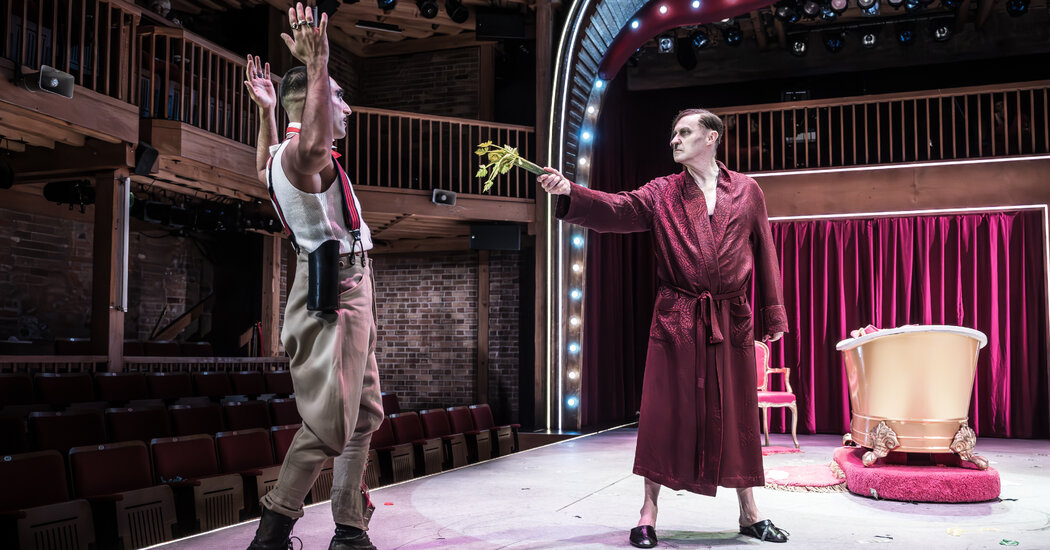
A new staging by the Royal Shakespeare Company in Stratford-upon-Avon, England, where it runs at the Swan Theater through May 30, leans heavily into Chaplin. As rendered by Mark Gatiss, the title gangster bears such an uncanny physical resemblance to Chaplin’s Hitler that theatergoers might initially experience a sensation not commonly associated with depictions of the Führer: of comfort, even a warm familiarity.
We are soon snapped out of it. Gatiss — who co-created and starred in the Emmy Award-winning TV series “Sherlock” — gives a splendidly skin-crawling performance, switching between wheedling self-pity (“My name is blackened by the envious!”) and unhinged aggression. Ui and his henchmen sow chaos so they can do away with the rule of law under the guise of restoring order. They burn down a vegetable stall and frame an innocent man for the crime, and then smash up the courtroom for good measure. This symbolizes the Reichstag fire, and the annexation of Austria is represented by Ui’s takeover of the suburb Cicero after the murder of Ignatius Dullfeet (Joe Alessi), who is based on Engelbert Dollfuss, the Austrian chancellor killed by the Nazis in 1934. At Dullfeet’s funeral, Gatiss licks the cheek of his widow (Janie Dee), which drew disgusted gasps from the first-night audience.
Far-right politics has been a familiar theatrical theme amid the global populist surge of the past decade. History plays and tragedies in particular, with their themes of hubris and tyranny, can serve as warnings, but sometimes — as in recent London revivals of “Richard III” and “Oedipus” — the pointed allusions to contemporary politics can feel forced and undermine the drama. When it comes to a play as emphatically allegorical as “The Resistible Rise of Arturo Ui,” however, it’s the other way around: The challenge is to inject drama into the polemic and ensure it’s a spectacle, not a history lesson.
To this end, the director, Seán Linnen, has imbued this production with a lurid, burlesque aesthetic, blending menace and absurdism. If Gatiss’s heavy makeup and preening malevolence recall the Joker from “Batman,” there is also much else that is cartoonish. Ui’s goons are similarly clown-like figures, and one of them (Mawaan Rizwan) prances around in a purple fur coat. Rebekah Hinds, playing the manipulable floozy Dockdaisy, looks and sounds like Betty Boop, with a wonderfully goatish laugh.
The tone is set in the opening scene, when Chicago’s cauliflower magnates, wearing earthy green suits, are gathered around an improbably vast heap of doughnuts. Vegetables are brandished in lieu of firearms — corn, celery and carrots as pistols; a stalk of sprouts as a machine gun — but the gunfire sounds real enough. The scenes are punctuated by snatches of spiky rock music, written by the band Placebo and performed by musicians on a balcony above the stage. (It’s the second time the Royal Shakespeare Company has collaborated with a major rock band recently, following last year’s Radiohead/“Hamlet” mash-up.)
“The Resistible Rise of Arturo Ui” is a slight play, perennially unloved, even among Brecht aficionados, but Gatiss and the ensemble have done a smart job of bringing it to life. And the timing feels significant. There is only one explicit reference to current events, and it comes shortly after the courtroom scene, when the stage is briefly invaded by a posse of figures sporting bulletproof vests, face coverings and baseball caps — the unmistakable uniform of ICE agents. The image springs back to mind when, in a brief epilogue, Gatiss — still in full Hitler-esque garb — breaks character to deliver the play’s most famous line: “though the world has stood up and stopped the bastard, the bitch that bore him is in heat again.”
That warning is the play’s raison-d’être; the key word in the title is the adjective. The play’s most significant moment is actually its protagonist’s transformation, relatively early on, from a moping, physically graceless also-ran into a plausible big shot. Ui effects the change by hiring a Shakespearean actor (played by Christopher Godwin, a Shakespearean actor) to teach him how to hold himself and speechify. The scene is both cringingly funny and telling: Ui has a keen intuitive grasp of other people’s credulousness, and what must be done to exploit it. Power is a performance; the phonier the better. The fascist pitch was, and always will be, a con job.
The Resistible Rise of Arturo Ui
Through May 30 at the Swan Theater in Stratford-upon-Avon, England; rsc.org.uk.
https://www.nytimes.com/2026/04/22/theater/the-resistible-rise-of-arturo-ui-rsc-mark-gatiss.html


