


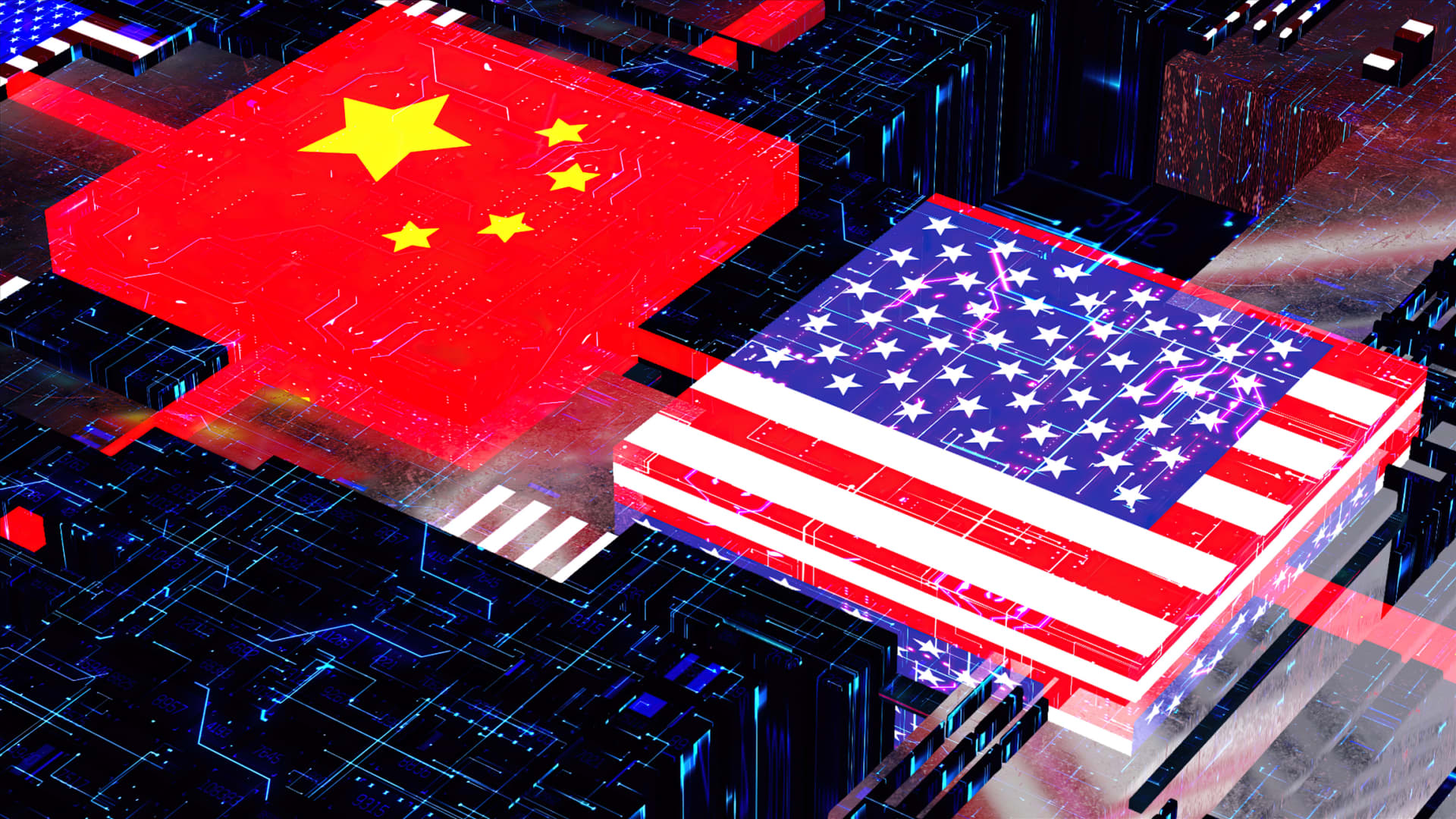

China’s artificial intelligence device market is already booming, and in the advanced technology race against the U.S., the country’s expertise in hardware could give it an edge.
“The advantage comes from the fundamental root that China is a nation of manufacturing,” Dr. Kai-Fu Lee, CEO of 01.AI and chairman of Sinovation Ventures, told CNBC. “Today, the competition is on the software, the models, the agents, the applications. But soon it will move to devices.”
Meta has sold millions of its smart glasses since introducing the specs in 2023, and the Chinese have caught on, with more than 70 Chinese companies creating competing products in the space.
Eyewear from companies such as Inmo and Rokid are sold worldwide. Xiaomi and Alibaba‘s are found only in China and are embedded with the tech giants’ own AI.
Alibaba’s DingTalk, a messaging platform for the workplace, this year released a credit card-sized AI gizmo meant for note-taking on the job.
The DingTalk A1 can record, transcribe, summarize and analyze speech from as far as 8 meters (26 feet) away, about the length of a large boardroom.
The device is similar to the Plaud Note, which is available in the U.S.
The device experimentation in China spans from the practical to the unconventional.
Chinese startup Le Le Gaoshang Education Technology released a “Native Language Star” brand translating gadget aimed at Chinese parents with limited English to teach English to their own children.
The contraption, which is looped around the back of a user’s neck like a travel neck pillow and comes down toward the chest, has a sort of muzzle unit that goes over the mouth and mutes the user’s own voice.
The unit is embedded with Tencent and iFlyTek AI and is billed as a way to turn an English-speaking Chinese parent into a “laowai,” or foreigner. It retails for $420.
Having so many hardware touchpoints helps with adoption and with getting people used to the technology. It’s also a boost for companies to gather a war chest of data compared to other countries, analysts say.
“When you still hear people outside of China talking about what the future of the AI device might be, the market is full of AI devices here already,” tech consultant Tom van Dillen of Greenkern said at his office in Beijing. “This creates this feedback loop again to make the AI even better.”
Yet an edge in hardware is far from a guarantee to win the AI race, especially if China’s AI lacks appeal with global customers due to privacy or other issues, or if it falls well behind its counterparts in the U.S. or elsewhere.
“You really have to be that Apple iPhone to reap the most of the reward,” Lee cautioned, referencing late entrepreneur Steve Jobs’ invention that is often seen as one of the most transformative consumer products ever. “I think the China advantage for building the Apple iPhone for the AI age is that the capabilities are there — engineers and entrepreneurs, and so on. But it will still be a race.”

https://www.cnbc.com/2025/12/08/video-china-ai-wearables.html
