


Journalist
Tanzeel Akhtar
Journalist


Share



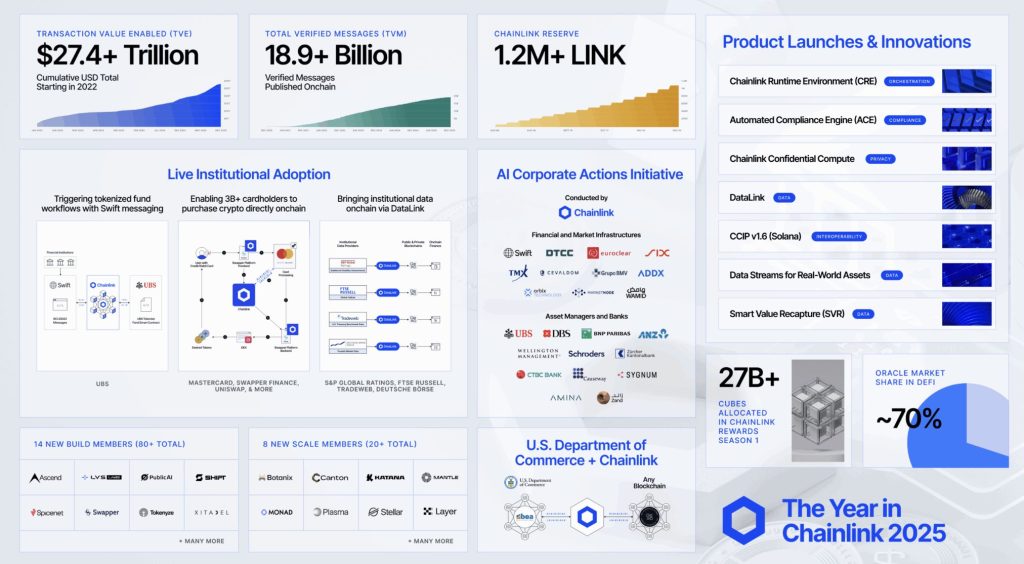
Chainlink said it has strengthened its position as the industry-standard infrastructure for onchain finance in 2025, as governments, banks and asset managers increasingly adopted its technology to move real-world financial activity onto blockchains, according to blog post published by the company.
The report highlights 2025 as an important year in which Chainlink’s oracle and interoperability standards became embedded across public- and private-sector financial systems used from everything from government data publication to institutional tokenized funds.
Government Adoption Accelerates
Government use of blockchain infrastructure marked progess during the year. Chainlink said the U.S. Department of Commerce partnered with the network to publish macroeconomic data onchain using Chainlink Data Feeds sourced from the Bureau of Economic Analysis.

Chainlink co-founder Sergey Nazarov also participated in high-level policy discussions in Washington, including the White House Digital Asset Summit, as U.S. President Donald Trump signed the GENIUS Act into law.
The engagement underscores growing coordination between policymakers and blockchain infrastructure providers as regulatory clarity improves.
Banks and Capital Markets Move Onchain
In banking and capital markets, global financial institutions increasingly relied on Chainlink to execute production-grade onchain workflows.
The research cites a partnership with Mastercard allowing more than three billion cardholders to purchase crypto assets directly onchain via a Chainlink-powered application.
Asset managers also expanded tokenized offerings. UBS completed what Chainlink described as the world’s first live, end-to-end tokenized fund workflow using its Digital Transfer Agent standard while firms such as WisdomTree and FTSE Russell began publishing institutional-grade net asset value and index data onchain.
Financial market infrastructures, including DTCC, Euroclear, and SWIFT, collaborated with Chainlink to streamline corporate actions processing and cross-chain settlement using standardized messaging formats.
DeFi and Tokenization Scale Up
Decentralized finance and tokenization platforms also adopted Chainlink at scale in 2025. Coinbase selected Chainlink’s Cross-Chain Interoperability Protocol (CCIP) as the exclusive bridge infrastructure for its wrapped assets while DeFi protocols including Aave and Lido upgraded their oracle and cross-chain infrastructure to support institutional-grade use cases.
Chainlink said the expansion of CCIP to non-EVM blockchains, including Solana, unlocked access to tens of billions of dollars in assets across multiple ecosystems.
Infrastructure Push Sets Stage for 2026
Beyond adoption Chainlink said it also introduced new platform capabilities in 2025, including its Runtime Environment, Automated Compliance Engine and Confidential Compute service aimed at supporting privacy-preserving and compliant onchain applications.
The report concludes that 2025 marked a turning point for onchain finance, with 2026 expected to see tokenization adoption accelerate further as institutions standardize around shared infrastructure.
“Governments, financial institutions, and market infrastructures are increasingly aligning around Chainlink standards,” the company said, positioning its network as core plumbing for the global shift toward onchain capital markets.
https://cryptonews.com/news/chainlink-extends-lead-in-onchain-finance-as-institutional-adoption-grows/