





Canada’s Food Price Report is warning Canadians to brace for even higher food costs next year, with rising prices in multiple sectors set to continue putting pressure on household grocery budgets.


The 16th annual edition of the report, released Thursday by Dalhousie University in partnership with universities across the country, says it expects food prices to rise between four and six per cent in 2026.
“For the average family of four, we’re expecting them to spend about $1,000 more next year to buy the exact same amount of food,” said Dr. Sylvain Charlebois, professor and senior director of the Agri-Food Analytics Lab at Dalhousie University.
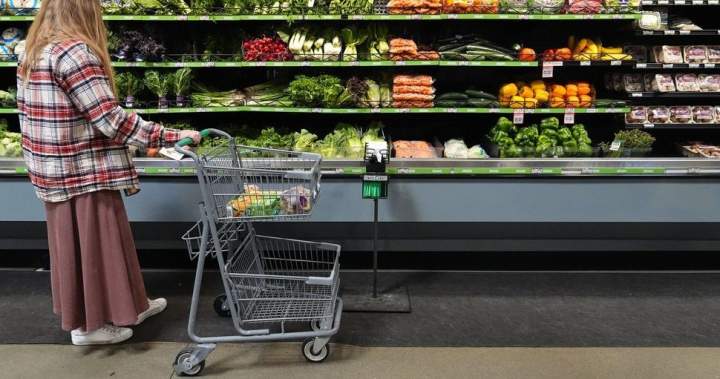
A customer looks for produce at a grocery store in Ottawa, on Wednesday, April 2, 2025.
THE CANADIAN PRESS/Justin Tang
The report’s previous projections for 2025 proved largely accurate. Last year, it forecast overall food prices would climb between three and five per cent. According to the latest Consumer Price Index data, grocery prices rose four per cent, landing squarely in that range.
Several food categories also tracked closely with expectations, including dairy, restaurant meals and seafood.
But the report says meat and “other food products” rose faster than projected, while bakery prices grew more slowly than expected. Prices for fruits and vegetables fell, offering rare relief at the checkout.
2026 forecast shows food prices rising across all major categories


Canada’s Food Price Report 2026
The first table in the report outlines the 2026 food price forecast by category, showing anticipated increases across each section.
Meat is expected to see the largest jump, rising between five and seven per cent, with the widest uncertainty range among all categories. Bakery items, vegetables and restaurant meals are also projected to climb noticeably, while fruit and seafood are expected to see more modest increases.


Get daily National news
Get the day’s top news, political, economic, and current affairs headlines, delivered to your inbox once a day.
Regional differences across provinces


Canada’s Food Price Report 2026
The second table highlights how food price trends are expected to vary across Canada.
Several provinces that saw above-average increases in 2025 — including British Columbia, Manitoba and New Brunswick — are forecast to fall below the national average in 2026.
Meanwhile, provinces such as Alberta, Nova Scotia, Prince Edward Island and Quebec are projected to experience above-average food price growth next year.
The report also measures what households are actually paying.
For 2025, it predicted a four-person family — a man and woman aged 31 to 50, a boy aged 14 to 18, and a girl aged 9 to 13 — could spend up to $16,833.67 on food. The report found that the total came in lower, at $16,577.16, a gap of $256.51.
Researchers say this year’s forecast marks a shift from previous editions, relying on a single, standardized modelling system to project 2026 food prices.
The approach blends multiple predictive tools and factors in climate impacts, economic trends, food manufacturing conditions and global geopolitical events.
“So the report looks at the biggest factors like the uncertainty around tariffs, the issue of of the GST holiday, the carbon tax, labor issues, interest rates, the dollar and the buy Canadian movement,” Charlebois told Global News in an interview on Tuesday. “So there are a lot of factors that have actually made things more expensive this year,”
Restaurants expected to face steep price hikes as Canadians cut back on alcohol consumption
Charlebois says there are two categories where the report has never been wrong in its predictions: seafood and restaurant price predictions. According to the research, he expects restaurants will see “much higher” prices in 2026 — another increase of four to six per cent.
“Restaurants are already unaffordable — it will now be beyond unaffordable. There is going to be less competition and restaurants will close,” he said.
One reason for that — patrons are consuming less alcohol, so restaurants are being forced to increase their menu prices to cover their costs.
“People are drinking less for all kinds of reasons. Health, cannabis use, cost, and lifestyle — especially with youth,” Charlebois said.
“The younger generation is not drinking as much. Clubs and bars are struggling, the SAQ in Quebec and the LCBO in Ontario are posting sluggish sales. Across the board Canadians are drinking less.”
Canadian families could pay $1,000 more for groceries in 2026, report warns