


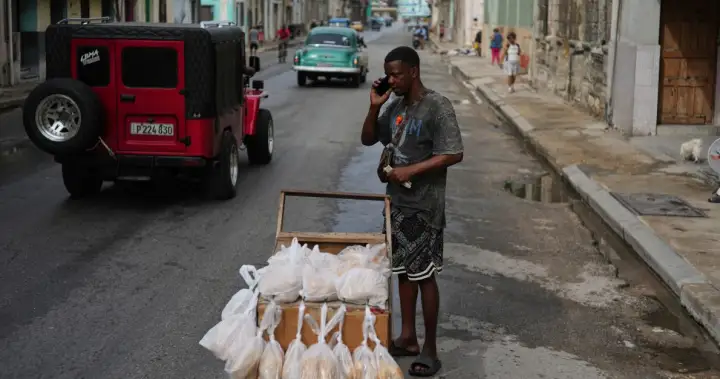
The mounting energy and economic crises in Cuba and U.S. President Donald Trump‘s latest comments suggesting imminent action against the country’s socialist government has some advocates urging Canada to do more to help.

The toll faced by the island’s 11 million people was put into stark relief this week by a nationwide blackout after Cuba’s aging, fuel-powered electrical grid collapsed Monday. The Cuban government said the blackout was a direct result of a U.S. embargo on oil exports to the country that started in January.
The lack of fuel has limited transportation, health care and even food supplies, creating a humanitarian catastrophe.
“For three months, we’ve been asking the Canadian government to do something to help the crisis in Cuba,” said Julio Fonseca, co-chair of the Canadian Network on Cuba.
While he said Canada’s announcement last month of $8 million in humanitarian food aid was appreciated, “we think that it’s not enough.”
“One of the first things it should do is to denounce the injustice of the blockade on the Cuban people for more than 65 years, which is nothing else but collective punishment on an innocent population with the goal of toppling its constitutional government,” he said.

The federal government has not commented on the Trump administration’s policy toward Cuba or the U.S. president’s rhetoric, which has escalated in recent days.
After musing last month about “a friendly takeover of Cuba,” Trump told reporters in the Oval Office on Monday that he could soon have “the honour of taking Cuba.”
“That’s a big honour, taking Cuba in some form,” Trump said. “I mean, whether I free it, take it, I think I can do anything I want with it, if you want to know the truth.”
On Tuesday, Trump said that “Cuba right now is in very bad shape” and “we’ll be doing something with Cuba very soon,” while U.S. Secretary of State Marco Rubio said Cuba’s government can’t fix its ailing economy.
Global Affairs Canada said in a statement Wednesday that the government’s “primary response to complex crises is to provide financial support to experienced organizations” that can deliver aid quickly, such as United Nations and non-governmental agencies.
“Canada stands ready to work with our partners on how we can best assist Cuba’s most vulnerable,” spokesperson Brittany Fletcher said.

Get breaking National news
Get breaking Canada news delivered to your inbox as it happens so you won’t miss a trending story.
“Canada is in regular contact with UN agencies, who are working on plans to scale up humanitarian response in Cuba, if, and when necessary. These plans would be based on the latest assessed needs.”
Randeep Sarai, secretary of state for international development, said last month the $8-million federal aid package would be delivered through “trusted partners in the World Food Program as well as UNICEF,” and that officials were “hoping that it gets to those most in need.”
“After that, we’ll be assessing the situation as it needs be and we can adjust our program accordingly.”

What Cuba needs most is fuel, Fonseca said.
“It is what moves the whole country,” he said. “Hospitals, transportation, transportation of food from one province to another, sick patients, et cetera.”
U.S. sanctions and Trump’s embargo have effectively blocked Cuba from purchasing or acquiring any oil, diesel or gasoline.
Cuban officials have said the island has received no fuel deliveries in three months, ever since the U.S. captured Nicolas Maduro from Venezuela, which had been Cuba’s primary oil supplier along with Mexico.
After that military operation, Trump issued an executive order threatening tariffs on any country that sold oil to Cuba and blocked Venezuela from selling energy to the island.
Although Trump rescinded the tariff order after the U.S. Supreme Court ruled against such emergency tariff powers, the administration has not ruled out other forms of retaliation — including sanctions — against countries that try to break through the oil embargo.
That leaves Canada in a tough spot, experts say, particularly given Trump’s threats against Canada’s sovereignty and the upcoming review of the Canada-U.S.-Mexico Agreement on free trade this summer.
“(Prime Minister Mark) Carney is left in a position where if he goes very far, much farther than he’s already gone — which is a pittance — it will undoubtedly bring out the Americans’ ire,” said Hal Philip Klepak, professor emeritus at the Royal Military College of Canada and an expert on Latin American issues.
“It’s the worst possible moment for Carney to take initiatives. Normally Canada would be in there with a lot more money, a lot of more initiatives to help Cuba out, because Cuba is an old friend.”

Carney has not publicly commented on the situation in Cuba.
Asked directly by NDP interim leader Don Davies in the House of Commons last month if Canada would stand with Cuba against “aggressive U.S. imperialism,” Foreign Affairs Minister Anita Anand said the government was focused on supporting Canadians wishing to leave the country.
“We are deeply concerned by the deteriorating conditions in Cuba,” she said.
Anand told reporters during the aid announcement two weeks later that she had not discussed “Canadian aid intentions” with her U.S. counterpart Rubio.
Bloc Québécois MP Alexis Brunelle-Duceppe urged Ottawa to speak out against the blockade in a statement responding to the funding package.
“This aid must not be an end in itself. It must be coupled with a call for the American government to end its policies that are harmful to the Cuban public,” he wrote in French.
Klepak said Canada could have better luck staking out a position supporting Cuba if it acted alongside NATO allies, who are already facing Trump’s anger for not heeding his calls for help securing oil shipments in the Strait of Hormuz from Iran.
Yet he said the situation remains “dicey” for Carney and that Canada should prepare for Trump to act sooner than later.
“I thinks it’s quite logical that Canada take measures and also prepare itself for what may be in the cards — particularly if Mr. Trump fails in Iran, because he will need a victory before (the U.S. midterm elections in) November,” he said.

Conservative deputy leader Melissa Lantsman said in a statement that her party endorses Canadian aid for the Cuban people, while arguing that Cuba’s leaders have created the crisis by putting the regime’s survival ahead of the wellness of its citizens.
Fonseca said the Cuban government has done “all it can with whatever little they have” and that he remained hopeful negotiations between Havana and Washington will lead to a solution.
Until then, he said Carney needs to speak up and reaffirm Canada’s sovereignty over its foreign policy.
“Some days you think he’s taking the lead and this is the leader that the world needs now,” he said.
“But at other points, he disappoints everybody again by just complying with everything the United States says or does.”
—with files from Global’s Touria Izri and the Canadian Press
As Cuba suffers and Trump eyes U.S. ‘takeover,’ is Canada doing enough?
