






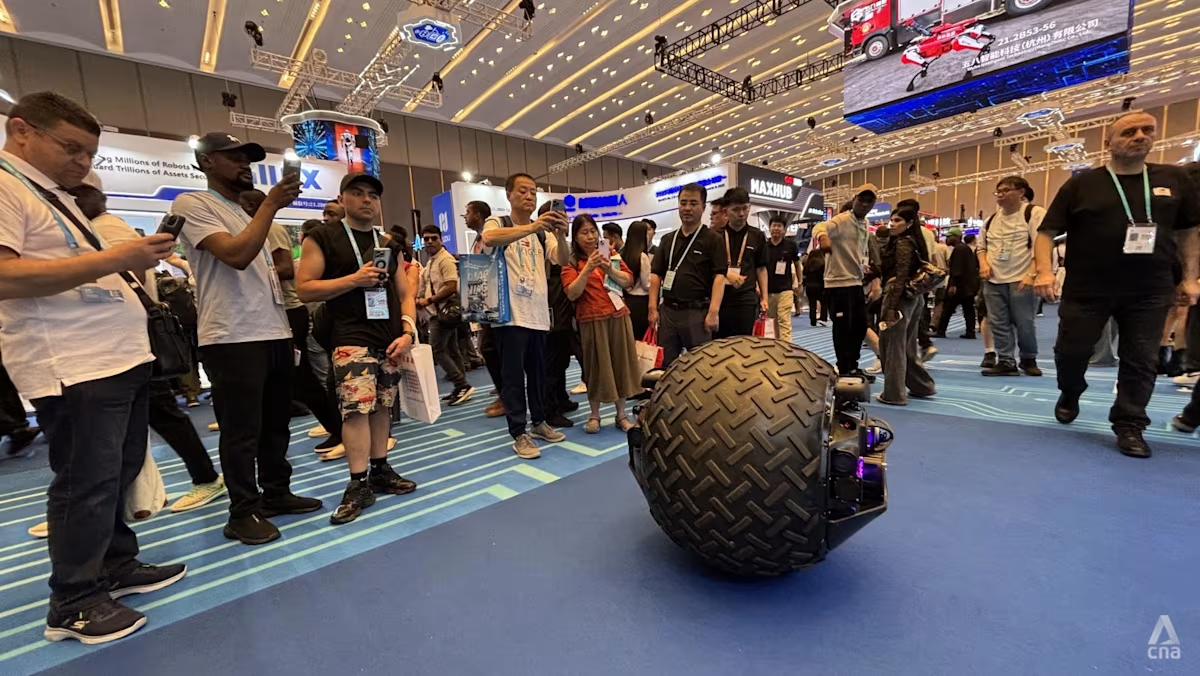
GUANGZHOU: Installing cables on live power lines. Cleaning skyscraper windows hundreds of metres above the ground. Chasing birds away from airport runways.
These are jobs long considered too dangerous, repetitive or labour intensive for humans.
At the Canton Fair in Guangzhou which is China’s largest trade exhibition first launched in 1957 and held twice yearly, Chinese companies are showing how robots may increasingly be able to do them instead – and some overseas buyers are already placing orders for the machines.
Across the exhibition halls of the current spring session running from Apr 15 to May 5, and featuring more than 32,000 exhibitors across various sectors, machines can be seen climbing walls, inspecting power lines and patrolling industrial sites, drawing crowds eager to see how automation could fit into their businesses.
Buyers from Europe, Southeast Asia, the Middle East and Latin America say the technology could help address labour shortages, rising costs and workplace safety risks.
China’s industrial robot exports rose 48.7 per cent in 2025, making the country a net exporter of industrial robots for the first time, according to Chinese customs data.
China is already the world’s largest market for industrial robots, accounting for about 54 per cent of global installations in 2024, with roughly 295,000 units deployed, according to the International Federation of Robotics.
The shift raises a broader question: what could the spread of automation mean for workers around the world?
Kenneth Huang, a professor specialising in innovation and technology management at the National University of Singapore (NUS), said the shift could reshape labour markets but not necessarily through widespread job losses.
“Robotics will significantly reshape labour markets – but not through simple, across the board job destruction,” he said.
GLOBAL DEMAND FOR ROBOTS
Automation is already expected to have a substantial labour-market impact.
The World Economic Forum estimates that 22 per cent of today’s jobs could be created or displaced by structural labour-market changes by 2030, while 41 per cent of employers plan to reduce their workforce where AI can automate tasks, according to its Future of Jobs Report 2025.
China is also among the world’s most automated manufacturing economies. Its factories operate about 470 industrial robots for every 10,000 workers, far above the global average of 162, the International Federation of Robotics said.
For some overseas buyers, the appeal of automation lies in reducing labour intensive work.
Jhonier Jimenez, owner of Colombian construction company Conversion WM SAS, said he was particularly interested in a robot developed by Guangdong Crownpower Electric Power Technology Development (Crownpower Tech) to install connectors on live power lines.
https://www.channelnewsasia.com/east-asia/china-canton-fair-robots-human-labour-replacement-6065156


