






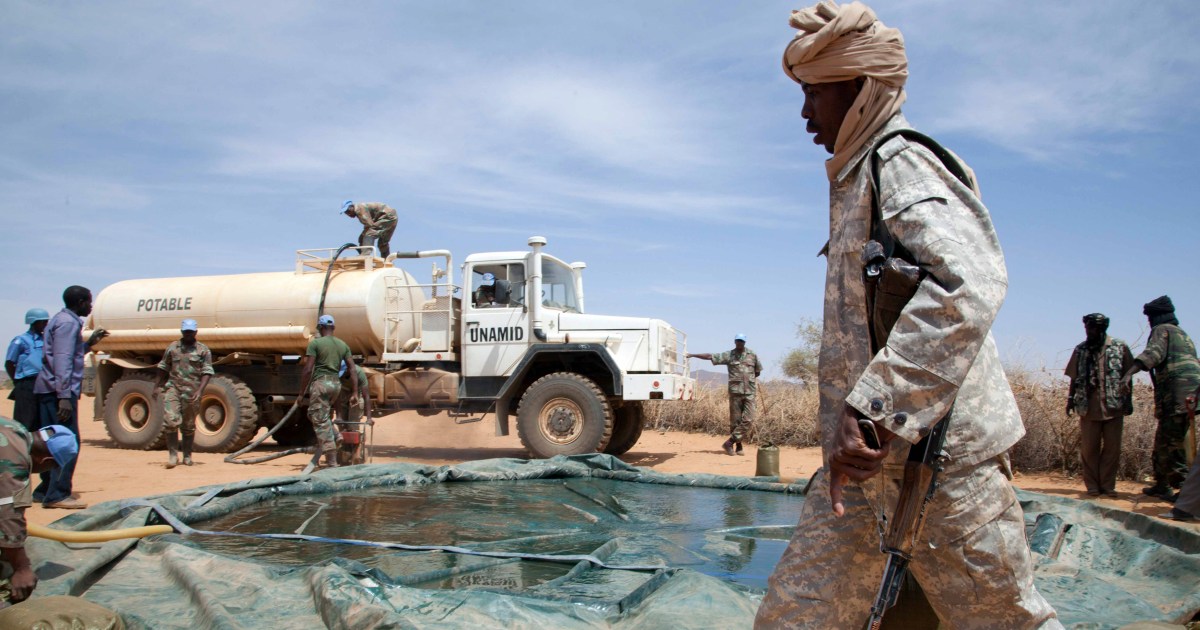
Johannesburg, South Africa – From deadly Cyclone Gezani in Madagascar and surging waterborne disease risks across flood-affected Mozambique, to parched land and herds of dead livestock along the Kenya-Somalia border, the continent is starting 2026 under siege from water‑linked climate shocks – just as African leaders gather for a summit that puts the precious resource at the centre of its agenda.
On paper, the African Union’s choice of water as its 2026 summit theme – with a focus on water as a vital resource for life, development and sustainability – appears apolitical. But experts say it is anything but.
Recommended Stories
list of 3 itemsend of list
“Water is life,” said Sanusha Naidu, a foreign policy analyst at the South African think tank, the Institute for Global Dialogue.
“But it’s not just that water is life – water is becoming a commodity of corporatisation and access. It is a humanitarian conflict. It is a climate change conflict.
“It’s a peace and security issue.”
Water and conflict
Although worsening climate change and the strain it puts on resources is a main pressure point, analysts point to other flashpoints where water and conflict intersect – including upstream-downstream tensions over shared natural resources, water being used as a weapon of war, and big industry claiming water resources at the cost of human beings.
In Africa, water cuts across interstate disputes like Egypt and Ethiopia’s fight over the Nile, deadly tensions between farmers and herders in Nigeria over access to the same arable land, antigovernment protests over failed service delivery in Madagascar, and the outbreak of health epidemics in the wake of major floods and droughts.
It’s really a “multitude” of competing or interlinked factors that are creating a “vicious circle” of challenges people have to deal with, Naidu says, especially in Africa, which is particularly vulnerable to climate change.
With temperature increases in Africa slightly above the global average, the continent faces a disproportionate burden from the climate crisis, according to the World Meteorological Organization and climate experts.
For Dhesigen Naidoo, a senior water and climate researcher with African policy think tank, the Institute for Security Studies (ISS), climate change is now experienced first and foremost as a water crisis.
“We’re talking about floods and droughts and very high energy storms that have been experienced around the world and in Africa with absolutely devastating impact,” he said, noting that “our ability to manage that has really diminished over time as the challenge gets bigger and bigger.”
From desertification to huge flooding, “too much and too little water have the same impact” as they both diminish people’s access to the resource, he said.
This lack of access leads to water scarcity as well as increased food shortages, growing numbers of climate refugees, and the higher prospect of conflict, according to Naidoo.
“If you look at the Sahel and [across Africa], the correlation between the activities of al-Shabab on the east side and Boko Haram on the west side, and the desertification creep, there’s an almost direct correlation [between strained resources and conflict],” he said.
In areas where there is a scarcity of basic resources like water, people are often forced to do whatever they can to survive, Naidoo explains. “And sometimes it leads to very, very bad security outcomes.”
This is evident in northern Nigeria, where an array of armed groups are recruiting among vulnerable local populations, while in the middle belt region, intercommunal conflict between farmers and herders over shared pastoral land resources has turned deadly.
Even away from front-line battles, water scarcity is heightening geopolitical security concerns. Observers point to electricity and water cuts that prompted angry antigovernment protests in Madagascar last year; and this week in South Africa, the country’s Human Rights Commission called for the water crisis to be declared a national disaster, amid protests from many Johannesburg residents who have gone without water for 20 days.


Upstream-downstream Nile tensions
Some water tensions were drawn into the very borders that delineate the continent.
When European powers carved up Africa before, and at the Berlin Conference more than a century ago, they crudely drew lines between tribes, territories, and key water sources.
Across Africa, 90 percent of surface water is in transboundary basins and requires transboundary cooperation or treaties to manage, according to the World Bank.
These include the Senegal and Niger River Basins in West Africa that cover Guinea, Mali, Senegal, Niger and Nigeria; the Limpopo and Orange River Basins in Southern Africa, which cover South Africa, Botswana, Lesotho, Mozambique and Namibia; and the Nile River Basin in the east and north, spanning Ethiopia, Sudan and Egypt.
While the treaties that govern water sharing are operating well in most regions, recent tensions around the Nile have revealed the potential for future upstream-downstream conflict, experts say.
Last year, Ethiopia inaugurated the Grand Ethiopian Renaissance Dam (GERD), its most ambitious infrastructure venture on the Blue Nile, amid tensions with downstream neighbours Egypt and Sudan, which rely heavily on the Nile and fear the Ethiopian dam will threaten their water security.
“The level of tension is relatively high at the moment” between Ethiopia and the downstream countries, particularly Egypt, who were unable to block the dam’s construction, notes Magnus Taylor, the deputy director of the Horn of Africa project at conflict prevention think tank, International Crisis Group.
Beyond the technical operational concerns of the dam, there are also broader tensions, Taylor says, as the GERD marks a historic shift in Nile power relations.
“Egypt fears [the GERD] will challenge both its practical control over the Nile waters but also its broader political hegemony over the Nile basin,” he said.
That tension is then dispersed and “translated through other political and security situations which have been influenced by the GERD issue,” the analyst noted.
He points to the advantage that Egypt’s backing of the Sudanese Armed Forces in Sudan’s ongoing war has created for Cairo in ensuring Sudan supports its view on the GERD.
Separately, Cairo has also diplomatically courted Eritrea, Ethiopia’s northern neighbour with which it has contentious relations, he said, while Egypt has also offered security support to Somalia when Ethiopia pursued a sea access deal with the breakaway rival region of Somaliland.
Water as root, site, weapon of war
Taylor says that while the world is not yet seeing outright “water wars”, water disputes are nevertheless shaping and intensifying other conflicts across the Horn of Africa.
For ISS water expert Naidoo, “the notion of an inter-country conflict based on water is a very real thing,” and upstream-downstream tensions escalating into conflict are “a possibility in several parts of the world and certainly in several parts of Africa”.
The Egypt-Ethiopia tensions are currently the clearest example of a historically hegemonic downstream country now having to play by the rules of an upstream country that has asserted itself, he said. But “many very big economies in Africa”, like Nigeria, South Africa and Senegal, are also downstream countries, he points out.
“On the Niger River, Nigeria is a downstream country and currently has very poor relations with its northern neighbours, Mali and Niger. And that is a very serious issue about an upstream-downstream dynamic that might mimic what is currently happening between Ethiopia and Egypt,” Naidoo said.
Water has historically been a source of conflict, he argues.
“The art of war around water is well honed into the psyche of human beings,” said Naidoo, who remarks that the first-ever resource wars in prehistoric times were fought over water and food – even long before oil.
But more than just the root and reason, experts say water is sometimes used as the weapon itself.
Naidoo pointed to the wars in Sudan and Gaza as current examples “where there is a very high level of the weaponisation of water currently under way”. In both places, civilians suffer deprivation as supplies are blocked and water sources are targeted in armed attacks.
“We have, for a very long time, organised ourselves to have an informal agreement that all parties in any conflict would not weaponise water. But events are teaching us that people are quite happy to go back on that,” the water expert noted.
At the same time, technology is another factor putting strain on people’s access to water. Communications infrastructure and AI data centres all require industrial-scale amounts of water for cooling, putting more strain on the supplies that people rely on.
This means the prospect of water conflicts “will probably get a lot worse”, Naidoo said.
“We have organised ourselves to develop economies that are very highly dependent on regular water supplies. And so small perturbations in the system – being without water for three days – is cause for conflict,” he remarked.
“You can’t tolerate it because you actually can’t do without it. Not just personally on your own consumption, but because everything that works around you has a water dependency.”


Who is responsible?
The scale of challenges is concerning for experts and observers, and many feel those in leadership positions have not done enough to mitigate the crisis.
The AU’s decision to put water at the centre of its 2026 summit this weekend is important, yet overdue, Naidu says.
She says the continental bloc and national governments have known about the emerging water crisis for years, but have largely failed to act at the necessary scale.
She also argues that the responsibility lies not only with governments, but also with local officials, corporations that exploit and pollute, and consumers and civil society, who must change their behaviour and demand accountability.
Crisis Group’s Taylor says the AU may issue a communique at the summit, but because of the limited remit of the AU, this is unlikely to translate into any binding continent‑wide water agreements that can be enforced.
Al Jazeera reached out to the AU with questions about this year’s summit, but received no response.
For ISS’s Naidoo, treaties and agreements have a place, but power also lies with national governments, who can work to support and scale up real solutions already being produced at ground level.
He sees a silver lining in African innovation projects, including non‑sewered sanitation systems, which treat waste on-site through biological, chemical, or mechanical processes that rely less on water, or projects like the “overhead aqueduct” system in Kenya’s Kibera, which offers a way for areas without traditional underground piping to get clean water to residents of the Nairobi slum.
These examples show that Africa is not only a victim of the water crisis, he said, but also a source of potential solutions and a space where the continent can exercise Global South‑led leadership.
Getting water right is a non-negotiable, “social, humanitarian, economic, and security” issue, Naidoo said.
“The conundrum is that Africa has a very high level of tolerance to certain things, like the lack of services or lack of decent sanitation. Part of the reason why we don’t make progress in this domain is because it’s kind of accepted,” Naidoo said.
“But you can’t be tolerant of having no water,” he warned, “or you will die.”

https://www.aljazeera.com/news/2026/2/13/are-african-water-wars-on-the-horizon-as-au-puts-the-issue-on-its-agenda?traffic_source=rss


