






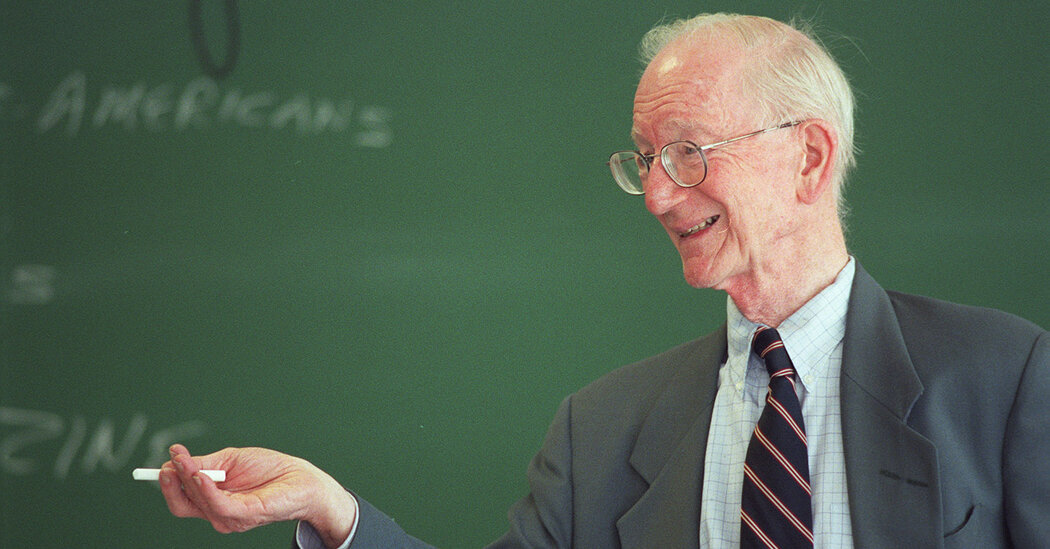
Andrew Hacker, a scholar of political science who wrote a host of provocative books on education, race relations and what he called a growing chasm between women and men, died on Tuesday at a hospital in Manhattan. He was 96.
His wife, Claudia Dreifus, said the cause was complications of stomach cancer.
To say that Professor Hacker, who taught at Queens College for over 50 years, was a contrarian hardly captured the audacity of his attacks on conventional ideas. He declared that colleges were failing to educate students and that high school math was a waste of time. He called men selfish, and said a war between the sexes was intensifying. He argued during the Vietnam War that the United States was falling apart or ungovernable, or both.
He wrote more than a dozen books and scores of book reviews and essays for The New York Times and The New York Review of Books, touching on the Kennedy family, Ronald Reagan, the national census, journalistic controversies, advertising, poetry, the cultural influence of movies, the terrors of the Internal Revenue Service and the joys of Marx and Lenin for beginners.
Whatever the subject, Professor Hacker’s ideas were usually iconoclastic and, to some, annoying. As he told visitors to his (now defunct) book website, themathmyth.net, “I combine information, analysis and irritation, all intended to get readers thinking.”
Reviewers fell into two camps over his books. Detractors called his statistical evidence questionable, his methodology dubious and his writing didactic and hyperbolic. But admirers found his prose eloquent, even passionate, in defense of women and minority groups, and said that his analyses, especially on racial issues, were persuasive and inventive.
“Andrew Hacker is a political scientist known for doing with statistics what Fred Astaire did with hats, canes and chairs,” Newsweek said of his book “Two Nations: Black and White, Separate, Hostile, Unequal” (1992). “He doesn’t crunch numbers; he makes them live and breathe. But who would have thought that even Hacker could turn up a dollar figure for what it’s worth to be born white? If you’re curious, it’s $1 million. A year. For life.”
He extracted that number with a Kafkaesque parable he presented to his students: A government official visits a white student and tells him that at midnight “you will become Black,” with dark skin and African American features, “unrecognizable to anyone you know,” although “inside you will be the person you always were.” The official offers compensation, and asks how much the student wants.
Most students, Professor Hacker reported, asked for $1 million for each year that they presented as Black.
“To be white is to possess a gift whose value can be appreciated only after it is taken away,” he wrote. “The money would be used, as best it could, to buy protection from the discriminations and dangers white people know they would face once they were perceived to be Black.”
Tom Wicker, in a review for The Times, noted that Professor Hacker had devoted five years of study and statistical analysis to the book, and hailed the author’s thesis that the nation had never given Black Americans “a chance to become full citizens.” But the conservative columnist John Leo, in U.S. News and World Report, said that “Hacker’s prose reflects the ossified thinking of an older white liberal elite.”
Professor Hacker’s “Mismatch: The Growing Gulf Between Women and Men” (2003), argued that the gender gap had become an abyss.
“There is a greater divide between the sexes than at any time in living memory,” he wrote. “The result will be a greater separation of women and men, with tensions and recriminations afflicting beings once thought to be naturally companionable.”
Michiko Kakutani, in The Times, called it “a glib, didactic book that uses sometimes dubious methodology to ratify women’s worst fears about dating and marriage and the opposite sex,” adding that Professor Hacker “focuses almost exclusively on those statistics that back up his thesis, presents the familiar or obvious with an air of revelatory zeal and glosses everything with speculative hyperbole.”
Professor Hacker’s more recent writings examined education. He collaborated with Ms. Dreifus, his partner (and later his wife) and a writer for The Times, on “Higher Education? How Colleges Are Wasting Our Money and Failing Our Kids — And What We Can Do About It” (2010), in which they argued that colleges were failing their teaching mission because of encroachments from research commitments, tenure, athletics and other interests.
With a 2012 guest essay in The Times — under the headline “Is Algebra Necessary?” — Professor Hacker touched off another lively debate. While acknowledging that basic math is a significant part of education, he said that nearly all high schoolers would never need algebraic algorithms in later life, and that many would fail the required subject and drop out of school in frustration. He proposed its elimination.
He extended his argument in a follow-up book, “The Math Myth and Other STEM Delusions” (2016). It denied that all careers in science, technology, engineering and math require higher math skills. He said algebra and calculus might not be necessary, even for many scientific careers. Alternatively, he proposed courses in “numerical literacy,” or adult arithmetic.
The book “certainly stirred up the math establishment,” wrote A.K. Whitney in The Atlantic. But she argued that dropping difficult math would send the wrong message.
“The teenage me,” she said, “would have rejoiced outwardly at no longer being forced to deal with functions, but inwardly it would have been the confirmation of my groundless fears: Sorry, you’re just too stupid to even try this.”
Andrew Hacker was born in Manhattan on Aug. 30, 1929, the older of two children of Louis and Lilian (Lewis) Hacker. His parents were on the Columbia University faculty, his mother as a Teachers College lecturer, and his father as an economics professor who wrote “The Triumph of American Capitalism” (1940).
Andrew and his sister, Betsy, grew up in a home where politics and current events were everyday topics of discussion. He attended the progressive Lincoln School through the 10th grade, and then transferred to Horace Mann in the Bronx, where he wrote for the school newspaper and graduated in 1947.
In an interview for this obituary in 2018, Professor Hacker attributed his career choices largely to the influence of a professor at Amherst College, whom he did not name.
“He was more than a role model,” he said. “He was a human model. There is a whole lot about him inside me, in terms of character and personality, a certain cynicism perhaps, an inflection in the voice. In some portion, I became that person. He’s why I became a teacher.”
A political science major, he graduated from Amherst in 1951, from Oxford with a master’s degree in 1953 and from Princeton with a doctorate in 1955. He then joined Cornell as a lecturer, rose to full professor in 1966 and joined Queens College in 1971.
“I looked at myself in the mirror one day and decided that I didn’t want to spend the rest of my life in an Ivy League school,” Professor Hacker recalled. After 16 years, the transition to the melting pot of Queens College was, in his word, he said, “the ultimate.”
“The Cornell students were smarter, but the Queens students were hungrier,” he went on. “The administration at Queens said to me, ‘You want to come here?’ They couldn’t quite believe somebody would want to leave Cornell.”
In 1955, he married Lois Sheffield Wetherell. They had a daughter, Ann. His wife died in 1967. In 2003, he and Ms. Dreifus became domestic partners and were married in 2011. He lived in Manhattan. In addition to his wife, he is survived by his daughter, Ann Gower, and his sister, Betsy Dexheimer.
Professor Hacker agreed in 1996 to give up tenure and salary at Queens if the college hired two assistant professors to take his place. He became a pensioned professor emeritus and continued to teach there until December.
In “The End of the American Era” (1970), Professor Hacker portrayed a nation mired in Vietnam and declining into oblivion. “I must reject his fundamental thesis that ‘America’s history as a nation has reached its end,’” John Barkham wrote in a review in The New York Post. “Though we are living in a time of troubles, we will survive them as we survived such times before.”
Professor Hacker’s last book was “Downfall: The Demise of a President and His Party” (2020), an analysis of what he predicted would be the mutual self-destruction of Donald J. Trump and the Republican Party. At his death, he was at work on a project about Thomas Jefferson, Alexander Hamilton and their conflicting ideas about America’s future.
Among his book reviews for The Times was a 1979 look at “Marx for Beginners” and “Lenin for Beginners.” He called the Marx book “magnificent,” and the one on Lenin “skillfully done.” The texts, he noted, were accompanied by illustrations, almost like comic books.
“Materialism, dialectics, determinism are all succinctly explained,” Professor Hacker said. “We see a cave man hewing at a wheel, and are informed that he is engaged in making history. Naturally, there are omissions. The book ends with the proletariat seizing power.”
https://www.nytimes.com/2026/04/21/books/andrew-hacker-dead.html


