


Earlier this year, a group of OpenAI employees convened in a private chat to discuss the latest thing Sam Altman, OpenAI’s chief executive, had posted to social media. It was not the first time they had done so.
The chat, which two people said they jokingly referred to as “Making Sam’s Tweets Reality,” nodded to their boss’s proclivity for announcing OpenAI’s plans on social media, where employees often found out about his ideas at the same time as the rest of the world. It was where they discussed how to build the surprise products he posted about. At Mr. Altman’s behest, OpenAI spent years pursuing any and all artificial intelligence projects, buoyed by billions in investment and its reputation of having a multiyear technological head start.
Now things have changed, with stiffening competition from rivals like Anthropic, Google and even Elon Musk’s SpaceX. Mr. Altman has felt the heat — and has decided to shift strategy.
In the past few months, OpenAI has culled projects it sees as “side quests” — a term describing nonessential tasks in a role-playing game — including its video generator, Sora. It has instead doubled down on moneymaking endeavors like coding tools that can be sold to businesses. The goal, insiders said, is to be more disciplined in the face of intensifying competition as OpenAI prepares for a potentially blockbuster initial public offering as soon as this year.
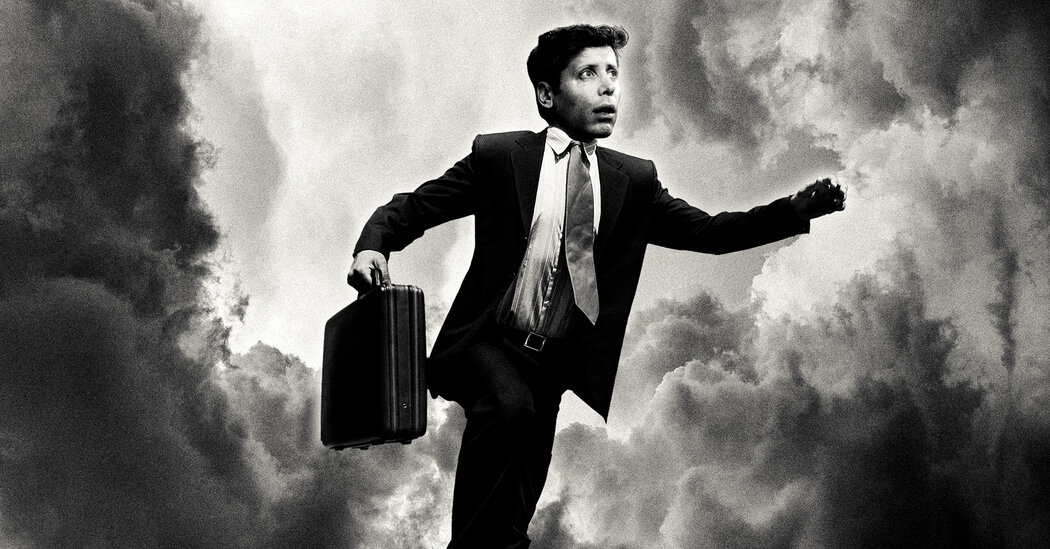
The moves test the leadership of Mr. Altman, 41, who has faced rising criticism over OpenAI’s direction and his mutable management style.
“The same company trying to push the frontier of A.I. is also being asked to show financial discipline,” said Brad Gastwirth, the global head of research at Circular Technology, a market intelligence firm. “That’s not an easy balance.”
OpenAI remains a leading A.I. lab that has raised more than $122 billion over the past year, is valued at $852 billion and has struck a series of deals with industry giants like Amazon and Nvidia. Its revenues have ballooned to an “annual run rate” of $24 billion, which is an estimate of long-term revenue based on short-term data, and more than 900 million people regularly use its ChatGPT app.
But others have caught up. Google has placed A.I.-powered features at the forefront of its widely used products. SpaceX, which aims to build A.I. data centers that “orbit the Earth,” said this week that it was working with Cursor, an A.I. start-up, to improve its A.I. models.
Perhaps most threatening is Anthropic, the San Francisco A.I. company that has built a booming business selling coding tools to individuals and businesses. This month, Anthropic said its annual revenue run rate surpassed $30 billion, up from $9 billion at the end of 2025. Almost every week, it is releasing new A.I. products that have rocked longstanding software companies.
An OpenAI spokesman declined to comment or make Mr. Altman available for an interview. The chief executive may be busy with other matters before a trial opens in federal court next week in Oakland, Calif., over a 2024 lawsuit that Mr. Musk filed against him. Mr. Musk has claimed that Mr. Altman violated OpenAI’s founding contract by putting commercial interests with A.I. over the public good. OpenAI has denied the accusations.
“We want to be a platform for every company, scientist, entrepreneur, and person,” Mr. Altman said in a social media post on Thursday announcing OpenAI’s latest A.I. model. “We want our users to have access to the best technology and for everyone to have equal opportunity.”
(The New York Times has sued OpenAI and its partner, Microsoft, accusing them of copyright infringement of news content related to A.I. systems. OpenAI and Microsoft have denied those claims.)
When OpenAI released ChatGPT in 2022, the chatbot swiftly topped download charts and smashed growth records. The momentum gave Mr. Altman the leverage to attract billions of dollars in investment and to lure top A.I. talent.
It also lulled him into a false sense of security, which allowed for distractions, six current and former OpenAI employees said. Friends and colleagues described Mr. Altman as someone who enjoys chasing “moonshot-like” products, even if they prove costly or impractical.
OpenAI soon jumped into many eclectic projects. One team worked on building a “not safe for work” chatbot that could engage in racy conversations with users. Another team spun up a stand-alone social network, where people could generate A.I. videos and share them across the internet. Still another team was charged with developing ways for A.I. to accelerate scientific research.
Then, over the past 18 months, OpenAI’s head start evaporated as Google, Anthropic and others came on strong.
“The landscape continues changing so quickly, and so unexpectedly, that sentiment for different companies can flip-flop practically overnight,” said Rayan Krishnan, the chief executive of Vals AI, an A.I. start-up.
Late last year, OpenAI’s executives snapped into action. The company hired Fidji Simo, the chief executive of Instacart and a former Facebook vice president, to become its chief executive of A.G.I., for artificial general intelligence, deployment. In practice, Ms. Simo became the company’s day-to-day operator and has helped Mr. Altman streamline strategy, three current and former employees said.
“We really have to nail productivity,” Ms. Simo said in internal messages to employees that were relayed to The Times. She emphasized how important it was to catch up in areas that competitors like Anthropic were dominating, characterizing the situation as a “code red.”
In recent months, Mr. Altman, Ms. Simo and Sarah Friar, OpenAI’s chief financial officer, reviewed the company’s projects to figure out what was and was not working, three people said.
They settled on investing resources in Codex, OpenAI’s enterprise coding product, with the idea that they can sell coding tools to businesses, while streamlining parts of ChatGPT to create what Ms. Simo characterized as a “super app” for desktop computers. They are also building advertising products inside ChatGPT. The Wall Street Journal previously reported on plans for the app.
Not everyone is joining OpenAI’s next phase. Three executives announced their departures last week after Mr. Altman wound down or reorganized parts of the company, including some science initiatives and Sora. Some top executives have expressed reservations as to whether OpenAI will be ready for an I.P.O. this year, two people familiar with the internal discussions said.
Last month, OpenAI gave employees a week off so they could avoid burnout, two people familiar with the matter said. Other current and former employees characterized the time off differently: the calm before the storm.
https://www.nytimes.com/2026/04/24/technology/sam-altman-openai-money.html
