


Richard Gadd has a type. Two types, actually.
The first is a cowardly, guilt-ridden, self-hating prevaricator who is supremely passive-aggressive and careless of other people’s lives. He is tortured by his sexuality and dishonest about it with everyone, especially himself. He thinks that everything should revolve around him, and he is at the center of the bleak, morbidly comic tales that Gadd writes.
The second is a monster — an unhinged, unbridled force of nature whose libidinous rage both terrifies and seduces the protagonist. The two characters come as a pair because they’re inseparable: two halves of a troubled whole, superego and id, Eros and Thanatos, Abel and Cain, Dr. Jekyll and Mr. Hyde.
That might seem like a lot of conceptual weight to put on a television show about a struggling London comedian and his stalker (the 2024 Netflix mini-series “Baby Reindeer”) or on Gadd’s new series, “Half Man,” about the entwined lives of a Glasgow writer and his violent childhood friend (premiering Thursday on HBO).
But it is key to Gadd’s method, which is not dramatic in any very coherent fashion. His approach is fable-like and polemical; his characters and their actions — the betrayals, the deceptions, the agonies, the beat-downs — make sense only in that archetypal framework.
I was not a big fan of “Baby Reindeer,” Gadd’s breakout hit. Jessica Gunning gave a heroic performance as the sociopathic stalker, Martha, but the show’s ballyhooed transgressiveness floated on a thin bed of sentimentality. And its determination not to take a point of view on Donny, the troubled comedian and abuse victim played by Gadd (and based on his life), meant that the only thing about him that fully registered was his victimhood. (Which may have something to do with why critics and audiences were so taken with it.)
But the series, which Gadd had adapted from an autobiographical stage show, was polished and cleverly constructed. And it clipped along, in seven shortish episodes that clocked in at under four hours; his downbeat, neurasthenic comic sensibility and slender stock of ideas were sufficient for the show’s ambitions.
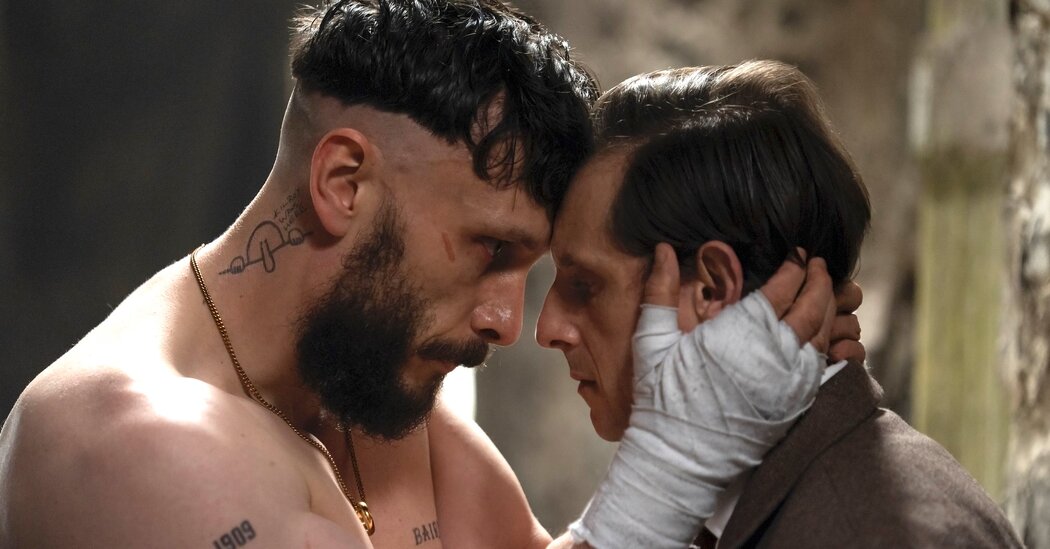
“Half Man” repeats the mouse-and-lion dynamic of “Baby Reindeer,” with several significant differences. Gadd has scaled up, to six episodes averaging more than an hour each. And he has handed off the central role of the nonconfrontational writer, Niall: Mitchell Robertson plays him as a high school and college student, and the formidably talented actor Jamie Bell (“Billy Elliot,” “Film Stars Don’t Die in Liverpool”) plays him as an adult.
Gadd moves over to the monster role, playing Niall’s feral stepbrother, Ruben, the son of Niall’s mother’s lesbian partner. (Ruben delights in the phrase “brother from another lover.”) Fans of “Baby Reindeer,” in which Gadd’s lanky frame emphasized Donny’s fragility, may not recognize him — he has new muscle and a striking haircut, and he towers over the 5-foot-7 Bell like a Viking warrior.
Ruben and Niall are boyhood roommates and lifelong frenemies rather than stalker and stalked, but their relationship is as fraught, in its own way, as that of Martha and Donny. Ruben has as little control over his anger and brutality (which he uses in protecting Niall from teenage bullies) as Martha did over her obsessive jealousy. Ruben’s violence recurs through the years in ways that are damaging to both him and Niall. That the deeply closeted Niall is both terrified of Ruben and besotted with him further complicates every stage of their lives.
Ruben is essentially a glowering stereotype of male insecurity, anger and violence — half man, half beast — but he has style, and his swagger and assurance can make him amusing to watch. Both Stuart Campbell, as the young Ruben, and Gadd have fun with the role’s lighter side. After Ruben has “read some books” in prison and is eager to impress Niall, Gadd gets to deliver such unlikely mots as, “You might be the painter, but I’m the rolling hills.”
Niall is more complicated but less interesting and, worse, less entertaining. Like Donny in “Baby Reindeer,” he’s an antihero whose travails are largely of his own making. But he doesn’t have Donny’s sweaty, squirmy energy, and as the show drags on and he makes one catastrophically selfish decision after another, he becomes increasingly unlikable. Bell has the skill to make Niall credible; that he can’t make you muster up much feeling for him is the script’s problem, not his.
Other roles from “Baby Reindeer” have counterparts in “Half Man”: the person the protagonist loves but is ashamed to be with, now a gay man (engagingly played by Charlie de Melo as an adult and Bilal Hasna as a teenager); and the sensible woman the protagonist takes advantage of, now a college flatmate (Julie Cullen and Kate Robson-Stuart). Neve McIntosh, who plays the green-skinned private detective Madame Vastra in “Doctor Who,” brings a weary charm to the role of Niall’s mother.
Gadd has a knack for creating appealing, recognizably human side characters. But they can’t make up for the lack of substance at the center of “Half Man.” Life certainly can seem like a constant test of a man’s virility, but Gadd’s dramatization of that notion doesn’t have enough resonance — as drama it’s fussy and overwrought and as dark comedy it’s lightweight and inconsequential. The occasional jolts of sex and violence only emphasize the overall superficiality. It’s probably not a good sign when the only people you care about in a show are the ones your hero mistreats.
https://www.nytimes.com/2026/04/22/arts/television/half-man-review-richard-gadd.html
