


And of course, Michael never got to be a kid, really, because Joe took that away from him. So as an adult, he is always seeking out children. But the movie knows what you’ll think, instantly, about that. So there are many scenes — many scenes — in which he visits children in hospitals to distribute toys and comfort, and is observed from a doorway by someone else, who gently smiles.
This Michael is flat, barely human. Hagiography is the standard mode in which all estate-involved biographical movies work, documentary and fiction alike, the implication being that audiences can’t handle any hint that a figure might not be a saint, or at least a saintly victim. The notion that a human — someone who gets angry or bitter or has a bit of an ego on them — is inherently easier to relate to, far more believable and ultimately more lovable, seems lost on most filmmakers.
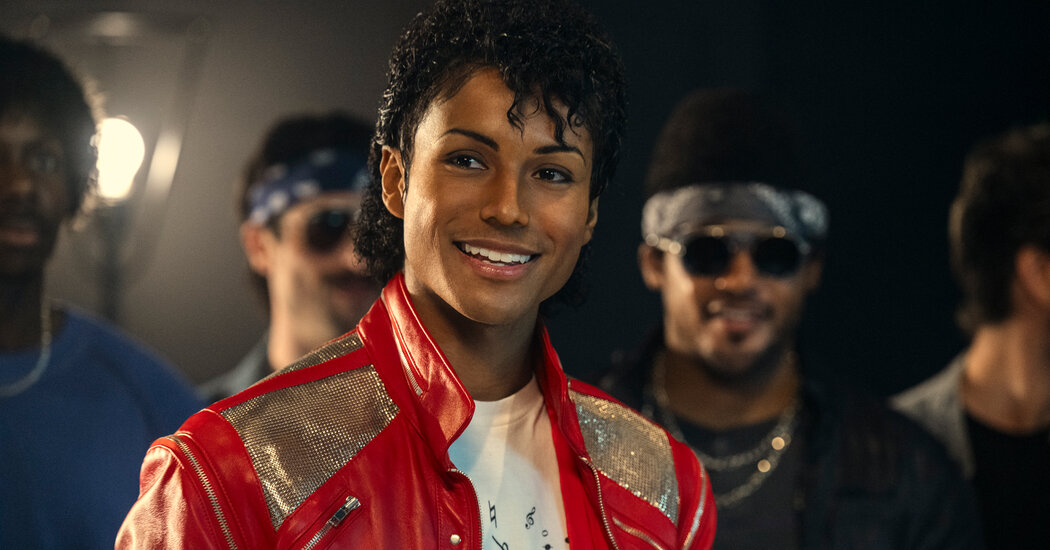
Here, what we are left with is a string of musical set pieces, like a greatest hits album, performed ably by the stars — in his debut role, Jaafar Jackson dances like he is possessed by his uncle’s talent — but strung together in repetitive false-note ways that are insulting both to audience and subject.
Because of course, any life sounds like a triumph if you end the story right before things get tough. The movie omits the really hard stuff that plagued Jackson; his scalp surgery after experiencing third-degree burns in 1984 now becomes mostly a driver of his success and determination to “shine my light, to spread love and joy, to heal,” but we never witness the painkiller addiction that grew from it. If you didn’t know better, you’d think Jackson, who died in 2009, played Wembley in 1988 and never had another problem in his life.
The movie itself becomes a tale of triumph and glory for someone everyone admired, rather than an estate’s attempt to scrub clean the life story of a star who has been multiply accused, in harrowing terms, of child sexual abuse. That same estate is the reason that an HBO documentary that gives space for two men who have accused Jackson to tell their story has been deleted from its streaming platform; you can’t watch it, because it might as well not exist.
The three-ring media circus that surrounds every celebrity gives us versions of them we can choose to believe in. “Michael” aims to deliver a version of Michael Jackson that, strangely enough, conforms to what the movie’s version of Joe Jackson wanted all along: a perfect child, a top-notch performer and certainly nothing more than that. In this business, you can make up just about anything.
Michael
Rated PG-13 for scenes of beating a child with a belt, a perilous stage fire and some bad language, mostly from a record executive. Running time: 2 hours 7 minutes. In theaters.
https://www.nytimes.com/2026/04/21/movies/michael-review.html
