


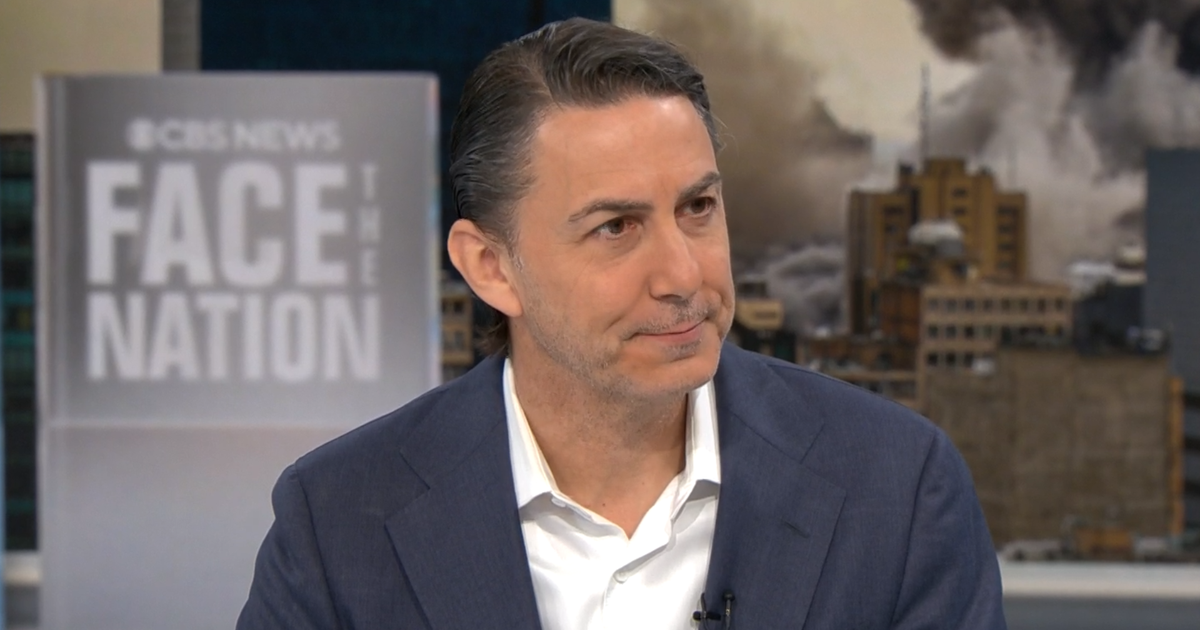
The following is the transcript of the interview with Amos Hochstein, Biden administration senior energy adviser and Middle East negotiator, that aired on “Face the Nation with Margaret Brennan” on April 19, 2026.
MARGARET BRENNAN: And we’re joined now by Amos Hochstein. He was a former Biden White House senior energy advisor and Middle East negotiator, and he’s now managing partner at the investment firm TWG global. Good to have you back here.
AMOS HOCHSTEIN, MANAGING PARTNER, TWG GLOBAL, FORMER SENIOR ENERGY ADVISER TO PRESIDENT BIDEN: It’s great to be here.
MARGARET BRENNAN: So President Trump said current gas prices are not very high, but regular gas costs are averaged like $4.05 a gallon. Last time we saw that was under the Biden administration when Russia invaded Ukraine. So if you were advising President Trump today, how do you make sure this spike isn’t long lasting?
HOCHSTEIN: Well, we’re over $4 now, because we have a real disruption. In the Russia invasion of Ukraine, we had a concern of a disruption that never actually happened, and it went all the way up to $5. For the President right now, any continued duration of closure of the Straits of Hormuz will have to have a spike in prices. We’re at a- when you have an energy crisis like the Strait of Hormuz. It’s very slow moving, and then it’s like falling off a cliff, because when you close a strait, the world still has all the tankers that were on the water before, and that take- could take 25,30 days to get to their destination. But right now, there are no tankers on the road, on the- on the seas to Asia and to Europe. So we’re getting to the point now where certain countries no longer have any fuel, no longer have jet fuel. Now those are poor countries, and now middle income countries, but that eventually comes to the U.S. So he’s got a couple of weeks before this can go much higher.
MARGARET BRENNAN: But he’s got to get a deal quickly, in other words.
HOCHSTEIN: He’s got to get a deal quickly.
MARGARET BRENNAN: So, because we are seeing all these economies get hit. I mean, in Europe, they’re saying jet fuel is only a few weeks- there’s only six weeks left or so. Secretary Bessent said he expects a price drop sometime between June and September. Is that realistic?
HOCHSTEIN: I think what- right now, what they’re doing in the administration is saying things further out to say, Okay, we’ll deal with that in June. If we get to June, prices are high, we’ll say it’s August to November.
MARGARET BRENNAN: They’re trying to talk the markets down.
HOCHSTEIN: They’re talking the markets down as if the straits are closed- you talked about Europe. Certain Asian countries are already canceling flights. They don’t have any jet fuel. They’re running out and probably two to three weeks at most, before large parts of Asia. But remember Margaret. When a plane leaves the United States, they can’t take jet fuel with them. The administration has been saying, we have plenty in the U.S., great. But if you leave the U.S. and there is no jet fuel on the other side. So what happens is the fuel surcharges that Americans are going to see, that are already starting to see, and ahead of Memorial Day in the summer, tickets are going to be very expensive. When jet fuel is expensive in the rest of the world. It is also expensive here.
MARGARET BRENNAN: And we saw Spirit Airlines really struggling under that with the bankruptcy issue. Let me ask you about your Mideast experience here. In July 2024 Secretary Blinken claimed Iran was one or two weeks away from having enough fissile material breakout capacity to eventually make a weapon if Iran had decided to do so. There were indirect negotiations that the Biden administration did, but it went nowhere. So when President Trump argues that he did, when no other president would, is it just simply that the bill was coming due and it fell on his watch?
HOCHSTEIN: I do think there’s a certain element to that, and that’s why I was supportive of President Trump joining in in June to take the strikes that we had thought internally in the Biden administration, we may have to take if there was a second term. We thought that the spring, summer of 2025 was probably, we may have to be there in the same place. And we did, we did war games. We did some practice runs on what it would look like to look into it, because that may have had to happen under our watch as well. But we- he said, we obliterated their nuclear program. The question then is not about what he did in June, this war we were in now, did not attack the nuclear facilities, again. This was not about the nuclear, so the question now becomes, can you do a deal with the Iranians? And the maximalist positions that both sides have are right now very far apart, despite all the rhetoric that we’re we’re almost there, or we are there, but if we’re not there, we’ll bomb the hell out of them.
MARGARET BRENNAN: Right, or who knows who’s going to show up or not show up from the Iranian side to negotiate with. I thought that was interesting, that the ambassador acknowledged that.
HOCHSTEIN: Well, look, Margaret, when you have a negotiation that’s being done loosely, right? Phone calls and no real paper, you get to a point where Iran says Lebanon was included. The U.S. says, no, it wasn’t. The Iranians say we’re opening the straits because it’s completely open, and the Americans say, no, the blockade is staying. There’s no- if there’s no paper, no serious negotiation on this, and we’re trying to do it really quickly to assuage markets. Then you get to these misunderstandings, and now we’re in a worse position. This is a very serious issue, and I think it shouldn’t take just three days to do a nuclear deal. It’s really, really critical. But if the straits are not opened soon, the leverage that they have, and my concern is, no matter how the war ends, the Iranians now have a card they never had before in practice. In theory, we knew they can close the straits, but they never did, and now, for the foreseeable future, they have this card against us and against their neighbors.
MARGARET BRENNAN: Why do you think President Trump isn’t deploying his top diplomat and his national security advisor? Why aren’t we seeing Secretary of State Rubio leading on this?
HOCHSTEIN: That’s a mystery that I think many in the region and around the United States are asking, why is this not being run by the Secretary of State who’s also his national security advisor. Maybe the secretary of state doesn’t believe that this is the right approach. I don’t know you. You have to ask him if you can get him to answer that question.
MARGARET BRENNAN: We would love for him to join us.
HOCHSTEIN: I’m sure you would. But that’s- that’s a real mystery. Look, the Vice President of the United States–
MARGARET BRENNAN: –But does it show you know when you’re going to the negotiating table? The Vice President going is important because the last two times Witkoff and Kushner showed up with the Iranian delegation, the talks fell apart. In fact, they ended in bombing. So you need someone who wasn’t there the last two times it failed, right?
HOCHSTEIN: And you need someone who is senior enough that the Iranians believe speaks for the President. So I think that it’s important that the Vice President or someone go. I think it would have been great if we can get to a point where you have preparatory talks, and you send the vice president at the end of the process, in order to break the log jam.
MARGARET BRENNAN: I want to pick up on Lebanon, you brokered that 2024 ceasefire in Lebanon on Friday this past week, we saw the President announce 10 days of pause to halt the fighting between Hezbollah and Israel, which is basically linked to the big deal he really wants to get to with Iran. What do you make of this truce?
HOCHSTEIN: So a few things. One, I’m glad to see that the fire is halted, even if it’s a pause. The worrisome part is that it was seen as a ceasefire that was brokered by Iran by insisting on a Lebanese ceasefire before they would show up to talks in Pakistan. That’s a disaster, because the one thing we have always been emphasizing, Iran does not control Lebanon. It is none of their business what happens in Lebanon. Hezbollah has been unmasked in this conflict over the last couple of years as not really a Lebanese fighting organization, or terrorist organization, as they claim. But rather they said, we are doing this at the behest of the Iranians. And so allowing the Iranians to dictate terms is not a good thing. However, direct talks between Israel, even at the lower level, at the ambassador level, is a good development. Most of the Lebanese people want to see a lasting ceasefire, even if they don’t want to see a peace agreement. They want to see agreement, they want to see end of conflict, but we have to have a serious effort here. There’s such a great moment of opportunity. It will not be a moment of opportunity if Israel is occupying a significant part of Lebanon to re-establish a buffer zone. That won’t work, because ultimately that will help Hezbollah reestablish its political footing and their narrative. So we have to get to the table, create a- make sure Israel withdraws from Lebanon, stop the fighting and give the actual help to Lebanon to disarm Hezbollah. They cannot do it on their own.
MARGARET BRENNAN: This is what I asked Ambassador Waltz on that, can they do that. And to be clear, the Israelis have said not only that they’re going to stay in southern Lebanon, but also take some of the territory that they had seized after Assad fell in Syria. So it’s is serious negotiation that has to take place.
HOCHSTEIN: This is a tactical victory for Israel that will lead, once again, an overreach, that will lead them to lose more ground.
MARGARET BRENNAN: I want to ask you, as a Democrat, there was this extraordinary vote this past week in the Senate. Forty Senate Democrats tried to block a U.S. weapons sale to Israel, and that adds to this growing rift we have seen between your party and Benjamin Netanyahu. Do you think Democrats are going to come to regret this break in the alliance?
HOCHSTEIN: So I hope that it’s not a break in the alliance. I think this, what it really demonstrates is for the last several years, Prime Minister Netanyahu has sacrificed Israel’s interest in the United States. The most important asset the Israel has is not its military or its intelligence. It’s the relation, it’s the special relationship with the United States that has been bipartisan for so many decades. He has destroyed that because he has decided to become not just part of the Republican Party, but he’s decided to become just an appendage of Donald Trump. And so every Democrat now sees, if you want to be Trump, great, if we’re anti-Trump, then by de facto, we are against you. I think this is a lot to do with Bibi Netanyahu and his extremist right-wing government, and not to do with Israel. Look, you have half of Israel is voting against Bibi. So I think this- Democrats should be aligning with Israel, not with Bibi. But I think this is a very big wake up call this week, that vote.
MARGARET BRENNAN: Significant vote. Amos, thank you for your insights.
https://www.cbsnews.com/news/amos-hochstein-energy-middle-east-face-the-nation-transcript-04-19-2026/
