


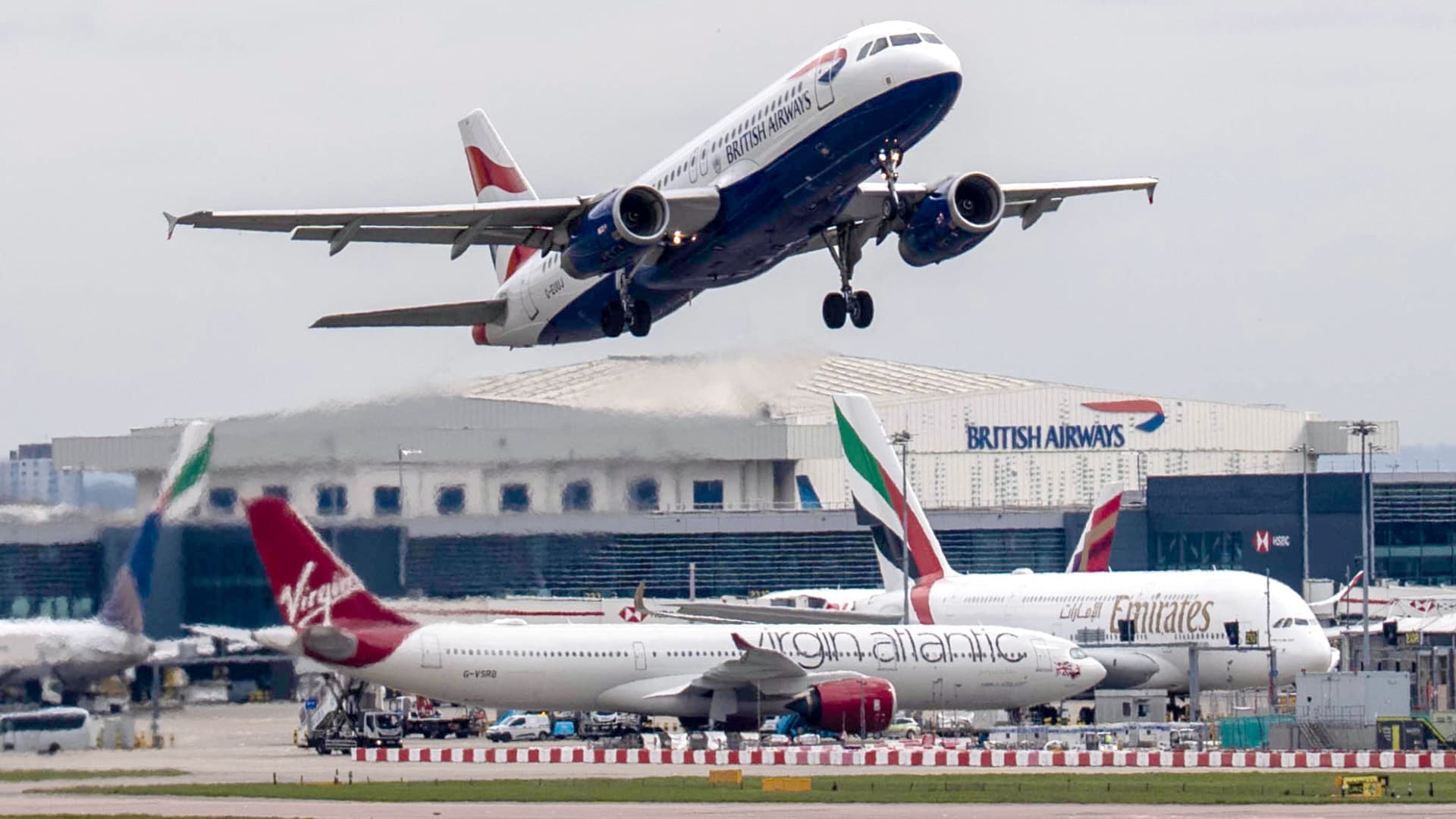
Stock picture of a British Airways plane taking off from London Heathrow Airport.
Stefan Rousseau – Pa Images | Pa Images | Getty Images
Europe’s airline industry is at risk of a “systemic” jet fuel shortage in the next few weeks if the Strait of Hormuz blockade continues, with the potential of hundreds of flight cuts, according to experts.
Claudio Galimberti, chief economist at Rystad Energy, told CNBC’s Ritika Gupta on “Europe Early Edition,” on Tuesday that the situation facing airlines “pretty much depends on how many barrels will be flowing through the Strait.”
“The situation within the next three, four weeks can become systemic, so you can have severe cuts of flights in Europe already starting in May and June,” he added.
Traffic through the strategically vital waterway ground to a halt after Iran closed it during the war with the U.S. and Israel, sending oil prices surging.
After peace negotiations between the U.S. and Iran collapsed at the weekend, the U.S. began a naval blockade of ships entering and leaving Iranian ports in the Strait of Hormuz, aiming to cut Iran’s oil exports and increase pressure on Tehran.

Rico Luman, senior economist at ING, said: “There are many warnings of looming shortages in the weeks ahead, if there’s no supply coming again.”
“We’ve seen these vessels now stopping, so supplies from the Middle East have run out, and we need replacements,” Luman told CNBC’s Steve Sedgwick and Ben Boulos on “Squawk Box Europe.”
ACI Europe, which represents airports across the EU, said last week that a shortage could hit as early as three weeks, disrupting peak travel season with “harsh economic impacts.”
Several EU member states rely on the economic boost from the summer travel season, with air travel generating 851 billion euros (nearly $1 trillion) in GDP for European economies a year and supporting 14 million jobs, per the group.
“We’ve seen already constraints in Asia, so Asia is linked to the Middle East, the most dependent on the Middle East, especially for jet fuel. So we’ve seen constraints in countries like Vietnam and Thailand on air travel, but this is also spilling over to Europe, because it’s a global market,” Luman said.
The U.S. and Israel’s war with Iran, which began on Feb. 28, sent oil prices soaring to over $100 a barrel, causing an energy shock, with airlines most severely impacted. Jet fuel prices soared 103% month-on-month as of March, according to the International Air Transport Association.
In the U.S., the price of jet fuel nearly doubled, increasing from $2.50 a gallon on Feb. 27 to $4.88 a gallon on April 2.

West Texas Intermediate futures for May delivery were down 1.86% to $97.24 per barrel as of 7:09 a.m. ET on Tuesday, while the International benchmark Brent Crude for June delivery was down 0.33% at $99.03 per barrel.
Rystad Energy’s Galimberti said that markets were expecting a “quick resolution” to the crisis but, with the development of the U.S. blockade over the weekend, “it does look like this is a long process.”
He referenced the Russia-Ukraine war, saying: “If you look at the history of conflict, the longer it takes to solve them, but past the first eight weeks, nine weeks, the more likely it is that they become a protracted conflict.”
Airlines are responding to the crisis
European airlines are already cancelling flights and lowering profit expectations as the conflict continues.
“We’ve seen several announcements of ticket price increases already,” ING’s Luman said. “So there’s more to come if this remains the same situation, and we don’t expect the oil prices to come down to previous levels… so this is relevant for customers, of course, in their travel.”

Aurigny, a carrier based on the island of Guernsey, announced at the end of March that it would reduce flight capacity on certain routes between April and June due to “heightened global instability,” as well as adding a temporary £2 ticket surcharge.
Scandinavian airline SAS said it was cancelling 1,000 flights in April, while Ryanair’s CEO Michael O’Leary said the carrier would look to cancel some flights and reduce capacity over the summer if the fuel shortage continued.
Wizz Air’s CEO warned in March that it expected a 50 million euro hit to its 2026 net profit, while Virgin Atlantic’s CEO Corneel Koster told the Financial Times on Tuesday that the airline will struggle to turn a profit this year even after adding fuel surcharges.
“No matter what happens in the Gulf going forward… some of this disruption to global energy prices will be here to stay,” Koster told the FT.

