


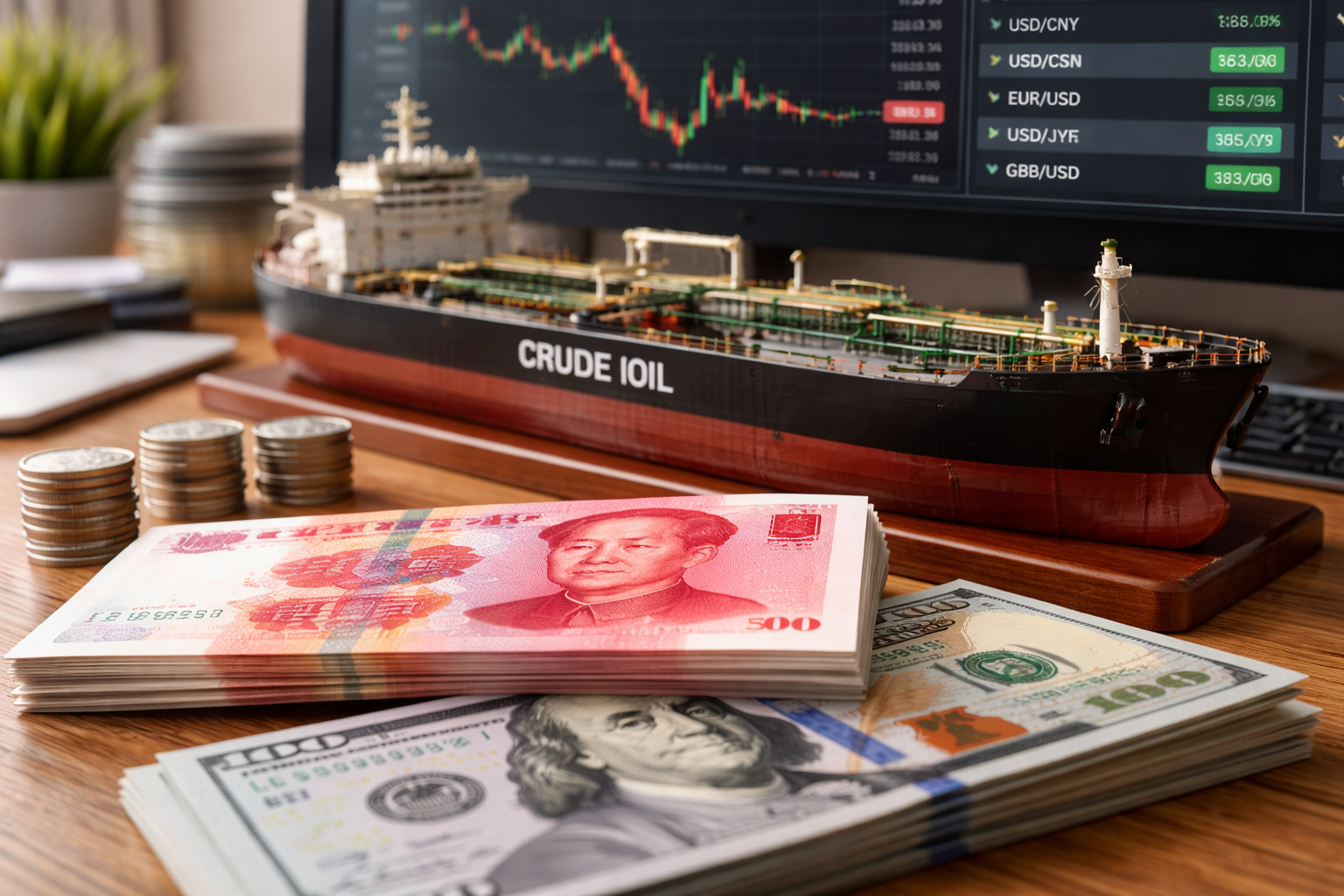
The significance of the US dollar in global trade has taken a hit over the last couple of years, but a straightforward decline is not on the cards yet.
Iran plans to reopen the Strait of Hormuz, contingent on a mandatory fee of up to $2 million per ship, payable in Chinese Renminbi or cryptocurrency. The enforceability of this demand is uncertain, as legal experts deem the fee unlawful.
Iran’s effective, full control over the vital strait, as demonstrated over the past six weeks, raises significant questions regarding the possibility of countries bypassing these measures.
The recent developments in the Iran conflict are being welcomed by those who anticipate the US dollar’s decline. They view this situation as a sign of the so-called Petrodollar’s demise, interpreting it as yet another challenge to the dollar’s leading position within the global currency system.
Considering that roughly one-fifth of the global oil and LNG supply transits the Strait of Hormuz, Iranian influence could potentially disrupt the settlement of this supply in US dollars.
Furthermore, since the majority of these energy shipments are destined for Asia, there is an existing incentive to increasingly settle this trade using the Chinese Yuan (CNY).
Petrodollar’s demise: expert disagreement
The US dollar’s position as the world’s leading reserve currency is primarily cemented by its overwhelming use as a vehicle currency in global commerce. This dominance means the USD is extensively employed not only in direct trade involving the US but also in transactions between countries other than America.
Evidence of this phenomenon lies in the fact that the dollar’s share in international payment systems far surpasses the US’s actual share of global trade, according to the Journal of International Economics.
This is undoubtedly due, in part, to commodity transactions being settled in dollars.
“Nevertheless, we do not believe that the dollar’s status is under serious threat due to Iran’s alleged efforts to establish the “Petroyuan.” Thu Lan Nguyen, head of FX and commodity research at Commerzbank AG, said in a report.
This is not only because it remains highly questionable whether such efforts will succeed.
Additionally, Alpine Macro’s chief geopolitical strategist, Dan Alamariu, disagrees with the notion of a US decline.
On Friday, he wrote in a note that leaving Iran’s regime intact and with some control over the strait would be a “strategic setback” for the US and a humiliation for Trump.
“The bigger question is whether this marks the end of American superpower status, dollar dominance, and the petrodollar. More possible if Iran ends up with control of the SoH, but we would not bet on it,” Alamariu was quoted as saying in a Fortune.com report.
Alamariu also dismissed comparisons to the 1956 Suez Crisis. In that event, the US forced Britain and France to relinquish their effort to retake the Suez Canal, marking the conclusion of their status as great powers.
Alamariu noted that the petrodollar is facing increased risk. However, he wrote that the Gulf Cooperation Council (GCC) has a compelling incentive to maintain strong ties with Washington. This is due to the perception that Beijing is closely aligned with Iran.
The idea of a petroyuan or petroeuro replacement remains far-fetched.
The dollar’s dominant position, according to Wall Street analysts, is fundamentally supported by its role as the required currency for the global oil trade.
However, the rise of the yuan, particularly during the Iran conflict, may lead to the establishment of a “petroyuan.” This shift is being considered as the traditional US security guarantees and their protection of free navigation are perceived to be weakening in the face of persistent drone attacks that have successfully breached American air defenses.
Decline in Gulf region’s global trade
In 2024, oil, oil products, and natural gas collectively represented approximately 10% of global goods trade, according to Comtrade data. Of this total, the Iranian government’s planned initiatives would directly affect under twenty percent.
Because the Gulf States receive payment for their energy exports in US dollars, they consequently maintain the majority of their foreign exchange reserves in the same currency.
“This practice is further supported by the fact that their exchange rates (with the exception of Kuwait) are pegged to the dollar, necessitating a substantial reserve of USD to maintain the peg,” Commerzbank’s Nguyen said.
Despite this, the figures remain relatively modest. GCC data indicated that the foreign exchange reserves of the Gulf States recently totaled about $800 billion.
Based on International Monetary Fund (IMF) data, this constitutes slightly under 7% of the world’s total foreign exchange reserves.
Should Gulf States drop their dollar peg and subsequently decrease their dollar reserves, the dollar’s share of global reserves would probably only decline by a small, single-digit percentage point, according to Nguyen.
The US dollar’s dominance is gradually eroding, evidenced by Iran’s plans and the dollar’s shrinking share in global foreign exchange reserves, which has fallen from 70% in 2000 to just under 60% recently.
While some might emphasise the role of valuation effects, the persistently high dollar share can be viewed as a deliberate strategy. Studies indicate that central banks, especially those with substantial reserves, actively manage their currency holdings through buying and selling, suggesting this allocation is intentional.
Dollar’s enduring structural support
Dollar dominance has recently declined, notably in central bank reserves moving away from the US dollar toward “non-traditional” currencies, as confirmed by the Journal of International Economics.
This shift is driven by geopolitics, especially since the Ukraine war, countries less aligned with the West increasingly settle payments in Renminbi, domestic currencies, or other alternatives, rather than USD or EUR.

Sanctioned nations like Russia (with large pre-war reserves) and Iran, cut off from USD payments, must use alternative currencies or systems for trade.
A critical inquiry is how enduring the repercussions of Western sanctions will prove, and if this trajectory is likely to accelerate.
“In my view, this primarily depends on how states that anticipate potential conflicts with the US or the EU perceive the risk of sanctions – similar to those imposed on Russia or Iran,” Nguyen said.
The dollar’s benefits are clear, with reports suggesting that the Russian government might revert to the USD system following a peace agreement, despite years of trying to weaken dollar dominance.
Paul Blustein, a Center for Strategic and International Studies scholar, argued that even if the petrodollar declines, the dollar’s dominance is sustained by other unmatched factors.
He specifically cited the unparalleled depth, breadth, and liquidity of American financial markets, alongside the ability to move money across US borders with almost no restrictions, in a Fortune op-ed.
https://invezz.com/news/2026/04/13/petroyuan-or-dollar-strength-hormuz-conflict-sparks-global-currency-fight/
