


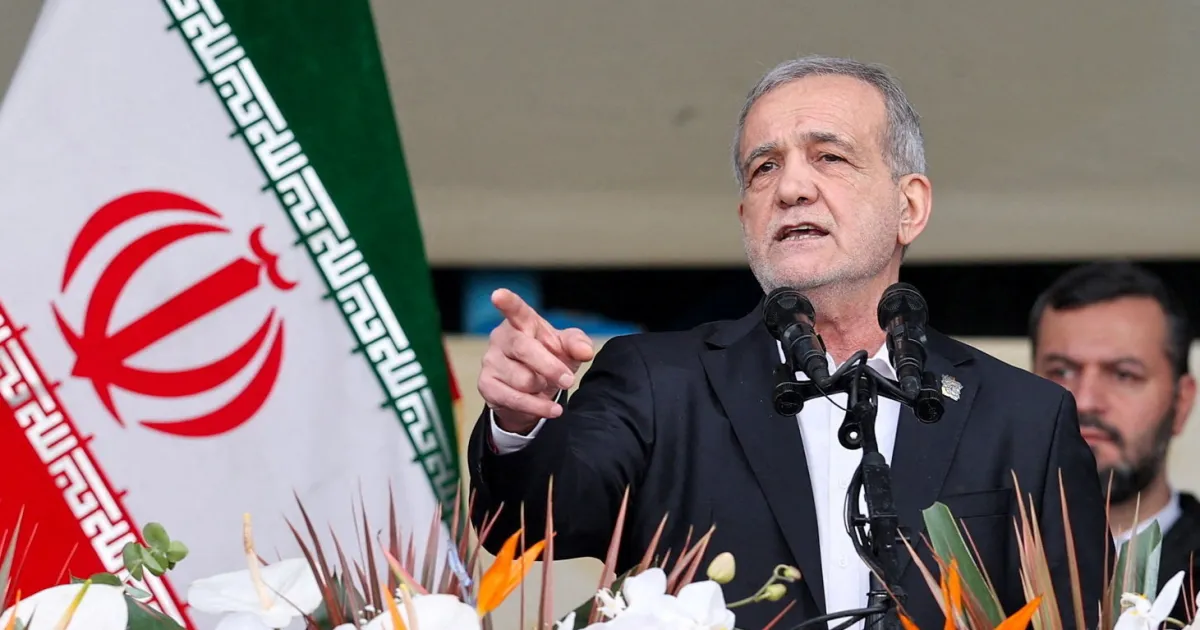
Iranian President Masoud Pezeshkian has offered an apology to neighbouring countries that have been subjected to Tehran’s retaliatory strikes since the United States and Israel launched a military offensive on the country.
But Iran’s powerful Islamic Revolutionary Guard Corps (IRGC) expressed its disapproval of the president’s remarks on Saturday, warning neighbouring countries that Tehran would continue attacks if US and Israel used their territory to attack Iran.
Recommended Stories
list of 3 itemsend of list
Iranian Foreign Minister Abbas Araghchi said Tehran is not going to stop attacks while Mohammad-Bagher Ghalibaf, speaker of Iran’s parliament, underscored Tehran’s right to self-defence.
Iran’s leadership has been sending mixed messages about its attacks on neighbouring countries in the Gulf region. On Saturday and Sunday, more Iranian strikes were reported. On Saturday, Kuwait, Qatar, Saudi Arabia and the United Arab Emirates said they were attacked.
So why is Iran sending mixed messages to Gulf countries? How should its statements be interpreted?
What have Iranian leaders said?
In a recorded message on Saturday, Pezeshkian pledged to halt attacks against neighbouring countries unless an attack on Iran originated from their soil.
“I personally apologise to neighbouring countries that were attacked by Iran. Our commanders, leaders and loved ones lost their lives due to the brutal aggression that took place, and our armed forces are heroes who gave their lives to defend our territorial integrity,” he said without specifying which countries he was referring to.
“We didn’t intend to violate neighbouring countries’ [territory]. As I have said many times, they are our brothers. We stand with these ones we love in the region,” he added.
Shortly after Pezeshkian’s apology, the IRGC weighed in and said the armed forces of Iran “once again declare that they respect the interests and national sovereignty of neighbouring countries and, up to this point, have committed no aggression against them”.
“However, should the previous hostile actions continue, all military bases and interests of criminal America and the fake Zionist regime on land, at sea, and in the air across the region will be considered primary targets and will come under the powerful and crushing strikes of the mighty armed forces of the Islamic Republic of Iran,” an IRGC statement added.
Pezeshkian later clarified on X that Iran had not in fact attacked any of its neighbours but rather “targeted US military bases, facilities, and installations in the region”.
Late on Saturday, the secretary of the Supreme National Security Council of Iran, Ali Larijani, echoed the IRGC’s message and said: “When the enemy attacks us from bases in the region, we respond – and we will continue to respond.”
“This is our right and a standing policy. Regional countries must either prevent the US from using their territory against Iran, or we will have no choice but to do it ourselves,” he added.
On Sunday morning with attacks across the Gulf continuing, Pezeshkian said his remarks on Saturday were misinterpreted by “the enemy that seeks to sow division with neighbours”.
According to Iranian state media, the president reiterated that Iran wants good relations with “the brotherly neighbouring countries” but has been forced to respond to attacks coming from the territories of other countries.
He stressed, however, that this response does not mean there is a dispute with those countries.
“Iran stands strong against those who attack it and will respond with strength,” he said.
Iran’s Ministry of Foreign Affairs also issued a statement on Sunday emphasising “that Iran’s defensive operations against US military bases and installations in the region should by no means be construed as enmity or hostility towards the countries of the region”.
Khalid al-Jaber, executive director of the Middle East Council on Global Affairs in Doha, says different Iranian officials have sent several “contradictory” messages to countries in the region.
“We don’t know which one is true. We don’t think now, in war, that Iran is going to stop attacking some infrastructure in the Gulf,” al-Jaber told Al Jazeera, citing the attack on the water desalination plant in Bahrain a proof of that.
“Since the attack on Ayatollah Khamenei, it seems like there is no institute or a person or leadership we can talk to, or we can make a deal with, to try to understand what their perspective is, what their point of view is,” he said.
How should Iran’s messages be interpreted?
According to Al Jazeera’s Resul Serdar, Pezeshkian’s apology was overtaken by the Revolutionary Guard’s dominance.
“Political figures in Iran are responsible for running state affairs and nonstrategic affairs. But when it comes to strategic affairs, such as the country’s foreign and security policies, politicians don’t have a say, including the president, who, according to the constitution, is the number two in charge. This is a very well-known fact in Iran,” Serdar said.
The centre of power lies with the office of the supreme leader and with the IRGC, even during peacetime, he added.
On Sunday, Serdar said Iranians were interpreting Pezeshkian’s statement that his remarks had been misconstrued as one not meant for Gulf countries but instead for Azerbaijan and Turkiye.
“Azerbaijan because of the ethnic tensions. There are tens of thousands of Azeri [people] living in Iran, so an attack on them could backfire, and for Turkiye, it is a NATO member,” he said.
Azerbaijan has sought Iran’s apology after a drone attack targeted its autonomous Nakhchivan exclave on Thursday. Tehran, however, has insisted that it was not behind the attack.
On Wednesday, Turkiye’s Ministry of National Defence said a ballistic missile fired from Iran towards Turkish airspace had been intercepted and destroyed by NATO. But Iran’s armed forces have also denied firing any missile towards Turkish territory.
Ali Vaez, director of the Iran project at the International Crisis Group, told Al Jazeera that Pezeshkian’s occasional off-key remarks have underscored his limited political instincts and experience in navigating high-stakes moments.
“But in wartime, rhetorical missteps by civilian officials are ultimately beside the point: The only voice that truly matters is the IRGC’s,” he added.
How has the Gulf reacted?
After an apology and threats from Iranian officials, strikes on countries across the Gulf have continued.
On Sunday, an Iranian drone attack caused material damage to a water desalination plant in Bahrain, its Ministry of Interior said.
That came a day after Araghchi said the US attacked a desalination plant on Qeshm Island off southern Iran, setting a “precedent”. There has been no immediate comment from Iran since Bahrain’s statement. A majority of Gulf countries depend largely on desalinated water for their inhabitants’ consumption.
Also on Saturday, Qatar, Kuwait and the UAE reported incoming missiles and drones in their territories. On Sunday, Kuwait said two Ministry of Interior personnel were killed while on duty and attacks on its international airport and social security office caused fires.
Saudi Arabia said Sunday that an attack on Riyadh’s diplomatic quarter was foiled and several drones were downed in its airspace.
On Sunday, the Gulf Cooperation Council said Iran’s continued attacks against Bahrain and Kuwait are “dangerous acts of aggression” that threaten regional security and stability. The bloc comprises Bahrain, Kuwait, Oman, Qatar, Saudi Arabia and the UAE.
So far, countries in the Gulf have intercepted and destroyed most of the Iranian missiles and drones but have not yet launched strikes against Tehran.
Vaez told Al Jazeera that the Gulf states can certainly retaliate but that is likely to lead to even more aggressive Iranian retaliation.
“Siding with Israel to bomb another Muslim state would also entail political consequences for the Gulf states,” he added.
How has the US reacted?
After the Iranian president’s apology on Saturday, US President Donald Trump said in a post on his social media platform, Truth Social, that Iran has surrendered to its neighbours.
“Iran is no longer the ‘Bully of the Middle East,’ they are, instead, ‘THE LOSER OF THE MIDDLE EAST,’ and will be for many decades until they surrender or, more likely, completely collapse!” Trump posted.
“Siding with Israel to bomb another muslim state would also entail political consequences for the Gulf states,” he added.
In an interview with Al Jazeera on Saturday, Hamidreza Gholamzadeh, director of the Iranian think tank Diplo House, said Trump’s interpretation of Pezeshkian’s comments as a “surrender” is “totally false”.
Gholamzadeh said Iran is asking its neighbours “that they stop cooperating with the United States or the Israeli regime and do not allow them to use their land or their airspace to attack Iran”, describing the request as something “very normal” and “legal”.
https://www.aljazeera.com/news/2026/3/8/why-are-iranian-leaders-sending-mixed-messages-on-gulf-attacks?traffic_source=rss
