


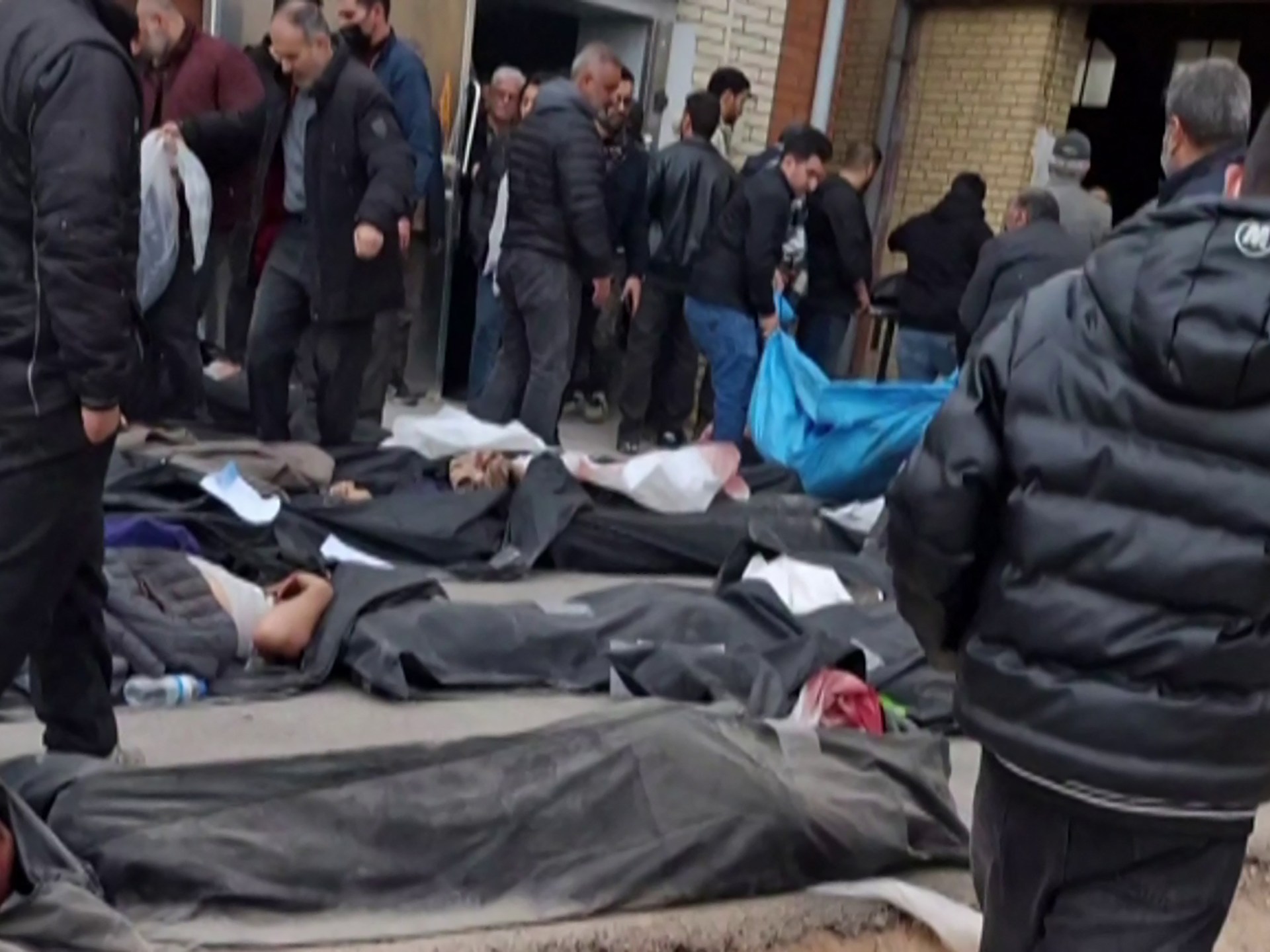
Ever since the crackdown on protests in Iran between January 8 and 10, there has been contention on what the true death toll of those bloody events is. According to figures provided by the Iranian government, 3,117 people were killed, including civilians and security forces. Yet estimates from outside the country have put the number at anywhere between 5,000 and a staggering 36,500.
This wide range not only reflects the fact that it has been extremely difficult to verify these reports, but also that there has been a concerted effort to use the death count to manufacture global consent for an attack on Iran and, in a deceitful rhetoric, downplay the official death toll of the genocide in Gaza.
Since the outbreak of the protests, there has been a race to estimate and report on the casualties – something I call a “Death Toll Olympics”.
Iran-focused human rights organisations led by dissident activists have been going through all sorts of evidence and testimonies to verify the number of the dead. As of writing this piece, the US-based organisation HRANA (Human Rights Activists News Agency) has cited more than 6,000 deaths and a further 17,000-plus cases under examination.
However, there are valid doubts about the speed of the activist-led verification process.
For every reported death, multiple accounts have to be examined, possible duplications must be identified and eliminated; and dates, locations and specific circumstances must be cross-checked against the timeline of events.
Furthermore, any visual evidence has to be localised and authenticated based on open-source data or corroborated by the accounts of multiple witnesses. From an investigative standpoint, the reliability and quality of activist-led counts that increase rapidly on a daily basis, therefore warrants caution.
The UN Special Rapporteur on Iran, Mai Sato, has cited a conservative estimate of around 5,000 deaths. At the same time, she has mentioned that unverified numbers of up to 20,000 have been reported to her by medical sources.
The described obstacles, and difficulties of verification over the past weeks, have been further exacerbated by Iran’s severely restricted internet access. Despite this, major media outlets have begun distributing much higher figures, solely based on vague anonymous sources who claim privileged access within Iran’s government or health sector.
On January 25, for example, UK-based TV network Iran International published a report claiming 36,500 were killed, citing “extensive reports” allegedly obtained from the Iranian security apparatus – reports it has neither published nor otherwise made transparent.
The same day, United States news magazine Time published an article titled “Iran Protest Death Toll Could Top 30,000, According to Local Health Officials”. It claimed that “as many as 30,000 people could have been killed in the streets of Iran on Jan. 8 and 9 alone” based on the accounts of two senior officials of the country’s Ministry of Health, whose identities were not revealed for security reasons. Notably, the magazine admitted in the text that it did not possess any means to independently confirm that number.
Two days later, British newspaper The Guardian followed the same trend with an article titled “Disappeared bodies, mass burials and ‘30,000 dead’: what is the truth of Iran’s death toll?” The piece introduced the figure of 30,000 based on estimates of an anonymous doctor, who spoke to the newspaper. He and his colleagues in Iran, the outlet admitted, were actually hesitant to provide a concrete figure.
Other media – from the Sunday Times to the Pierce Morgan Uncensored show – have cited papers circulated by Germany-based ophthalmologist Amir Parasta claiming death toll numbers between 16,500 and 33,000. However, the latest available version of the paper, dating back to January 23 uses disputable extrapolation methods to reach its figures. Strikingly, Parasta does not make any secret of his affiliation with Reza Pahlavi, the son of Iran’s ousted Shah
The exiled crown prince and his team, whose extensive social media manipulation and disinformation efforts have been exposed by recent investigations by the Israeli newspaper Haaretz and University of Toronto’s The Citizen Lab, have been key actors in inciting and escalating the recent protests towards confrontation. Accordingly, the fatality numbers disseminated by Mr Parasta cannot be perceived as neutral and constitute partisan estimates at best.
Despite acknowledging their own inability to verify these estimates, the media in question nevertheless put these extreme figures in titles and subheadings. It didn’t take long for other outlets to report on these inflated numbers, referring to these major publications as primary sources. Activists and Western politicians have also used them to push their respective agendas, thereby further fuelling a spiral of disinformation campaigns on social media. – In other words, a “death toll olympics” was born.
All of this has served two ends.
First, it has supported efforts to manufacture consent for foreign military intervention and malicious political action. While the protests were still ongoing, US President Donald Trump repeatedly threatened military action against Iran in the event of a deadly crackdown. As of writing these lines, there has been a significant US military build-up around Iran, effectively thickening the war cloud.
Second, the speculation about the Iranian death toll has helped pro-Israel politicians and commentators in the West to downplay the casualties of the Israeli war on Gaza. In this way, it has become a utilitarian tool for relativising the genocide of the Palestinian people.
Confronted with mounting pressure regarding the death toll, Iran’s President Masoud Pezeshkian ordered the authorities to “publicly publish the names and personal data of those deceased during the recent bitter incidents”. His director of communication has even promised that a procedure has been set up to examine and verify any conflicting claims.
It remains to be seen how effective and transparent the promised procedure will turn out. It is undeniable that thousands have been killed in Iran, mostly by Iranian security forces, amid a multi-day brutal crowd and riot control effort.
Structural obscurity and the restricted access to Iran for independent experts will likely mean that the exact death toll will never be determined. However, the more transparency can be established regarding the scale of the killings, the more likely it is that the perpetrators can be held accountable.
An arduous verification process of the recent deaths is crucial not only for the sake of accountability, but also to expose the media manipulation that is once again preparing the ground for a unilateral US-led act of aggression in the Middle East. In light of this, the “Death Toll Olympics” remains an ignominious disservice to the wretched of the Earth from Palestine to Iran.
The views expressed in this article are the author’s own and do not necessarily reflect Al Jazeera’s editorial policy.
https://www.aljazeera.com/opinions/2026/1/31/appropriating-the-death-count-manufacturing-consent-for-an-attack-on-iran?traffic_source=rss
