


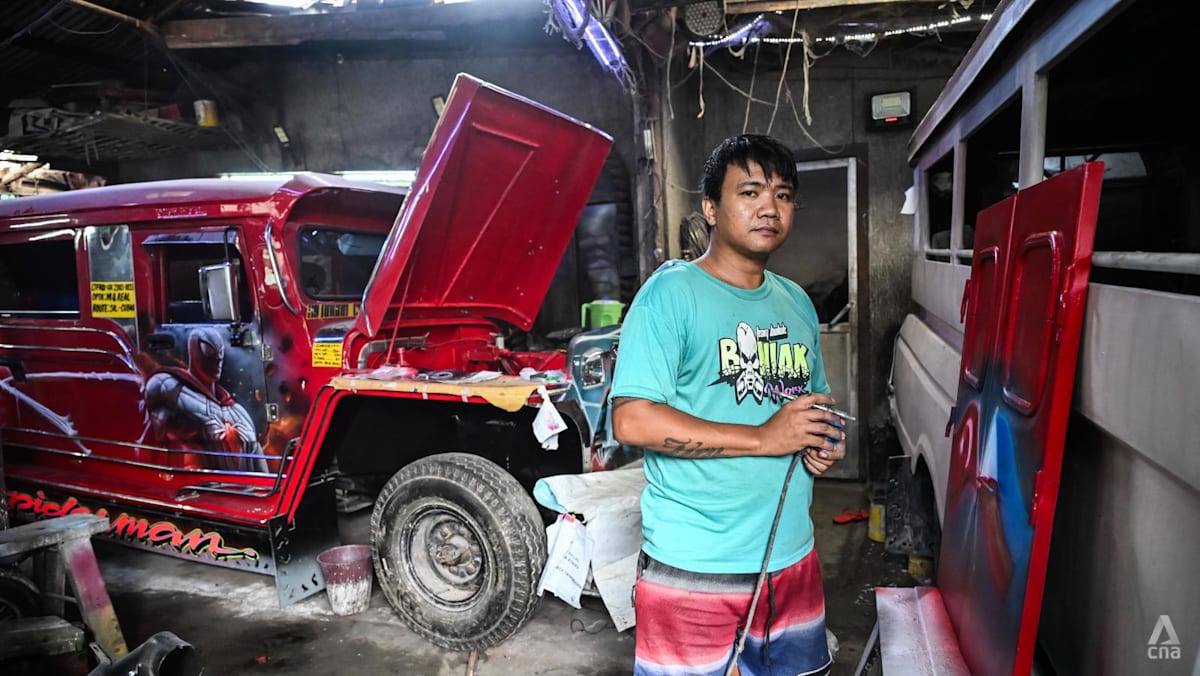
Jeepney artists mostly work informally, so their number is not tracked in official labour or business registries. But in the community, there is a knowledge that while hundreds used to do this work, there might only be a handful of artists remaining.
Most are freelancers ready to take on commissions. A full custom job, increasingly rare, pays about US$5,000 and takes two months. But they might also hold second jobs, for example, as auto mechanics or graphic designers. Salonga said his take-home pay would normally be US$250-340 per month.
The jeepney first emerged in the Philippines following the country’s independence from the United States post-World War II. These former military vehicles were left behind and increasingly locally fabricated using mixed parts for a new role, moving people around at a cheap price, similarly to small but flexible buses.
They operate in hop-on, hop-off style on fixed routes around the city.
They resemble “a Frankenstein’s monster of different parts and pieces”, and say a lot about the resourcefulness of the population, said Jose Victor Torres, a historian and professor at De La Salle University-Manila.
“It was a symbol of resilience. It was something that was born out of necessity, out of materials that were totally discarded,” he said.
“I’m not saying that Filipinos like getting garbage, but it’s something that they got and made use of. And I think that identifies with the Filipino.”
https://www.channelnewsasia.com/asia/manila-jeepneys-traffic-artists-philippines-transport-5858021
