


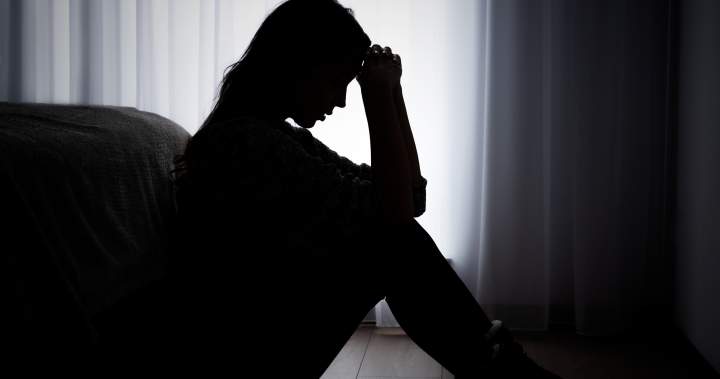
The COVID-19 pandemic may be over, but mental health and addiction professionals say life hasn’t returned to normal for all Ontarians.

Hayley Hamilton, senior scientist at the Centre for Addiction and Mental Health (CAMH), said in an interview that issues faced during the pandemic such as higher alcohol use and lower reported mental health lingered even in 2025.
“As (we) progressed through the pandemic, at least I hoped, you began to hope that we would see a turnaround,” she said. “That as we moved out of the pandemic then we would start to see some, you know, return to close to estimates that we had prior to the pandemic. Quite often we just saw the estimates remaining as they were early in the pandemic.
The rise in substance use and impact to mental health were detailed in the Centre for Addiction and Mental Health’s 2025 Monitor report, which surveyed 3,012 Ontarians aged 18 and older between February and March of last year.
The number of adults reporting fair or poor mental health rose from 26.2 per cent in 2020 to 29 per cent last year. Those who reported frequent mental distress, defined as 14 days or more in a month, increased from 16.8 per cent to 18.7 per cent.
“Society has changed,” Hamilton said. “It’s important for us to recognize that our interactions, our work or the economy, cost of living and our sense of control over our future and what is to come, I think, is also an issue.”
The use of treatments to tackle anxiety and depression has also increased since the pandemic, the report found, with 26.5 per cent of women using anti-anxiety medication in 2025 compared to 22.3 per cent five years prior.
Get weekly health news
Receive the latest medical news and health information delivered to you every Sunday.
Dominique Morisano, a clinical psychologist and University of Toronto adjunct professor, said people are still struggling.
“I’ve seen that people in some ways really lost a lot, it sounds wild, but a lot of people lost the ability to understand how to connect with friends and community,” Morisano said. “Especially for teenagers, I would say, and kids, in which normally that’s when they would have been learning those skills about social connections, social skills.”
Seniors have also seen a rise in medication use, with 16.3 per cent of those 65 and older using antidepressants compared to 10.8 per cent in 2020.
The report also found five years after the COVID-19 pandemic, while the number of Ontarians that reported certain forms of alcohol use in the past year has dropped from pandemic highs, it has not returned to pre-pandemic levels.
Binge drinking, defined as having five drinks or more in a single occasion, has remained “stable,” dropping slightly from 11.3 per cent in 2020 to 9.6 per cent last year.


Alcohol dependence has also seen only a slight decrease but is still higher than pre-pandemic levels, having sat at 7.4 per cent in 2019 before rising to 13.9 per cent in 2020. The number now sits at 12.1 per cent five years later.
“Individuals cope in different ways, whether it’s through daily drinking and other substance use,” Hamilton said. “Sometimes it is reflected in your mental health, the depression or anxiety or other mental health measures. So, to me, it relates back to coping and how individuals cope with whatever concerns or challenges they’re experiencing.”
With people still struggling, there are things that can be done and resources to access, but psychologist Taslim Alani-Vergee said things can be “tricky.”
“What makes it tricky is that for the everyday person, knowing who to go to, how to start that relationship and how to find the right provider becomes tricky and it costs a lot of money,” Alani-Vergee, who founded the Silm Centre for Mental Health, said.
It’s why she said more funding, especially in the public health system, is needed to make it easier for people to access various services and to reduce the wait times that people may face, but there’s still other things to do.
“There needs to be an acknowledgement that professional services in and of themselves are not going to do the trick,” she said.
“One hour once a week or once every two weeks or once a month isn’t going to cut it when people are struggling … I think we need to see those supports integrated into workplaces, into communities where people know they’re allowed to be struggling and that they do still have stability in all this uncertainty.”
© 2026 Global News, a division of Corus Entertainment Inc.
Poor mental health, harmful alcohol use persists post-pandemic: report
