


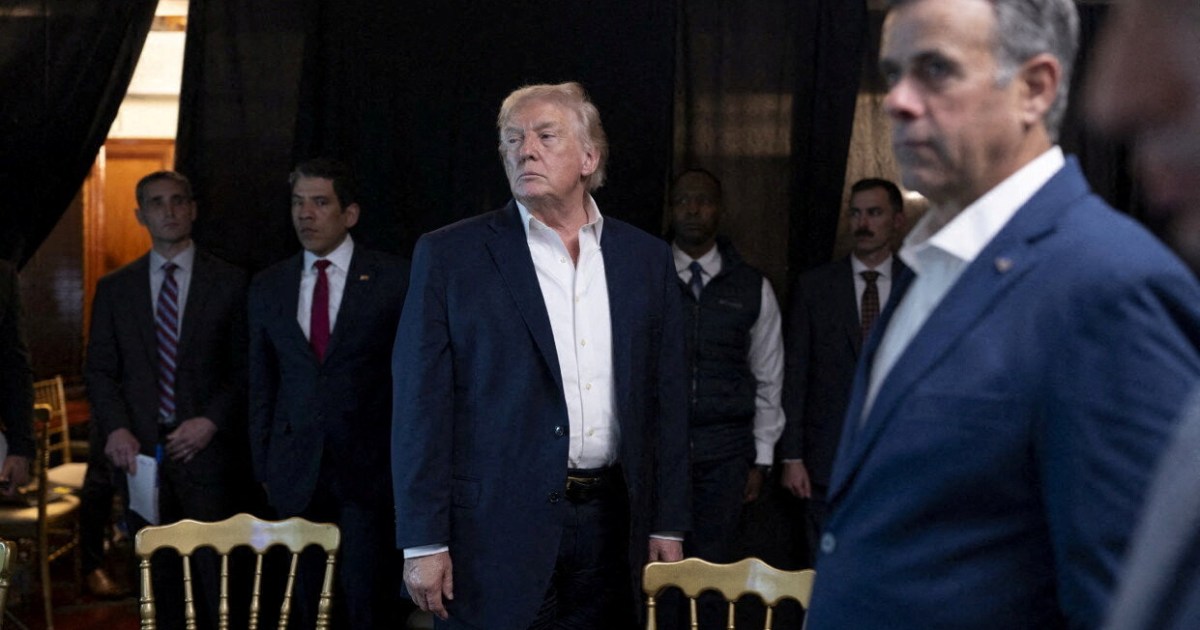
United States President Donald Trump said that a US military assault succeeded in capturing Venezuelan President Nicolas Maduro and his wife, Cilia Flores, both facing US charges related to cocaine trafficking under newly unsealed indictments.
In a January 3 news conference at Mar-a-Lago, Trump said the US would “run the country until such time as we can do a safe, proper and judicious transition”.
Recommended Stories
list of 3 itemsend of list
Trump also said that Venezuelan Vice President Delcy Rodríguez was sworn in as interim president. The US president said Rodríguez had talked to US Secretary of State Marco Rubio and was “essentially willing to do what we think is necessary to make Venezuela great again”.
However, Rodríguez criticised the US military action as “brutal aggression” on state television and called for Maduro’s immediate release.
Maduro has led Venezuela since 2013, succeeding an ideological ally, Hugo Chavez, who had been in office since 1999. Under both men, US relations with Venezuela frayed over foreign policy, oil and human rights.
In July 2024, Maduro declared victory after an election that international observers described as fraudulent. The country’s opposition candidate, Edmundo Gonzalez Urrutia, reportedly received about 70 percent of the vote.
Tensions between Trump and Maduro escalated in September after the US government began attacking vessels off the coast of Venezuela, killing more than 100 people, in what Trump described as an effort to thwart drug smuggling.
When a reporter asked Trump during the Mar-a-Lago media event whether he had spoken to Venezuelan opposition leader Maria Corina Machado following Maduro’s arrest, Trump said that Machado “doesn’t have the support or the respect within the country”.
Machado, who recently won the Nobel Peace Prize for her fight for democracy in Venezuela, had a 72 percent approval rating from Venezuelans in a March 2025 poll by ClearPath Strategies.
Trump said, without evidence, that the US’s role in governing Venezuela “won’t cost us anything” because US oil companies would invest in new infrastructure in the oil-rich country. “It’s going to make a lot of money,” he said.
PolitiFact fact-checked Trump’s and Rubio’s statements from the news conference.
Rubio: “It’s just not the kind of mission that you can pre-notify [Congress about] because it endangers the mission.”
The Trump administration’s lack of warning to Congress bucks laws and precedents.
Rubio said that members of Congress were not notified in advance of the US actions on Venezuela. Trump said the administration was concerned about Congress potentially leaking news of the administration’s decision to capture Maduro.
Senate Majority Leader John Thune, a Republican from South Dakota, praised the operation as a “decisive action”.
But Congressional Democrats said that Congress should have been notified in advance. Senator Tim Kaine, a Democrat from Virginia, said, “Maduro is terrible. But Trump put American servicemembers at risk with this unauthorised attack.”
Senator Jeanne Shaheen, a Democrat from New Hampshire, said Trump and his cabinet were not forthcoming about their intentions for regime change in Venezuela, so “we are left with no understanding of how the administration is preparing to mitigate risks to the US, and we have no information regarding a long-term strategy following today’s extraordinary escalation”.
The US Constitution assigns Congress the right to declare war. The last time this happened was during World War II.
Since then, presidents have generally initiated military action using their constitutionally granted powers as commander-in-chief without an official declaration of war.
Since Congress passed the 1973 War Powers Resolution, the president has had to report to Congress within 48 hours of introducing the US military into hostilities, and terminate the use of the military within 60 days unless Congress approves. If approval is not granted and the president deems it an emergency, an additional 30 days are granted for ending operations.
In recent decades, congressional consent has usually been granted through an authorisation for the use of military force. But such an authorisation has not been passed for operations in Venezuela. Kaine and other lawmakers have pursued legislation – so far fruitlessly – to prohibit the use of federal funds for any use of military force in or against Venezuela without congressional authorisation.
The Trump administration has whittled away at prior notification requirements. Under federal law, eight bipartisan senior members of Congress must receive prior notice of particularly sensitive covert actions. In June 2025, the administration told Republicans, but not Democrats, about a forthcoming US strike on Iranian nuclear facilities. For the Venezuela operation, it appears no lawmakers were notified in advance.
Trump: Each US boat strike off the coast of Venezuela saves 25,000 people
The Trump administration has struck at least 32 vessels, killing about 115 people, in the Caribbean Sea and Eastern Pacific Ocean since September. Trump said previously that the boats were carrying drugs en route to the US, and during the news conference, he said the drugs on each boat would kill “on average, 25,000 people”.
However, experts on drugs and Venezuela told PolitiFact that the country plays a minor role in trafficking drugs that reach the US. And the administration has provided no evidence about the type or quantity of drugs it says were on the boats. This lack of information makes it impossible to know how many lethal doses of the drugs could have been destroyed.
The Centers for Disease Control and Prevention reported 73,000 US drug overdose deaths from May 2024 to April 2025. This means that the drugs on 32 boats, which would have killed 800,000 people based on Trump’s claim, would be responsible for nearly 11 times the number of US overdose deaths in one year.
Trump: “Maduro sent savage and murderous gangs, including the bloodthirsty prison gang Tren de Aragua, to terrorise American communities nationwide.”
There is no evidence that Maduro sent members of the Venezuelan prison gang Tren de Aragua to the US.
The US Justice Department indictment against Maduro does not mention Trump’s statement.
An April report from the US National Intelligence Council contradicted Trump’s statements about links between Maduro and Tren de Aragua.
“While Venezuela’s permissive environment enables [Tren de Aragua, or TDA] to operate, the Maduro regime probably does not have a policy of cooperating with TDA and is not directing TDA movement to and operations in the United States,” the report said.
Trump: Venezuela ‘stole’ US oil in the past.
[We probably need an italics statement here about the verdict?]
In the early 20th century, Venezuela’s long-serving hardline leader, Juan Vicente Gomez, allowed foreign companies almost exclusive access to the country’s oil resources.
In 1975, after decades of seeking greater control of its oil resources, Venezuela nationalised its oil industry.
“Trump’s claim that Venezuela has stolen oil and land from the US is baseless,” Francisco Rodríguez, a Venezuelan economist at the University of Denver, told The Washington Post. “The US was much more interested in having Venezuela be a provider of oil — relatively cheap oil — than to have a production collapse in Venezuela,” Rodríguez added.
As a result, the change was “relatively uncontroversial” at the time, he said.
US oil companies, including Exxon and Mobil as well as Gulf, now Chevron, lost about $5bn each in assets, and were compensated $1bn each, according to news reports, The Washington Post reported.
But Rodríguez said the companies did not push for additional compensation at the time, in part because no forum existed to do so.
In general, experts have told PolitiFact that invading a country to take its oil would be both illegal and unethical. In 2016, Trump mused about how the US should have taken Iraq’s oil when it invaded to remove its then-leader, Saddam Hussein.
Experts pointed to the annex to The Hague Convention of 1907 on the Laws and Customs of War, which says that “private property … must be respected [and] cannot be confiscated”. It also says that “pillage is formally forbidden”.
“If ‘to the victors go the spoils’ was legal doctrine, then we would have believed that [Saddam Hussein] should have been able to keep Kuwait City after he invaded [Kuwait]” in 1990, terrorism analyst Daveed Gartenstein-Ross told PolitiFact in 2016. “But we viewed that — quite rightly — as an act of aggression under the UN Charter.”
https://www.aljazeera.com/news/2026/1/4/fact-checking-trump-following-us-capture-of-venezuelas-maduro?traffic_source=rss
