


Notably absent from the race is the National League for Democracy (NLD), led by Nobel laureate Aung San Suu Kyi who remains in military detention.
The party, which won landslide victories in the 2015 and 2020 elections, has been dissolved by the junta.
Many other anti-military parties are also not in the running.
JUNTA CRACKDOWNS
Amid calls to boycott the election, voter turnout remains one of the junta’s main concerns.
In July, it introduced a new law imposing harsh prison sentences on anyone accused of disrupting the electoral process. Since then, at least 229 people have reportedly been detained under the new measures.
At the same time, the junta has adopted a softer messaging approach – invoking the legacy of independence hero General Aung San and enlisting celebrity influence to encourage public support and participation.
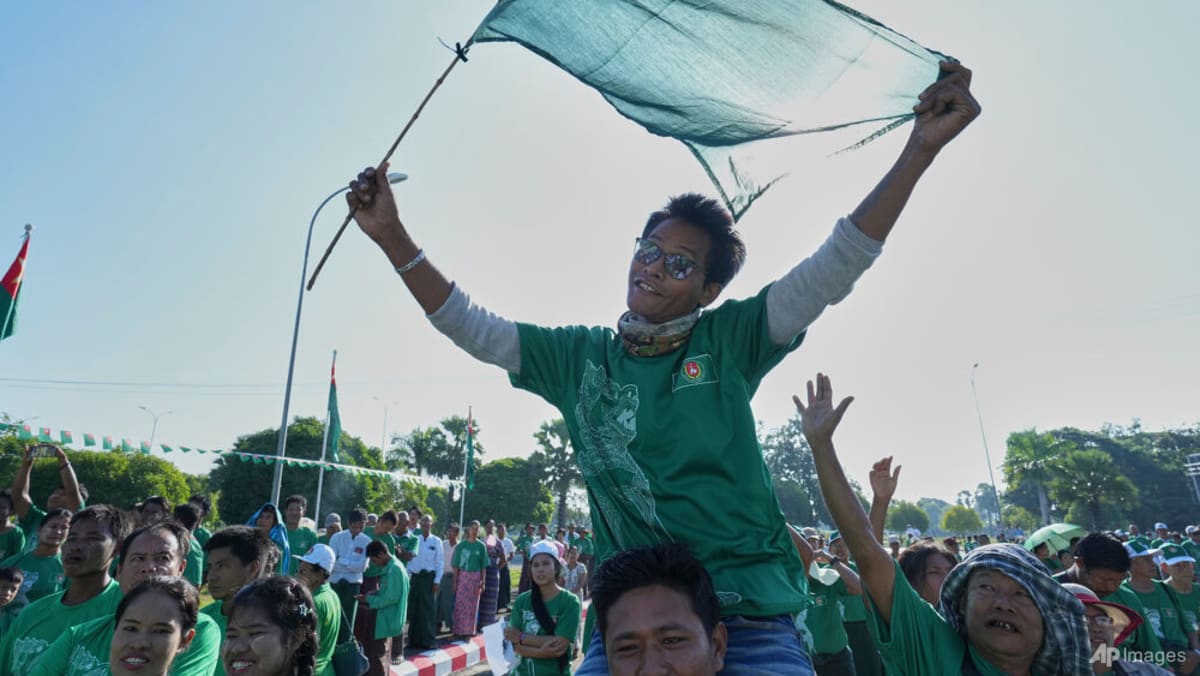
USDP’s Mya Tun Oo called on voters to encourage their family members to head to the ballot box.
“Reach out to your relatives, friends, neighbours and community… Help organise and motivate them to vote. Voting is an opportunity for every citizen,” he said.
CALLS TO BOYCOTT
Despite these efforts, pockets of resistance remain strong.
The opposition National Unity Government (NUG), formed by lawmakers ousted in the coup, has urged voters to stay away from the polls.
“The overwhelming majority of Myanmar people will not take part in that so-called sham election because it offers no genuine solutions for our country,” said NUG Foreign Minister Zin Mar Aung.
“Even if only one person casts a ballot, the junta would shamelessly use it as a claim to legitimacy,” he added.
“That’s why our message is not simply to just boycott – it is also a call to refuse complicity in the military’s attempt to entrench its power through this staged performance.”
Some voters echoed his sentiments, saying they have no faith and trust in the military.
“There’s absolutely no reason for me to cast my vote,” said one Yangon resident. “If I’m arrested because of that, then I’m ready to be arrested.”
Yet, pro-military voices remain vocal in some parts of the country.
“As a citizen of Myanmar, and as someone of Chinese descent, I’m glad to have the USDP,” said resident Pyin Oo Lwin.
“I also fully support participating in the upcoming election by casting my vote. It’s to build a better Myanmar with solidarity and harmony.”
With the outcome widely seen as a foregone conclusion, some analysts say the elections may still offer, at best, a narrow opening.
“The way everything is set up – the number of parties, who are … inclined towards the regime, the absence of previous opposition parties – I think you could say that it is foolproof,” said Khin Zaw Win, the director of Yangon-based think tank Tampadipa Institute.
“But (the situation in Myanmar) has been bad. So, if something positive comes out of this election … lead to something positive and make life easier for the majority … I would welcome it.”
INTERNATIONAL CRITICISM, CHINA BACKING
Internationally, reaction has been largely critical.
Many Western governments and the United Nations have dismissed the vote as a charade, with the UN condemning the junta’s sweeping crackdown on dissent ahead of polling.
The military insists the elections enjoy popular support, denying they are being conducted through coercion or suppression.
It has found backing from its most important ally, China, which has helped the junta recover from battlefield setbacks in rebel-held areas.
Meanwhile, the Association of Southeast Asian Nations (ASEAN) has maintained that progress in Myanmar depends on an end to violence and inclusive political dialogue.
These were among conditions laid out in the Five-Point Consensus agreed between ASEAN leaders and junta chief Min Aung Hlaing in April 2021, but these conditions remain largely unfulfilled.
The regional bloc – which Myanmar is a member of – will not send an official observer mission, out of concerns that doing so could legitimise the vote.
Individual ASEAN members, however, may still send observers on a bilateral basis.
Polls open on Sunday (Dec 28) in the first round of balloting, almost five years after the military seized control of the country. Voting will be held in three phases, with subsequent rounds scheduled for Jan 11 and Jan 25.
Voting will take place in just 265 of Myanmar’s 330 townships, limited to areas where the military maintains varying degrees of control, underscoring the constraints under which the elections are being held.
https://www.channelnewsasia.com/asia/myanmar-general-election-military-junta-5719926
