


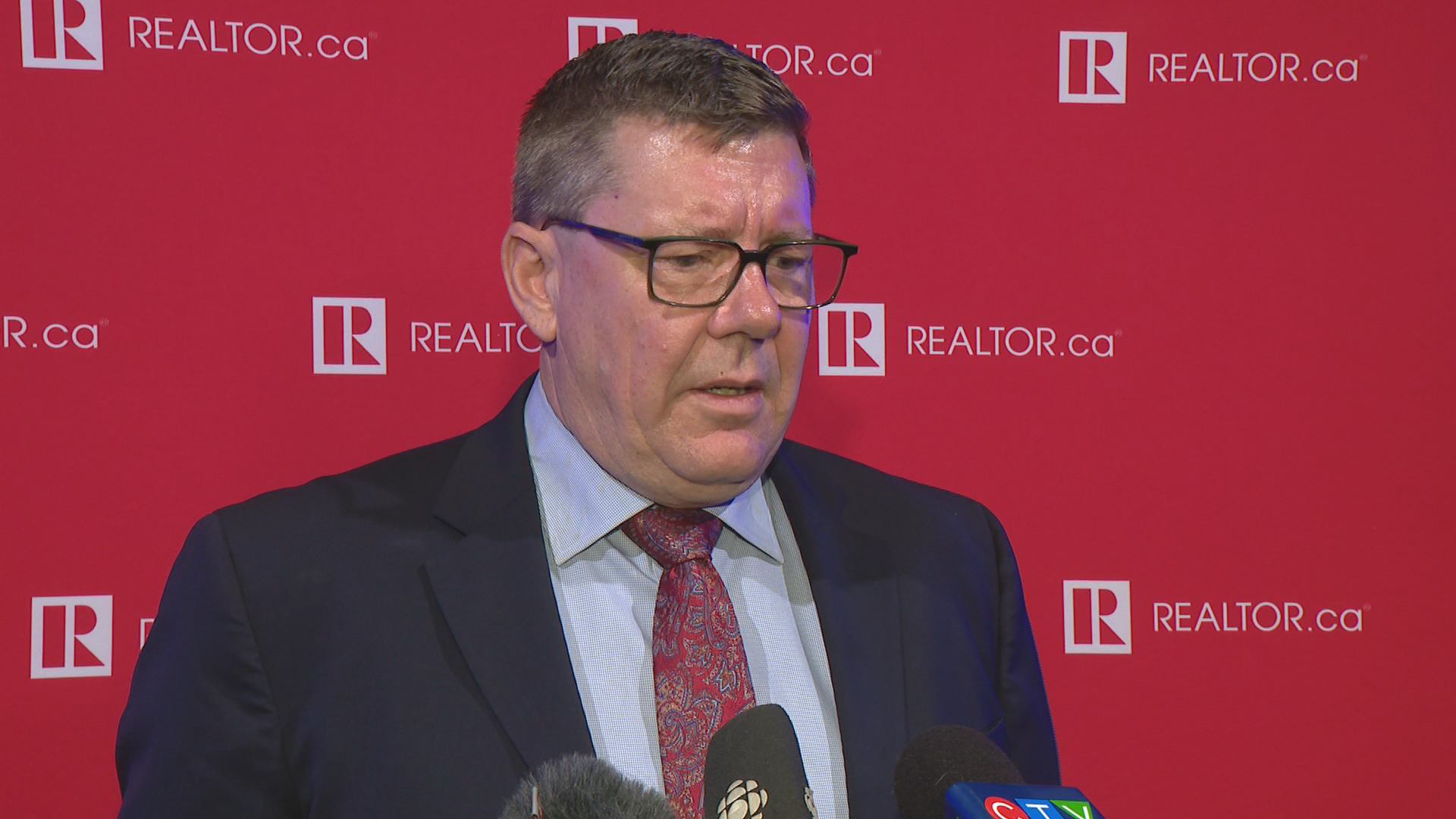
Leaders and producers in Saskatchewan are remaining optimistic following U.S. President Donald Trump’s threat of “very severe” fertilizer tariffs, saying they are more likely to be costly on American farmers than producers in Canada.

In response to a reporter Monday, Trump said he may tariff Canadian fertilizer “if we have to” to bolster domestic production.
While this rings as a phrase of uncertainty for Saskatchewan — where the largest share of potash is produced in the world — Premier Scott Moe is not fully buying it.
“You need to take the president very seriously, but maybe don’t take him literally on everything that he says,” Moe told reporters at a real estate event in Saskatoon Tuesday.
Moe added that there is “no room” to increase costs on American farmers and that new tariffs on fertilizer would drive up the cost of potash — a key component in fertilizers, of which Canada is the top producer.
Canada produced 32.4 per cent of the world’s total potash production in 2023, or around 22,000 tonnes, according to Natural Resources Canada.

Get breaking National news
For news impacting Canada and around the world, sign up for breaking news alerts delivered directly to you when they happen.
The other option for Americans, according to Moe, would be to turn to other markets like Russia, which is the world’s second-largest potash producer.
Moe added that Trump’s idea of strengthening local potash production may not be the most feasible.
“At the end of his comments he had said that if you tariff it you’re able then to produce more in the U.S. In the case of potash, that’s a little bit of a different conversation on, you know, where the mines are, where the actual potash is,” he said.,
Saskatchewan’s official Opposition leader is calling on Moe to take a stronger stance on what she says is an unreliable trading partner.
“I think it should add urgency to all of us again to not be complacent, to make sure that we’re actually increasing that port capacity here in Canada so we can diversify markets,” Carla Beck told reporters at an unrelated press conference Tuesday.

“Scott Moe seems to suggest that playing footsies or playing nice is going to get it get us where we need to go. I’m not seeing evidence of that. I’m not saying we go pick a fight, but the fight came to us,” Beck added.
As for the industry, some are speaking out about the potential challenges ahead if the U.S. were to move ahead with fertilizer tariffs.
In a statement to Global News, the Saskatchewan Mining Association said imposing tariffs could increase costs for farmers and consumers while straining supply chains, “with implications for global food security.”
The group added that fertilizer supply “cannot be replaced quickly” and that it takes 10 to 15 years to develop new capacity.
“The Saskatchewan Mining Association will continue to monitor these developments and engage constructively with policymakers to support predictable trade,” the group said.
Any tariff on the fertilizer industry would provide an opportunity for Saskatchewan potash producers and exporters to diversify their markets and make development efforts elsewhere in the world, said Chris Lane, CEO of Saskatchewan’s Trade & Export Partnership.
“We’ve been doing this for a long time, we will continue to do it,” said Lane.
“Separating the rhetoric from the reality on something like a tariff on fertilizer is an important message from me.”
© 2025 Global News, a division of Corus Entertainment Inc.
‘Don’t take him literally,’ Moe says on Trump fertilizer tariff threats
