






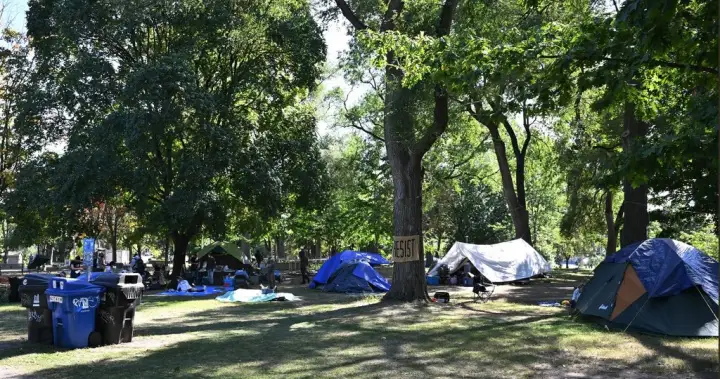
A philanthropic organization says it’s donating $25 million to establish a new system for tackling homelessness in Toronto that will use an evidence-based approach to move people off the streets and into supportive housing.


The Slaight Family Foundation says the money will go to a St. Michael’s Hospital research centre, as well as non-profit United Way Greater Toronto, to establish the Slaight Family Housing Lab — a program that aims to put roofs over people’s heads while providing wraparound services.
Dr. Stephen Hwang, director of St. Michael’s Hospital’s MAP Centre for Urban Health Solutions, says the new program draws on the centre’s research into the benefits of a housing-first approach.
Hwang says the housing lab will work with the City of Toronto to identify open supportive housing units while case management teams work with people living on the street to get them ready to move.
Hwang says the pre-move help can include getting people identification and ensuring they’re in good tax standing so they can be eligible for supportive housing units and other benefits.


Get breaking National news
For news impacting Canada and around the world, sign up for breaking news alerts delivered directly to you when they happen.
The wait list for social housing in Toronto was more than 100,000 names long in 2025, but Hwang says he’s optimistic the program can successfully house 300 people over five years based on the MAP Centre’s previous collaborations with the city.
The physician and researcher says the work doesn’t stop once people get housed. Case management teams will follow program participants for years, helping them access clinical care, addiction treatment, employment services and more to ensure they stay housed long-term.
Heather McDonald, president and CEO of United Way Greater Toronto, says the housing lab is about “doing whatever it takes to get people into housing,” and teams will tailor their responses to individual needs.
McDonald says organizations in the group’s network – including Na-Me-Res, which supports Indigenous men, and Margaret’s Housing and Community Support Services, which supports women facing homelessness – will play pivotal roles in the new program.
Hwang believes the housing lab can help Toronto’s overburdened health-care system in particular, since homeless people visit health-care facilities, especially emergency departments, at higher rates than the general population.
A Toronto project with a similar housing-first approach, Dunn House, was created specifically to provide supportive housing for homeless people who frequently visit emergency departments. That model has been a success for its residents and the University Health Network.
Hwang said the Slaight Family Housing Lab is a step in the right direction toward ending chronic homelessness, but more needs to be done to ensure every Canadian can afford a place to call home.
“If we’re going to invest more funds, we need to invest them in long-term solutions, not in short-term Band-Aids,” he said. “That’s why this ($25 million) gift is so wonderful because it’s doing both of those things. It’s addressing urgent needs but it’s also creating long-term solutions.”
One of the goals of the housing lab is to pioneer a model for addressing homelessness that other municipalities across Canada can replicate, Hwang said.
Homelessness is only getting worse in Ontario. A report from the Association of Municipalities of Ontario estimated that 85,000 people were without a home in 2025 — a 7.8 per cent increase compared to the year before.
The Slaight Family Foundation, which was founded in 2008 by late Canadian radio pioneer Allan Slaight, says Toronto’s homelessness crisis “demands urgent action,” and it’s proud to support front-line work to address it.
© 2026 The Canadian Press
$25M donation to establish new model for tackling homelessness in Toronto


